Domain - Eukaryota
Filamentous macroalgae
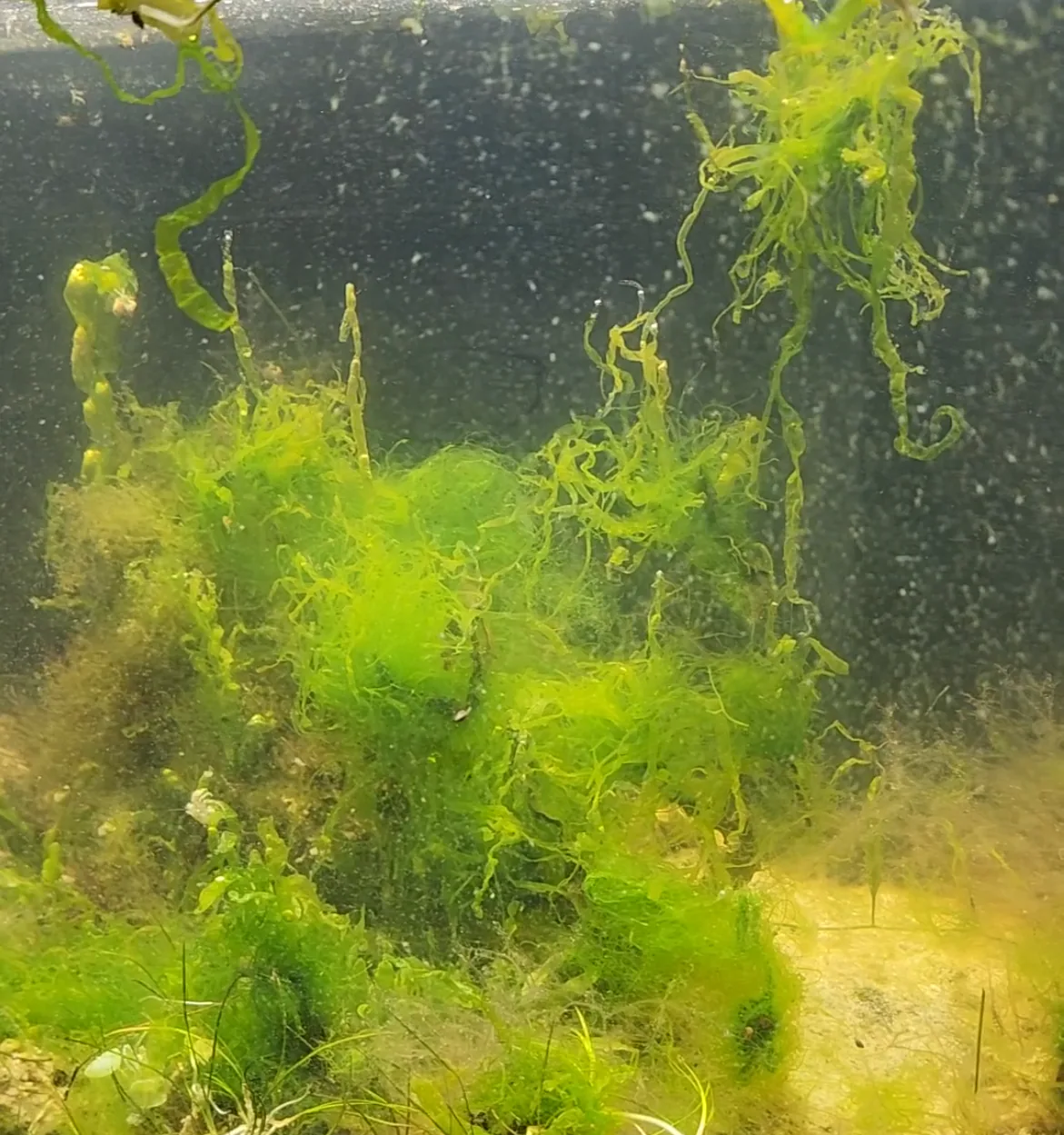
Thread-like green strands that grow in mats or tufts, absorbing nutrients and offering shelter for small aquatic life.
Domain - Eukaryota
Thread-like green strands that grow in mats or tufts, absorbing nutrients and offering shelter for small aquatic life.
Tracked as a broad functional filamentous macroalgae node, not a species-level identification. Use for public graph continuity around visible thread-like macroalgae, grazing, and producer-pressure context.
Filamentous macroalgae expanded across the Seagrass Meadow upper surface by 2026-04-13 and has been part of the visible producer/problem-growth layer. Mottled Shore Crab grazing was observed, but this does not prove complete control, stable balance, measured nutrient uptake, or a resolved long-term outcome.
Trophic classification is Producer. Food-web role: Photosynthetic algal producer. Feeding method: Photosynthetic primary producer. Dietary inputs: Light, carbon dioxide, water, and dissolved nutrients
This section will expand as more information is documented for this species.
Follow this species across the habitats where it currently appears in the miniBIOTA biosphere.
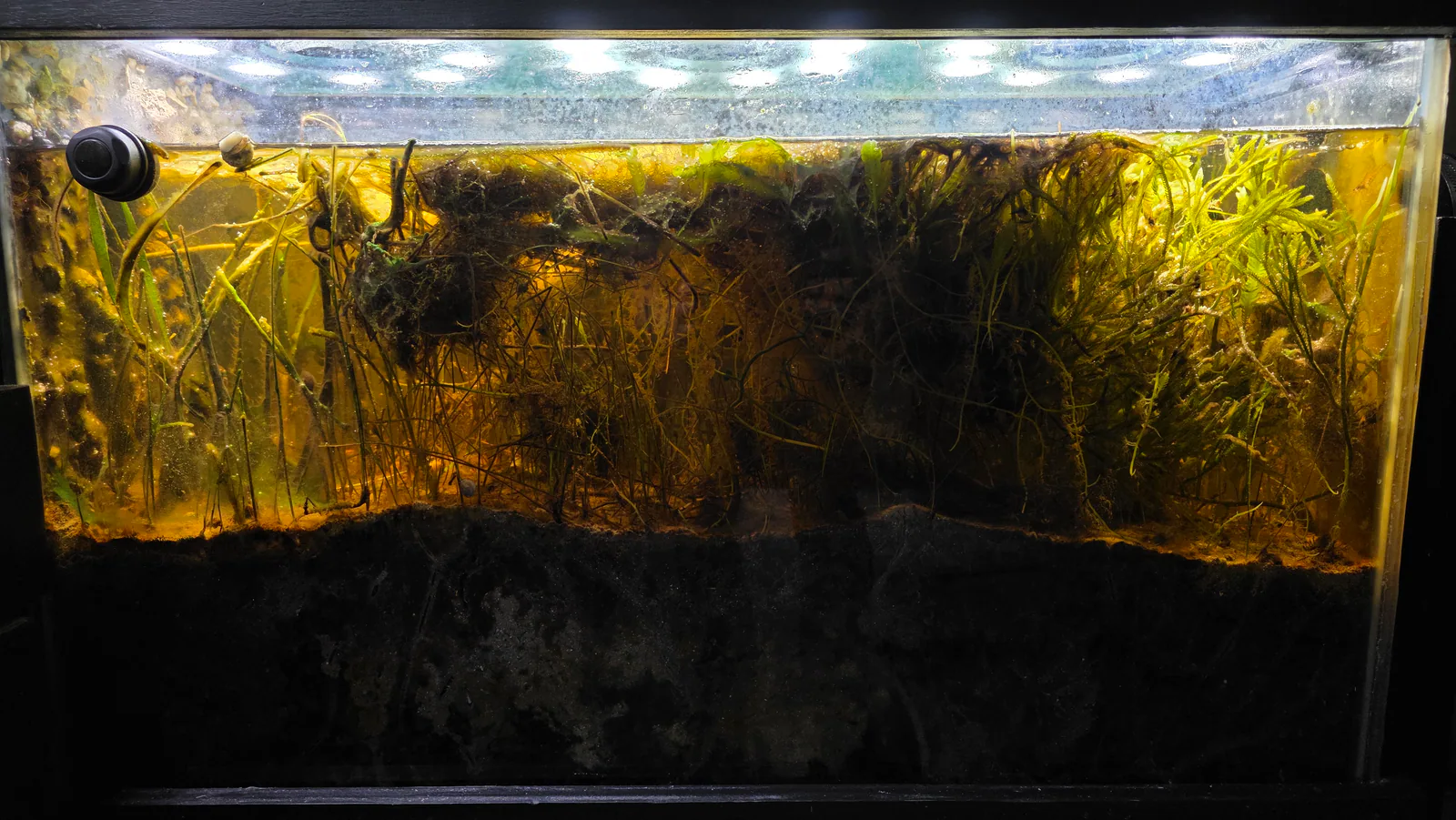
The Seagrass Meadow is framed as a fight for space and nutrient capture. Suspended algae can dominate the water column first, filter feeders such as mussels, slipper snails, and clams keep that bloom in check, and the released nutrients then become available to attached algae, cyanobacteria, and seagrass.
The Seagrass Meadow enters a succession crisis as nutrients move from suspended algae to filamentous algae, then into larger macroalgae and cyanobacteria that few visible consumers can control. Filter feeders, amphipods, isopods, crabs, shoalgrass, and spring growth all become part of the question: will the meadow reclaim its structured seagrass foundation, or flip toward a macroalgae-dominated state?
Matched from pipeline Species featured text: Filamentous macroalgae (Domain - Eukaryota)
Filamentous macroalgae remains oxygen-risk context.
Filamentous macroalgae remains freshwater producer context.
Filamentous macroalgae remains water-quality context.
Matched from pipeline Species featured text: Filamentous macroalgae (Domain - Eukaryota)
Filamentous macroalgae remains seagrass condition context.
Matched from pipeline Species featured text: Filamentous macroalgae (Domain - Eukaryota)
Filamentous macroalgae remains nutrient/water-clarity context.
Filamentous macroalgae remains water-quality context.
Filamentous macroalgae remains food source context.
Filamentous macroalgae remains competing producer context.
A dozen wild freshwater shrimp, including four pregnant females, were added to the Freshwater Lake after years without shrimp. The goal was to test whether the lake now had enough food and water-column life to support them, while added lake water might also bring in zooplankton for a stronger food web.
Matched from pipeline Species featured text: Filamentous macroalgae (Domain - Eukaryota)
A sample from the suspended green algae in the Freshwater Lake was checked under the OpenOcular microscope adapter. The cells were photosynthetic and actively motile, with a tentative comparison to Chlamydomonas, but the identity remained open for expert review.
Matched from pipeline Species featured text: Filamentous macroalgae (Domain - Eukaryota)
The Seagrass Meadow receives the wave and tide function it had been missing. Because no powered mechanical devices can operate inside the closed habitat, the solution uses external motion to move a PVC chamber and push water in and out of the biome. This entry marks a key engineering response to the meadow's oxygen, nutrient, and algae-pressure problems: recreating coastal movement without violating the sealed-system rule.
Matched from pipeline Species featured text: Eastern oyster (Crassostrea virginica)
Matched from pipeline Species featured text: Bladder snail (Physella Acuta)
Matched from pipeline Species featured text: Filamentous macroalgae (Domain - Eukaryota)
Two weeks after the freshwater and saltwater systems were brought together, new insects were added to increase grazing, detritus processing, and terrestrial food-web complexity. Grasshoppers and crickets entered an overgrown system where vegetation and detritus needed more consumers, making this a practical test of whether small herbivores could help shift the balance inside the connected biosphere.
This entry marks one of miniBIOTA's major integration milestones: the freshwater and saltwater systems were moved into one room and arranged into a single connected ecosystem stretching from lake to coast. The build created new physical links between habitats, exposed the next wave and tide engineering challenges, and set up the project to function as one larger biosphere instead of separate systems.
Green water returned after the sponge declined, while filamentous macroalgae disappeared from the grass blades. The shift suggested that available nutrients were moving into whichever algae layer could capture them without being eaten, revealing a balance between plankton, microalgae, and macroalgae.
Matched from pipeline Species featured text: Filamentous macroalgae (Domain - Eukaryota)
After heavy algae pressure, most of the sponge appeared lost, but a small colored section still suggested possible survival. The light period was reduced to slow algae growth, and the oysters on the other side still appeared to be doing fine while the system waited for better water movement.
The land and mangrove areas remained fairly stable, but the marine side became cloudy again after filamentous algae was physically removed from the grass. With the sponge failing and oyster condition uncertain, the next focus shifted toward improving water flow before restocking for balance.
Matched from pipeline Species featured text: Eastern oyster (Crassostrea virginica)
Matched from pipeline Species featured text: Red Mangrove (Rhizophora mangle)
Matched from pipeline Species featured text: Filamentous macroalgae (Domain - Eukaryota)
Turbo snails were added to reduce algae overgrowth, but progress was slower than expected and possible snail eggs appeared on the glass. At the same time, the sponge was growing steadily, adding a new branch and showing that it was still feeding despite clearer water.
Matched from pipeline Species featured text: Sponge (Phylum - Porifera)
With algae running out of control, turbo snails were added as fast grazers to consume filamentous algae. The expectation was that their waste would release nutrients back into the water, feeding plankton that could then be filtered by oysters and sponges, creating a more complete producer-consumer loop.
Matched from pipeline Species featured text: Eastern oyster (Crassostrea virginica)
Matched from pipeline Species featured text: Sponge (Phylum - Porifera)
After sponges and oysters cleared the plankton, nutrients shifted into filamentous algae growing across the marine system. More shore crabs became the next proposed control layer because existing females were already eating the algae, but males were needed for a reproducing population.
Matched from pipeline Species featured text: Filamentous macroalgae (Domain - Eukaryota)
After sponges and oysters cleared the plankton, dissolved nutrients became available to macroalgae growing over the seagrass. The algae bloom looked messy, but it created food and shelter for amphipods and isopods, setting up a possible trophic cascade into higher-level animals.
Matched from pipeline Species featured text: Filamentous macroalgae (Domain - Eukaryota)
A day and a half after the oysters were added, the water looked much clearer as the oysters filtered plankton and algae from the water column. Their waste also became a new food source for shrimp, creating a visible new connection in the food web while the wave and tide system was still unfinished.
Five oysters donated through a viewer connection were added to the marine ecosystem and began affecting the algae within the first two hours. The test asked whether five oysters could provide the right amount of filtration for the system before they were permanently attached in place.
A Cocoa Beach estuary search for suitable clams did not produce the right bivalves for miniBIOTA, but it revealed horseshoe crabs, macroalgae, and other organisms from the local ecosystem. The entry records both the field context and the next potential stocking material.
Matched from pipeline Species featured text: Filamentous macroalgae (Domain - Eukaryota)
A custom 3D-printed LED light fixture was built to support the ecosystem while reducing reliance on less efficient lighting. The change was part of the broader effort to manage plant and algae growth without letting fast growth become a long-term imbalance.
Warm water was causing biodiversity loss in the ecosphere, and added snails were not doing well under the conditions. The entry identifies temperature stress as a major constraint that needed correction before the system could recover diversity.
miniBIOTA 1 was scheduled for an update after the earlier habitat crash. The coastal side was expected to remain mostly stable, while the beach side needed revision as part of the recovery and rebuild plan.
This build update documents the engineering work needed to influence weather from outside a sealed habitat. Cooling liquid is routed behind glass so temperature gradients can drive condensation, humidity movement, and internal weather without powered devices inside the ecosystems. It captures miniBIOTA in a transition phase: still under construction, but moving toward a full atmospheric control system.
The ecosystem's habitats were physically linked through separate pathways for air, surface movement, and underground soil connections. Those links allowed the habitats to behave less like isolated tanks and more like connected parts of one biosphere.
Additional plants and animals, including filamentous macroalgae and sponges, were added to increase biological opportunity inside miniBIOTA. The system looked chaotic, but the new diversity created more surfaces, niches, and food-web potential.
Documented food-web, habitat, competition, nutrient, behavior, and risk relationships for this species.
Relationship Layer
A Mottled Shore Crab was observed grazing through filamentous macroalgae in the Seagrass Meadow.
Observation 158 documents a Mottled Shore Crab actively grazing through a large macroalgae and cyanobacteria clump in the Seagrass Meadow.