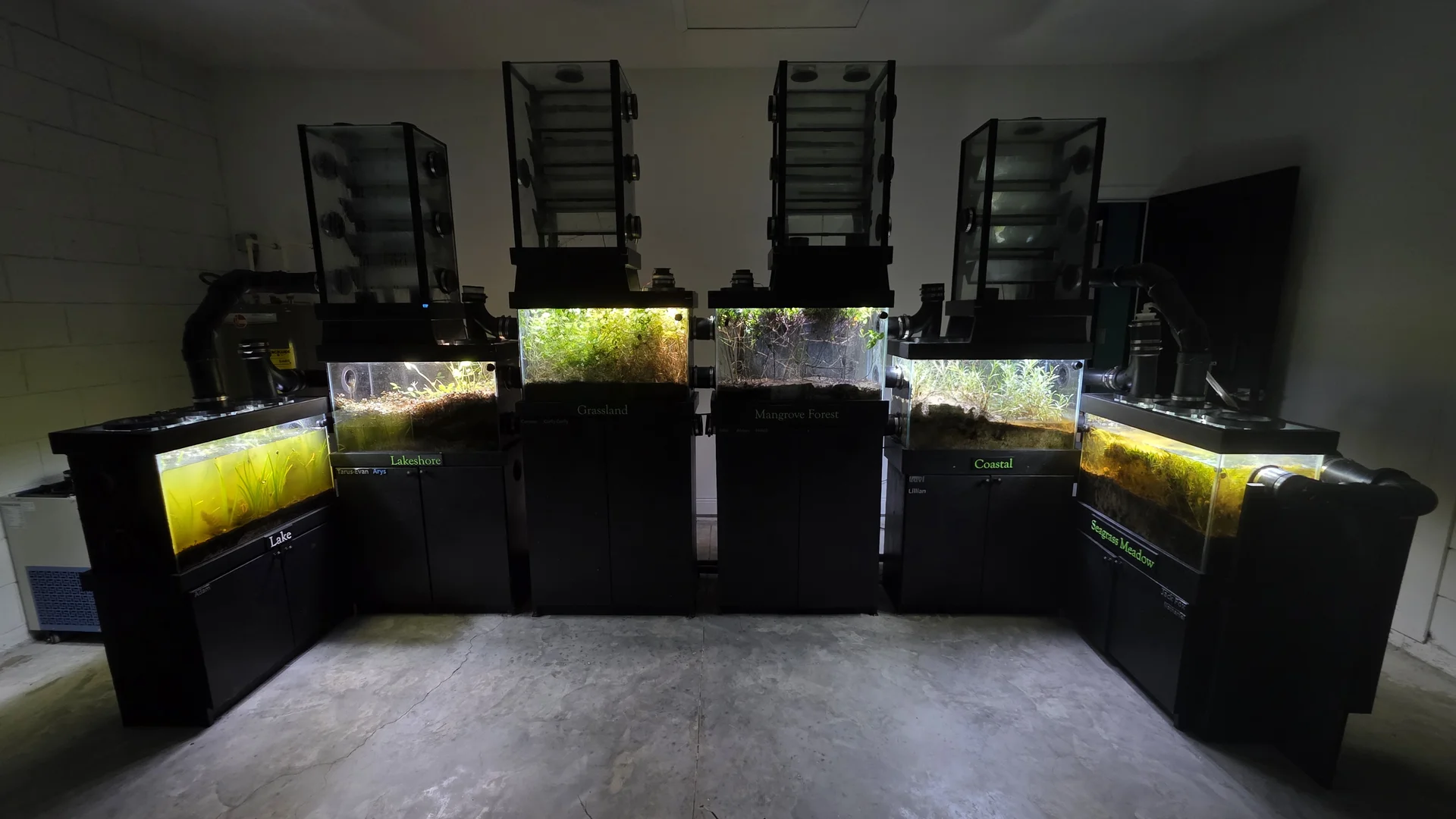
Ten Glass Tanks. Six Living Habitats. One Workshop Build.

miniBIOTA is an engineered, six-chamber living ecological enclosure built in a home studio near DeLand, Florida. Its connected freshwater, terrestrial, and marine habitats are being refined toward closed-loop cycling while the project documents what the physical system can actually sustain.

Josué observing the living habitat chambers in the miniBIOTA studio

Studio Craft & Origins

Why miniBIOTA Exists: Learning by Building

miniBIOTA is designed, built, and documented by Josué Gimbernard, its sole builder and operator. His background spans Air Force avionics, architectural drafting, custom cabinetry, mechanical engineering study, and commercial water-feature fabrication.

The project began in late 2019 as a hands-on way to study ecological systems: cut the cabinetry, drill the glass, route the plumbing, introduce living communities, then document what changes.

During earlier active cooling runs, humid air condensed against chilled atmosphere-tank glass and filled tipping buckets that returned water as rain. The chiller is currently offline for pump repair, so that demonstrated cycle is presented as operating history rather than a live claim.

How the Enclosure Works

The full enclosure photograph shows the six habitat chambers and four upper atmosphere-processing tanks. The notes below explain systems that run above, behind, and within the cabinets.

Full miniBIOTA enclosure with six living habitat chambers and four upper atmosphere-processing tanks
Full cabinet view: six lower living chambers and four upper atmosphere-processing tanks.

Upper Atmospheric Condensers

Four vertical 29-gallon processors sit above Biomes 2 through 5. Under active cooling, humid air condensed against their rear glass and collected in tipping rain reservoirs; that cycle is paused while the chiller pump is repaired.

Engineered Gravity Elevation

The custom plywood cabinetry uses stepped elevations so freshwater can move by gravity from Freshwater Lake through Lakeshore and into Lowland Meadow.

Substrate Isolation Barrier

A waterproof physical barrier situated between Lowland Meadow (Chamber 03) and Mangrove Forest (Chamber 04) prevents saltwater seepage from compromising the freshwater and terrestrial soil chemistry.

Wave Surge Mechanism

A stepper-motor-driven mechanical displacer in Seagrass Meadow generates programmable bidirectional surges with Marine Shore.

Distributed Telemetry Nodes

ESP32 nodes provide public temperature and humidity context for Biomes 2 through 5 and their atmosphere tanks. Several probes are under remediation, so missing readings remain visibly unavailable.

Biofilm & Root Self-Filtration

Microbial biofilms, mangrove root zones, macroalgae, and sediment-dwelling detritivores perform biological filtration and organic-matter breakdown within their habitats.

Cabinet, Plumbing, Climate, and Biological Work

What the enclosure was built to do, what has been demonstrated, and what is currently under repair.

1. Gravity Hydrology & Tidal Loops

Water moves through the freshwater chain (Lake → Lakeshore → Meadow) via an engineered elevation gradient. On the marine side, mechanical wave displacers generate bidirectional tidal surges between Marine Shore and Seagrass Meadow.

2. Demonstrated Atmospheric Rain

With the chiller operating, cooled rear glass condensed water vapor into droplets that filled tipping buckets and returned rain to the biomes. The chiller loop is currently offline for pump repair.

3. Biological Self-Filtration

Instead of chemical canister filters, the system relies on biological work: microbial biofilms, deep mangrove aerial root networks, macroalgae nutrient uptake, and sediment-burrowing detritivores that recycle organic matter.

How to Explore miniBIOTA

Start with the living system, then follow the records that show how it changes. The biosphere, species pages, and chronicles each reveal a different layer of the same connected world.

Supporters

Supporters are recognized directly on the biosphere, with nameplates placed on the biome cabinets they help sustain. The names below mirror the physical labels inside the miniBIOTA exhibit.

Supporter nameplates mounted below the Mangrove Forest biome cabinet

Nameplates by Biome

Freshwater Lake

Adam Biome Supporter

Lakeshore

Tarus-Evan Realm Supporter
Arys Realm Supporter

Lowland Meadow

Connor Biome Supporter
Curly Curly Biome Supporter

Mangrove Forest

Hekili Biome Supporter
Aiden Biome Supporter
Jake Biome Supporter

Marine Shore

Jovi Biosphere Supporter
Lillian Realm Supporter

Seagrass Meadow

Josue Realm Supporter
Jack Fox Realm Supporter
Nathaniel Biome Supporter

Have Questions?

The FAQ answers common questions about the biosphere, species, biome weather, engineering, and support. For new observations and build updates, follow the project channels below.

Read the FAQ