
Explore the Chronicles
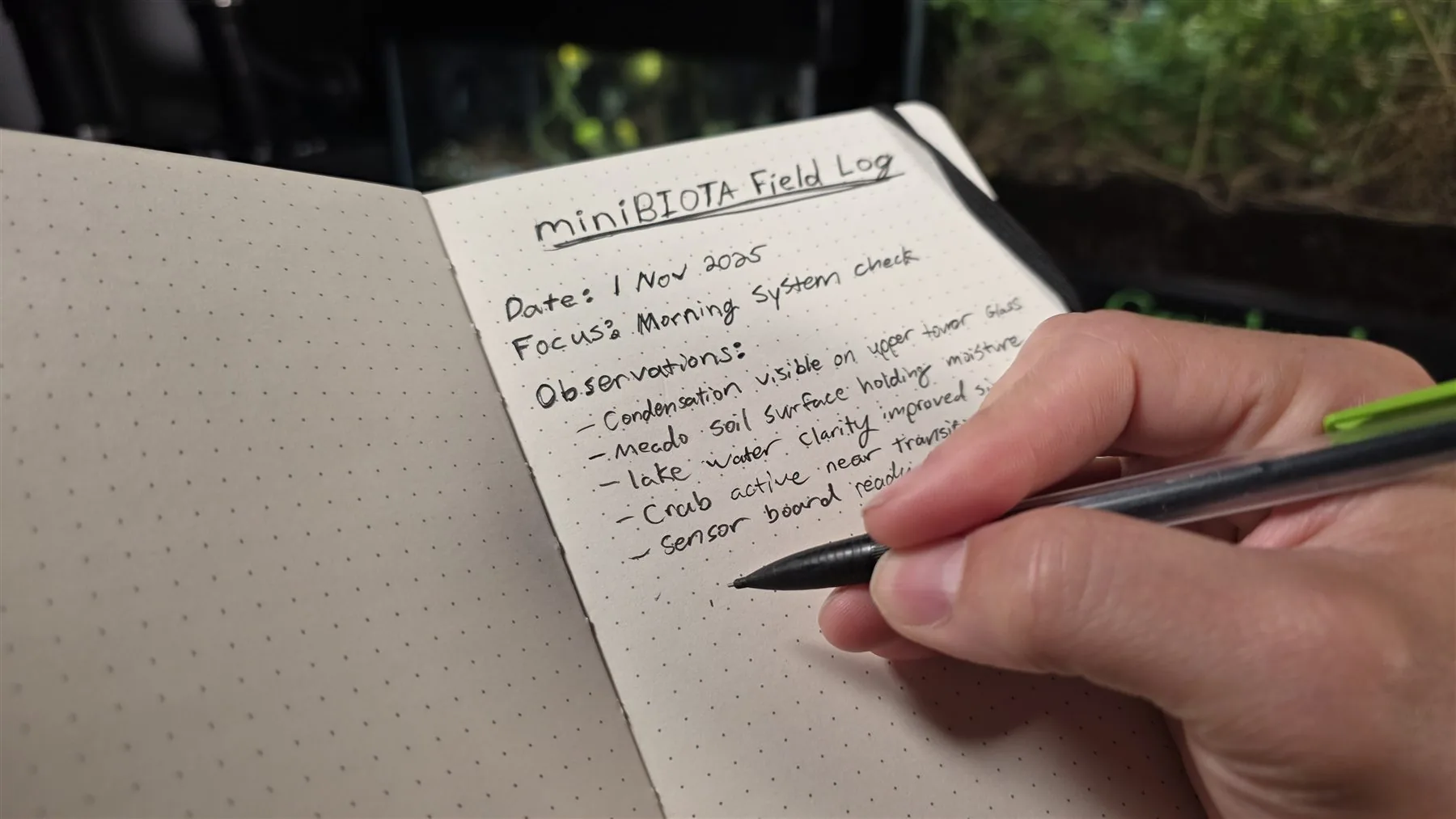
Chronicles are the narrative field archive for observations, milestones, media records, and biosphere story threads. Use this timeline to follow how the living system changes over time.
Chronicles are the narrative field archive for observations, milestones, media records, and biosphere story threads. Use this timeline to follow how the living system changes over time.
Archive Scope
The full archive is organized by year. Individual chronicle records may also appear on related species, biome, biosphere, or engineering pages when they provide subject-specific context.
After a small piece of hornwort added June 30, 2026 was grazed down quickly by the Slough Crayfish, Josue introduced a substantially larger amount from a multi-gallon culture on July 4, 2026, betting the larger standing biomass could outpace crayfish grazing. The crayfish are still actively eating it, cutting it into fragments in places, but growth is outpacing consumption and the water is showing early, modest signs of clearing. Unlike the floating plants added to the surface, hornwort works by pulling nutrients directly from the water column rather than blocking light from above. Josue's underlying motivation is shelter: baby shrimp born in the lake in April 2026 disappeared within days, and he believes the adults ate their own young because the water offered no cover; he's hoping a denser hornwort stand eventually changes that outcome.
Four species of floating plants (Valdivia Duckweed, Lesser Duckweed, Dotted Duckweed, Water Spangles) plus a small amount of Hornwort were introduced to the Freshwater Lake on June 30, 2026, as a deliberate multi-species experiment: which species, if any, can hold the surface against Slough Crayfish and Seminole Ramshorn Snail grazing under strong light, potentially shading the water column enough to reduce the persistent algae bloom while also adding crayfish food and shelter. This was a deliberate departure from an earlier stated plan to change nothing in the lake until the heat exchanger was installed, made because the heat exchanger build will take longer and the floating plants address goals (food, shelter) the heat exchanger does not. A full-day timelapse filmed on day three after introduction shows crayfish and snails already grazing the plants, gaps in surface coverage, and a sharp surge in visible Malaysian Trumpet Snails on the front glass (up to roughly a hundred, versus a historical max of about a dozen), read as a possible sign of reduced dissolved oxygen from surface shading and reduced gas exchange. Whether the plants can grow back faster than they are grazed remains an open question.
The climate system chiller's water pump transformer burnt out on March 2, 2026 after running non-stop. Rather than rush a pump fix, Josue opened the system to vent (a fallback mode proven over years pre-climate-system) and used the open window to rebuild the control system, which had been prototyped in a hurry. Built a single 12V power rail feeding six 3D-printed junction boxes (designed in Onshape, printed on a Bambu Lab printer) across all six biomes, WAGO-spliced with a wired T-off to each biome's future electronics box. Originally planned aviation-style GX16 connectors (Josue's aircraft-electronics background) but switched to simpler screw-terminal DC plugs to avoid unnecessary soldering. As of July 2, all six boxes are fully wired and ready to connect to electronics enclosures, the next build phase before the control system is fully operational and the chiller repair can resume.
The chiller pump burned out, taking the climate system offline, so the whole system has been left venting to manage humidity and air circulation while the...
Deep-dive follow-up to the July 3 wiring video, telling the design reasoning and dead ends behind the already-built 12V power rail and its six junction...
To keep pressure on the cyanobacteria that has held the Seagrass Meadow substrate since November 2025, a group of hermit crabs was collected from the Tampa Bay coast on June 12 and put to work across the biome. Where the mud crabs already in the substrate dig and break the sand apart, the hermit crabs work at a finer scale: they sift the sand and climb the grass blades, picking hair algae and detritus off every surface. They do not eat the cyanobacteria directly, but they graze the exact spots it grows and keep it physically disturbed. Three hermit crab species feature in the effort, the Hairy Hermit Crab (Paguristes karenae), the Long-claw Hermit Crab (Pagurus longicarpus), and the McLaughlin's Hermit Crab (Pagurus maclaughlinae) already established in the meadow. The Hairy Hermit Crab is a left-handed diogenid, with an enlarged left claw, which can reduce competition for shells with the right-handed species. Extra empty shells were added alongside them as housing. With the substrate now being worked from the sand up, the open question is how far this combined disturbance sets the cyanobacteria back.
Long-claw Hermit Crab, one of the three hermit crab species featured; right-handed Paguridae.
McLaughlin's Hermit Crab, already present in the meadow; right-handed Paguridae, completing the three-species cleanup crew.
The hermit crabs work the substrate surfaces the mud crabs cannot reach, extending physical disturbance of the cyanobacteria across the Seagrass Meadow.
The seven-month cyanobacteria the introduction targets; the hermit crabs graze the exact spots it grows.
Orangeclaw Hermit Crab, present in the footage; another hermit crab in the saltwater realm.
Mud Crab, the contrast species: digs and breaks the substrate, while the hermit crabs work the finer surfaces the mud crabs do not.
Florida Glass Shrimp, present in the footage from the same June 12 collection.
After the June 12, 2026 introduction of 75 Florida Glass Shrimp and 18 hermit crabs caused overnight low-oxygen stress, Josue increased the wave and tide system in the Seagrass Meadow to full power, resolving the deficit despite real mechanical risk: the belt, bearings, and 3D-printed motor mount have all failed before. A redesign is now underway to separate tide and wave motion into independent chambers driven by a brushless DC servo and industrial bearings, built to handle far more load than normal operation ever demands.
By June 2026, with the biosphere entering Year 7, a shared pattern emerged across all three major ecosystem zones. In the Freshwater Lake, Daphnia (Daphnia ambigua), Moina (Moina sp.), and copepods introduced in April 2026 established but did not scale. Water column stratification, with warm water in the upper half and cooler water below, may be limiting zooplankton range and reproduction even with adequate algal food supply. A heat exchanger for water circulation is in planning. In the Seagrass Meadow, cyanobacteria and Graceful Redweed (Gracilaria sp.) held ground through March into early June despite Mottled Shore Crab (Pachygrapsus transversus) grazing, turtlegrass and manatee grass introductions, sea urchin additions, and a large amphipod population converting dead shoalgrass into animal biomass. In the terrestrial and coastal systems, field crickets survived by walking to the lake to drink; grasshoppers did not, because the climate system does not yet produce morning dew on vegetation, which is how grasshoppers access water in a natural setting. The connecting observation across all three zones: nutrients arrive and are processed, but the system lacks export paths. The lake accumulates algae it cannot export. The meadow converts winter shoalgrass leaf shed into a nutrient pulse that feeds algae rather than leaving the system. The dryland atmosphere cycles moisture back from the water, but not on a daily schedule the dryland organisms can rely on. The next build phase targets water circulation in the lake and climate control for dew production as the foundation for closing these cycles.
The cyanobacteria mat in the Seagrass Meadow began fragmenting into separate clumps in June 2026, the first documented retreat since the growth appeared in November 2025. Two interventions on June 12 and 13 coincided with the change: the introduction of mud crabs (Family Panopeidae) and three hermit crab species, Long-claw (Pagurus longicarpus), Hairy (Paguristes karenae), and McLaughlin's (Pagurus maclaughlinae) Hermit Crabs, and the reprogramming of the wave system to stronger, more sustained currents. The crabs physically disrupt the mat wherever they move and the stronger current prevents it from resealing; whether the retreat continues or the mat stabilizes in lower-disturbance zones remains an open question.
First documented retreat of cyanobacteria coverage in the Seagrass Meadow since November 2025.
Wave system reprogrammed June 13 to stronger, more sustained currents; sustained flow prevents cyanobacteria mat from resealing after physical disruption.
Introduced June 12; one of three hermit crab species contributing to physical disruption of the mat.
After about a week without sightings, the Gulf marsh crab was rediscovered noticeably larger in the Marine Shore biome, confirming a successful post-introduction molt. He was observed actively feeding on dead seashore paspalum grass detritus, converting tough plant material into presoil poop and crab biomass. This confirms he is successfully finding food and occupying his herbivore-detritivore niche, although long-term persistence and coexistence alongside Atlantic sand fiddler crabs (Leptuca pugilator) remain under observation.
A mole cricket introduced to the lowland meadow caused widespread browning of the grass through extensive tunneling. At night, after a female field cricket partially entered his burrow and touched antennae with him, the mole cricket walled off his entrance using a ball of mud.
Turtle grass, manatee grass, and green feather algae were added to the Seagrass Meadow after winter shoalgrass shedding contributed to nutrient-rich water that helped feed redweed and cyanobacteria. The additions create more producer competition for nutrients, but the green feather algae, Caulerpa taxifolia, remains a risky aquarium species that may need removal if it spreads too far or crashes back too quickly.
Turtle Grass added as part of the producer-diversity hedge against winter nutrient pulses in the Seagrass Meadow.
Manatee Grass added as a second seagrass competitor with a different growth and shedding pattern from established shoal grass.
Green Feather Alga (Caulerpa taxifolia) added as a risky producer to observe; it may need removal if it spreads too much or dies back rapidly.
Shoal grass winter shedding provided the nutrient-pulse context for adding more producer competition.
Graceful redweed is the macroalgae pressure these producer additions are meant to compete against indirectly.
The Mottled Shore Crab (Pachygrapsus transversus) was documented grazing through the macroalgae and cyanobacteria clump in the Seagrass Meadow before sea urchins were added. By the end of March, the cyanobacteria had shrunk significantly and its growth looked checked. The observation marks an important self-correction beat in the meadow: the crab appears to help control one part of the algae pressure, while Graceful redweed remains the light-layer problem over the shoalgrass.
Seagrass Meadow self-correction beat: cyanobacteria looks checked while redweed remains unresolved.
Variegated sea urchins were added to the Seagrass Meadow after Graceful redweed and other macroalgae continued spreading across the surface and shading the shoal grass below it. During acclimation, one urchin immediately ate a small piece of Graceful redweed, making this the first direct food-web response to the meadow macroalgae problem.
Seagrass Meadow food-web intervention: variegated sea urchins added to graze Graceful redweed and other macroalgae shading shoal grass.
Ghost shrimp larvae were documented in the freshwater lake biome for the first time in miniBIOTA. This confirms that the adult ghost shrimp are reproducing after the flagfish were removed from the water column. The observation advances the long-running question of whether ghost shrimp can establish long term, but it does not yet confirm juvenile recruitment.
Eastern Melampus introduced 2026-04-23. Feeding behavior confirmed immediately, beginning to consume dead grass detritus within minutes of introduction, which is a strong early establishment signal. The Marine Shore biome's constant supply of decaying coastal vegetation provides an abundant food source. Nutrient transport function identified: tracks low tide, feeds at the waterline where nutrients concentrate, then returns to land and deposits those nutrients through droppings. Currently 2 individuals and monitoring for establishment and reproduction.
Two Eastern Melampus (Melampus bidentatus) were introduced to the Marine Shore biome on 2026-04-23. Within minutes, both were observed actively feeding on dead grass detritus at the waterline. This species is a detritivore, but its role extends further than just eating. It tracks low tide to collect nutrients at the waterline and then carries those nutrients back onto land through its droppings. Moving marine-derived nutrients back to the terrestrial side of the coastal biome is the most important function a species can perform here. Two individuals currently present and watching for establishment and reproduction.
Four days after introduction, the Gulf marsh crab was observed actively grasping live seashore paspalum blades, pulling them apart, and consuming the finer strands. This confirms its herbivore role in the biome and represents the first direct evidence of grass regulation. On the same date the crab was also observed scavenging a detached fiddler crab leg, which was unexpected and suggests a broader opportunistic diet than its herbivore classification implies.
The Marine Shore biome had been accumulating seashore paspalum overgrowth and detritus without the detritivore layer needed to process it. A field trip to a brackish tidal ditch in Spring Hill, FL with Grant from The Garden of Eder yielded five new species: Gulf marsh crab (Sesarma schubarti), Eastern Melampus (Melampus bidentatus), Ladder Hornsnail (Cerithidea scalariformis), Lawn shrimps (Family Talitridae), and Scorched Mussels (Brachidontes exustus). Each was selected to fill a specific vacancy in herbivory, detritivore layering, and filter feeding. The Gulf marsh crab, classified as a distinct species in 2024, was the most unexpected find.
The Freshwater Lake was reorganized after the flagfish was removed from the water column. One fish had been enough to suppress Daphnia and other microcrustaceans in the sealed lake biome, preventing the middle layer of the food web from forming. The April 17, 2026 longform documents the decision to remove the fish and let the lake rebuild around algae, microcrustaceans, shrimp, and crayfish.
The lake fish-removal event explains why Flagfish is now recorded as Removed from the Freshwater Lake.
Reduced fish predation reopened the possibility of a visible Daphnia layer in the lake.
Removing the fish changed the survival context for ghost shrimp larvae and the post-removal food web.
Freshwater amphipods are part of the post-removal microcrustacean layer being watched in the lake story.
Calanoid copepods are part of the water-column community affected by the fish-removal reset.
Cyclopoid copepods are part of the water-column community affected by the fish-removal reset.
Slough Crayfish remain one of the larger consumers in the rebuilt post-removal lake food web.
Rising temperature and an algae bloom triggered Bladder snail mating after a long period of low population pressure from Seminole Rams-horn competition. The observation highlights the energetic imbalance between cheap sperm production and costly egg production, visible in the recipient trying to dislodge the other snail during transfer.
Snails concentrate calcium into shells and make that mineral available to other land organisms, including hermit crabs. Unlike Cuban Brown Snails and Southern Flatcoils that were quickly eaten, Spike awlsnails have persisted for about a year by spending much of their time underground and surfacing at night.
Hermit crabs are calcium consumers / snail predators in the record.
Southern Flatcoil is mentioned as a prior land snail that was eaten.
Spike awlsnail record is routed to the terrestrial Lowland Meadow/grassland side.
We use cookies to enhance your experience and analyze website traffic. Your privacy is important to us.
Essential cookies are required for basic functionality. Analytics cookies help us improve the site. Learn more about our privacy practices