Jordanella floridae

Flagfish

A small Florida killifish that spent nearly two years as the Freshwater Lake's only fish, grazing algae and suppressing microcrustaceans until its predation on Daphnia and copepods was identified as the main bottleneck in the lake food web, leading to its deliberate removal in April 2026.

Overview

A small Florida killifish that spent nearly two years as the Freshwater Lake's only fish, grazing algae and suppressing microcrustaceans until its predation on Daphnia and copepods was identified as the main bottleneck in the lake food web, leading to its deliberate removal in April 2026.

Identity

  • Common name: Flagfish
  • Alternate names: American flagfish, Florida flagfish, flag fish, American flag fish, killifish, pupfish
  • Scientific name: Jordanella floridae
  • Identification confidence: Species-level
  • Uncertainty label: Observed

Taxonomy

  • Kingdom: Animalia
  • Phylum: Chordata
  • Class: Actinopterygii
  • Order: Cyprinodontiformes
  • Family: Cyprinodontidae
  • Genus: Jordanella
  • Species: J. floridae

Natural History

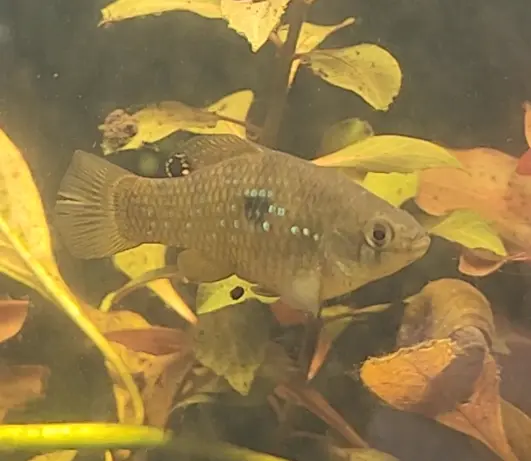
Jordanella floridae is the only species in its genus: a small, stocky, laterally compressed killifish endemic to the fresh and occasionally brackish waters of the Florida peninsula and portions of the Gulf Coastal Plain. It inhabits slow-moving, heavily vegetated habitats, marshes, ditches, weedy ponds, and spring runs, where it forages in the substrate, among plant stems, and at the water surface. The species is named for its distinctive coloration: males display a mosaic of iridescent red, blue, and green scales with a prominent dark spot on the side, resembling the American flag.

Flagfish are omnivores. They graze algae and plant matter with specialized teeth, but also actively hunt zooplankton, small invertebrates, worms, and surface insects. In vegetated wetlands, their algae grazing can be ecologically significant, and they are sometimes sold in the aquarium trade as "algae eaters." Their small invertebrate predation, however, means they compete directly with fish that depend on zooplankton-based food webs.

Males are territorial and may guard eggs deposited on substrate, algae mats, or plant roots. In captivity, lifespan is typically two to three years. Only one male was kept in miniBIOTA; no female was ever present, so reproduction was not possible.

Ecological Role

In Florida's natural wetlands, flagfish occupy a middling position in the food web, grazing algae and small invertebrates while serving as prey for larger fish and wading birds. Their algae grazing can suppress bloom conditions in vegetated shallows. In a small, closed system like miniBIOTA, a single flagfish had an outsized and ultimately destabilizing effect.

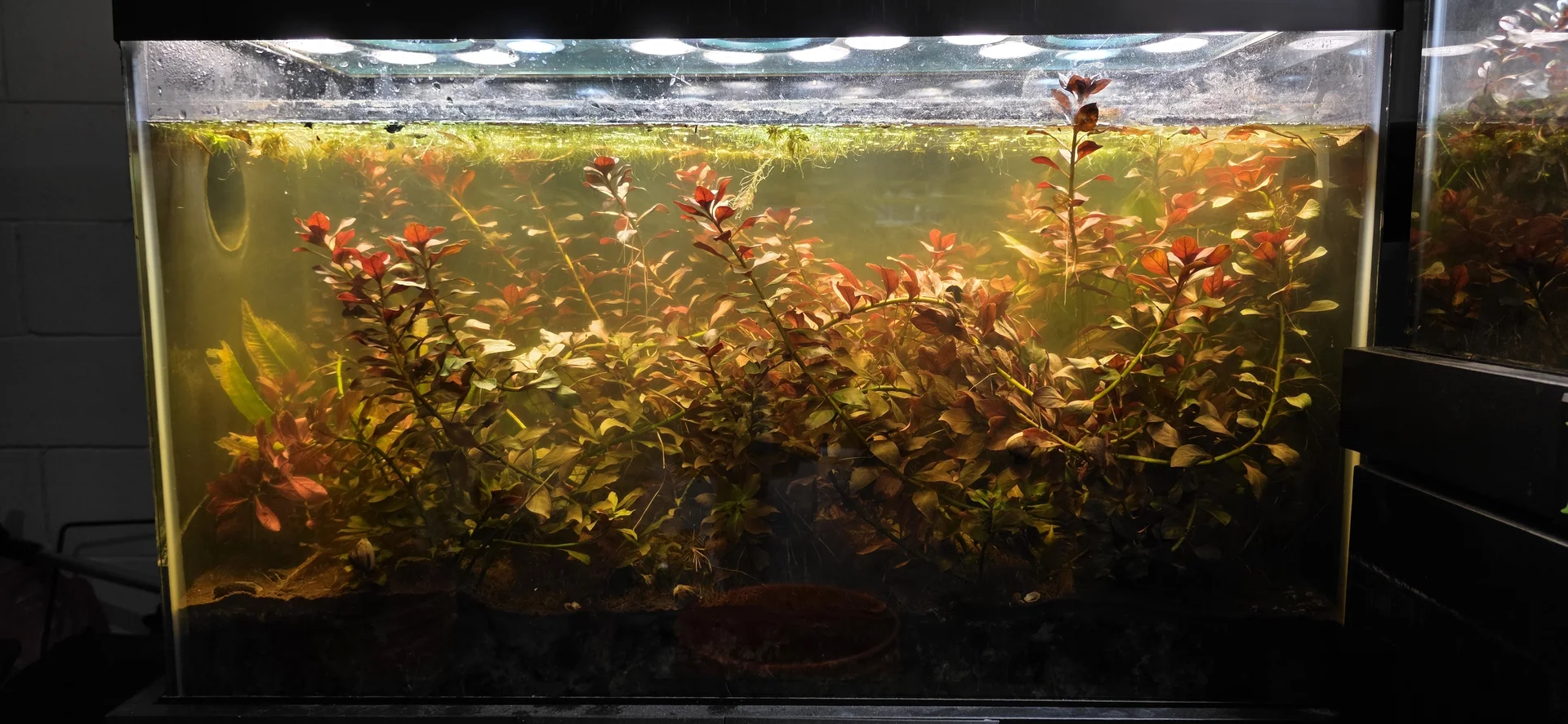
The February 21, 2026 observation documented the Flagfish's impact directly: Daphnia were dense and thriving in the Lakeshore biome (where dense vegetation provided shelter) but sparse and hidden in the Freshwater Lake where the Flagfish was actively hunting. "Predation pressure from flagfish likely limiting Daphnia population growth in the lake." The pattern became the central management rationale for removal: the flagfish was "shortcutting the food web by preying heavily on microcrustaceans that should serve as the next energy-transfer step after algae."

The removal on April 5, 2026 was a deliberate ecological intervention. The intended successor food-web structure was: suspended algae → microcrustaceans (Daphnia, copepods, amphipods) → crayfish and shrimp. Within eight days of removal, the lake had begun visibly clearing as the microcrustacean layer expanded. The flagfish was transferred to a retirement aquarium with higher natural food availability rather than discarded.

miniBIOTA Evidence

Introduction context: One male Jordanella floridae was introduced to the Freshwater Lake on June 3, 2024 as the system's only fish. It remained the sole fish in miniBIOTA until its removal. No female was ever introduced; reproduction was not possible. The fish was maintained as an algae grazer and a top-of-food-web presence in the lake.

Observation timeline:

  • February 21, 2026: Documented contrast between biomes, Daphnia dense and thriving in the Lakeshore (where dense vegetation provides shelter), but "present but sparse and mostly hidden" in the Freshwater Lake. "Predation pressure from flagfish likely limiting Daphnia population growth in the lake. Tape grass establishment may improve refuge availability over time.".
  • April 5, 2026: Flagfish removed from the Freshwater Lake and transferred to a retirement aquarium with higher natural food availability. Reason stated: "flagfish is an active predator of Daphnia and would have rapidly consumed the newly introduced population before it could establish." Decision timed to the introduction of wild-collected Daphnia ambigua (hundreds) on the same day. Video evidence.
  • April 8, 2026: Three days post-removal. Lake turned strongly green, suspended algae bloom reached maximum opacity with front-to-back visibility lost. Observation explains the management philosophy: "Flagfish removal was deliberate, they were shortcutting the food web by preying heavily on microcrustaceans that should serve as the next energy-transfer step after algae. Fish may return in the future when more lake tanks and space allow microcrustacean populations to persist alongside them." Goal stated as: "algae → microcrustacean → crayfish/shrimp".
  • April 13, 2026: Lake beginning to clear for the first time in some time, copepods thriving, Daphnia still present. Clearing attributed to microcrustacean expansion after Flagfish removal.

Confirmed:

  • One male introduced June 3, 2024; removed April 5, 2026 (approximately 22 months in system)
  • Active predation pressure on Daphnia documented February 21, 2026 (biome contrast)
  • Removed as deliberate management decision on April 5, 2026; video evidence
  • Transferred to a retirement aquarium, not discarded; fish was healthy at time of removal
  • Microcrustacean expansion and lake clearing documented in the eight days following removal

Inferred:

  • Flagfish predation was the primary constraint on the microcrustacean layer throughout its time in the lake
  • Algae grazing was a secondary ecological role; algae bloomed immediately after removal (lighting increase from March 12 was the proximate cause)
  • Flagfish presence kept Daphnia, copepods, and amphipods at population sizes too small to create a functional intermediary food-web layer

Unknown:

  • Whether the flagfish directly consumed any wild-collected Daphnia in the days around its removal (it was removed on the same day as their introduction, April 5)
  • Detailed behavioral record from the 22 months prior to the first documented predation observation
  • Whether the flagfish will return to the system in the future