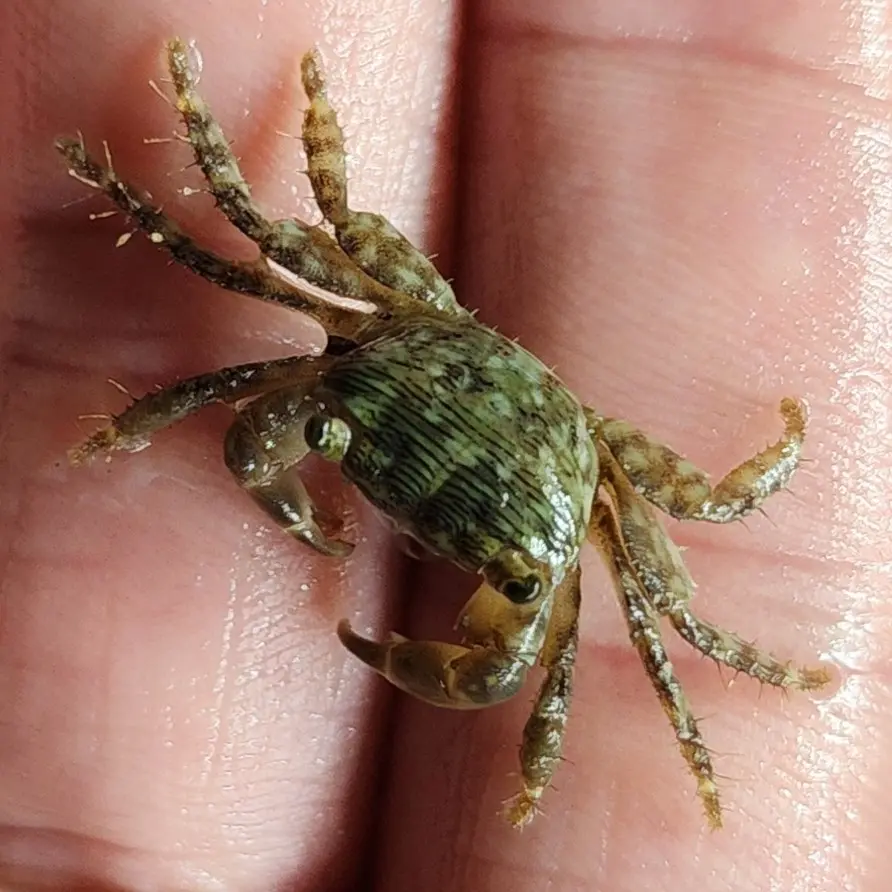
Pachygrapsus transversus

Mottled Shore Crab

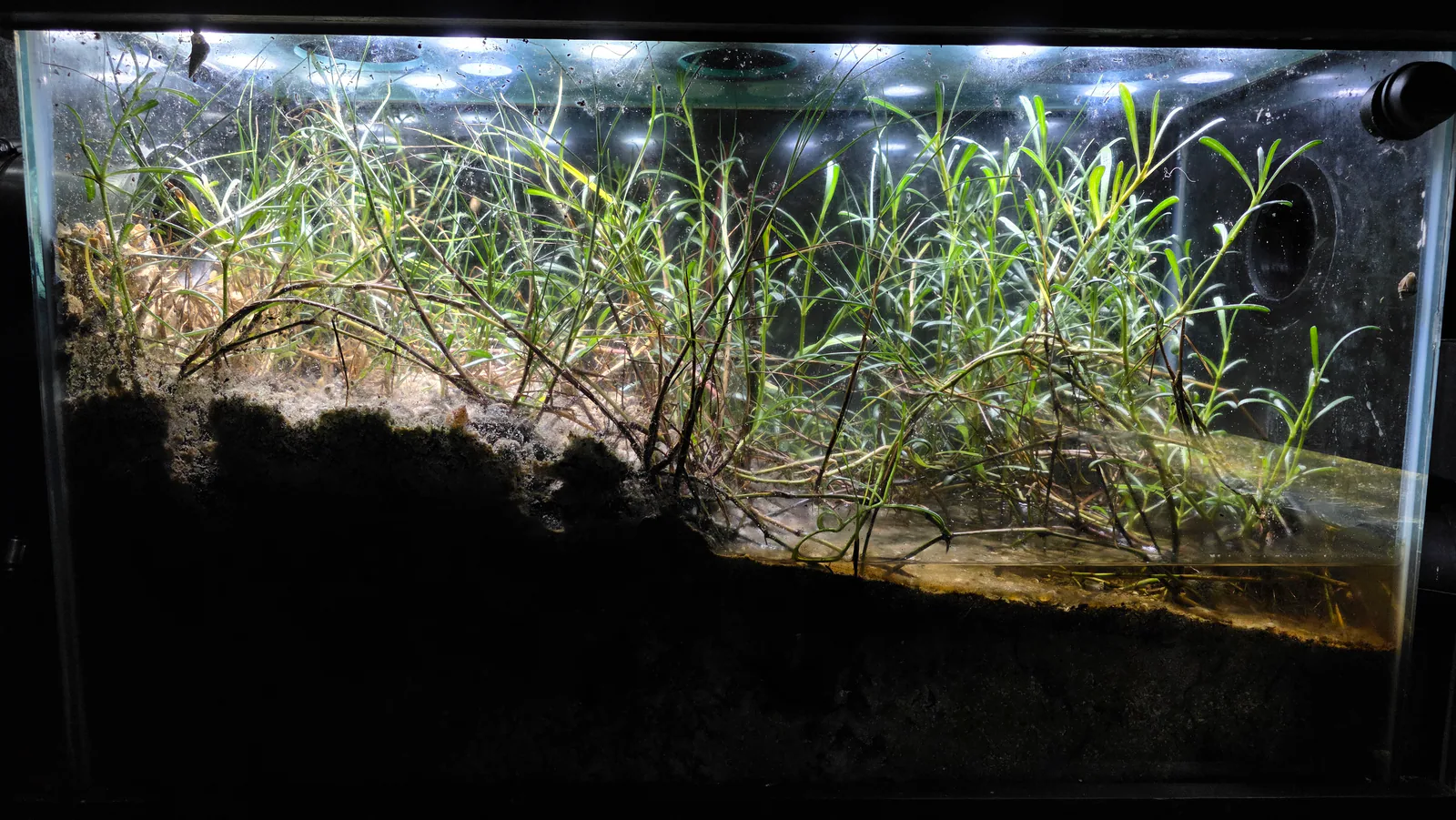
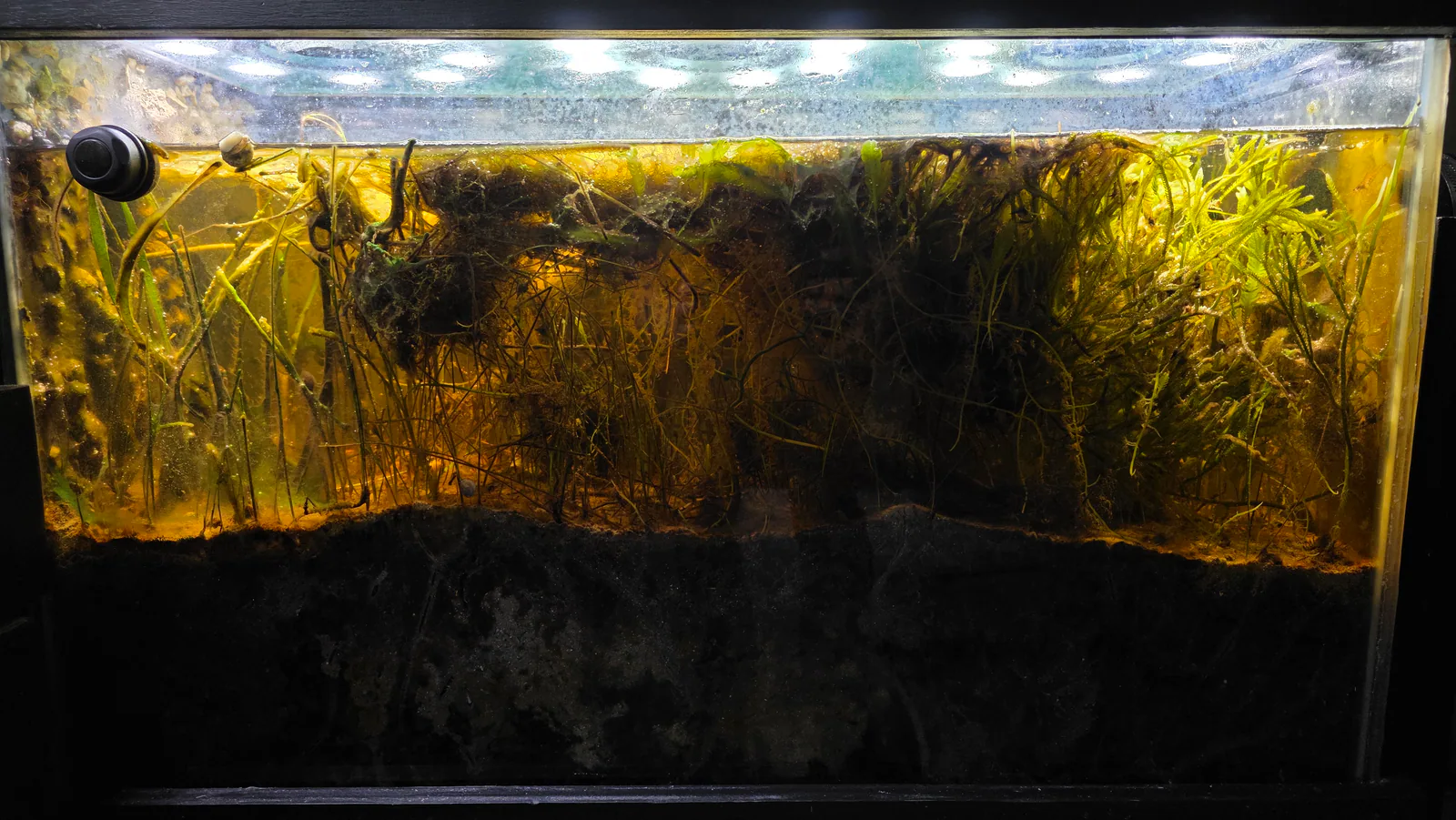
Found on hard surfaces in the Seagrass Meadow and Marine Shore, these flat, fast shore crabs graze algae, biofilm, and cyanobacteria-like growth from rock and tank walls, with two individuals confirmed active since July 2024.

Overview

The Mottled Shore Crab (Pachygrapsus transversus) is a flat, fast-moving intertidal shore crab with two individuals active in the miniBIOTA Seagrass Meadow and Marine Shore since their introduction on July 14, 2024. Both are confirmed female; one was observed carrying eggs in April 2025, which are treated as infertile in the absence of a male. The crabs have been repeatedly documented grazing algae, biofilm, and cyanobacteria-like surface growth from hard surfaces across the Seagrass Meadow, and a March 2026 observation with video evidence noted reduced cyanobacteria extent around active crab grazing. Population status is Vulnerable; two individuals with no confirmed recruitment.

Identity

  • Common name: Mottled Shore Crab
  • Alternate names: shore crab, mottled crab, rock crab, square back crab, pachygrapsus, mottled shore crab
  • Scientific name: Pachygrapsus transversus
  • Identification confidence: Confirmed
  • Uncertainty label: Confirmed, vulnerable population

Taxonomy

  • Kingdom: Animalia
  • Phylum: Arthropoda
  • Class: Malacostraca
  • Order: Decapoda
  • Family: Grapsidae
  • Genus: Pachygrapsus
  • Species: transversus

Natural History

Range and Florida Relevance

Pachygrapsus transversus is a widely distributed intertidal crab found along the Atlantic and Gulf coasts of North America, through the Caribbean, and into South America. In Florida, it is common on hard-bottom shorelines, rocky and rubble intertidal habitats, mangrove piling edges, and seawalls, where it grazes biofilm and algae from exposed surfaces. It is categorized by OBIS under Grapsidae and carries WoRMS AphiaID 107457 as an accepted species. The species is well suited to the coastal conditions represented in miniBIOTA's saltwater system.

Habitat

Pachygrapsus transversus is strongly associated with hard surfaces in the intertidal and subtidal zone: rock, rubble, concrete pilings, seawalls, mangrove roots, and similar structurally complex substrates. It uses surface irregularities and algal cover for shelter and forages by moving rapidly across these surfaces. In miniBIOTA, the crabs have been repeatedly observed on tank walls, rock surfaces, and macroalgal and cyanobacterial mats within the Seagrass Meadow. They anchor to the left tank wall where algae concentrations are highest and range through the far end of the Seagrass Meadow biome where macroalgae and surface growth accumulate.

Diet

Pachygrapsus transversus is primarily an algae grazer and biofilm scraper, using its chelipeds to tear and scrape material from hard surfaces. It is classified as an omnivore and can take plant material, detritus, small invertebrates, and animal remains opportunistically. In miniBIOTA, confirmed feeding items include algae from tank walls and rock surfaces (December 2024), macroalgae and cyanobacteria-like growth from the far end of the Seagrass Meadow (March 2026), and general plant and algal material across video observations. An April 2026 observation noted both crabs function largely as herbivores in this system.

Reproduction

Females of Pachygrapsus transversus brood fertilized eggs under the abdomen before releasing planktonic larvae into the water column. Larval development passes through multiple zoeal stages before settling. In miniBIOTA, one crab was observed carrying eggs on April 6, 2025; because both documented individuals are female, the eggs are treated as infertile and no larval release or juvenile settlement has been confirmed.

Tolerance Ranges

Pachygrapsus transversus is a marine intertidal species tolerant of typical subtropical and warm-temperate coastal temperatures and normal marine salinity and pH. It is adapted to tidal fluctuation and handles periods of emersion, wave action, and varying light. Formal tolerance measurements for temperature, pH, salinity drift, dissolved oxygen, and flow have not been taken in miniBIOTA; the crabs' nearly two-year persistence under system conditions is the best available evidence of their tolerance.
Ecological Role

The Mottled Shore Crab functions as a hard-surface grazer and algae-pressure modifier in the Seagrass Meadow and Marine Shore. By scraping algae, biofilm, and cyanobacteria-like growth from tank walls, rock surfaces, and algal accumulation zones, the crabs transfer energy from producer-level surface growth into animal biomass. The December 2024 observation noted they may make a more significant difference in algae abundance than turbo snails, though no controlled comparison was made.

The March 2026 observation is the strongest single ecological event: one crab was filmed actively grazing through the macroalgae and cyanobacteria clump at the far end of the Seagrass Meadow, and the observer noted that cyanobacteria extent appeared greatly reduced at that time. The crab's grazing is a plausible contributor to this self-correction, but other factors including light shifts, nutrient changes, and other grazers cannot be ruled out. The crab did not resolve the separate Graceful redweed growth, which remained an unresolved light-layer pressure alongside this species.

No confirmed symbiotic relationships exist in miniBIOTA. The crabs share the Seagrass Meadow with Sea Anemone, Eelgrass Isopod, Marine Scud, and other saltwater residents without documented direct interactions.

miniBIOTA Evidence

Introduction Context

Two Mottled Shore Crabs were introduced to the miniBIOTA Seagrass Meadow on July 14, 2024. No introduction observation note is preserved in the current Markdown archive for that date. Both individuals are confirmed female based on later observation. No introduction method or source origin is recorded in the database.

Observation Timeline

  • December 17, 2024: Algae on the left tank wall (rocks on glass) observed being consumed, attributed to the mottled shore crabs that habitually anchor to that surface. Observer noted they may be making a more significant difference in algae abundance than turbo snails. No media (obs-2024-12-17-0038).
  • April 6, 2025: One of the two crabs observed carrying eggs. Both individuals are confirmed female; eggs are treated as infertile in the absence of a male. No media (obs-2025-04-06-0092).
  • March 26, 2026: One crab observed actively grazing in the large macroalgae and cyanobacteria clump at the far end of the Seagrass Meadow. Cyanobacteria extent noted as greatly reduced. Observer noted the crab appears to be playing a direct role in controlling or reducing this growth. Video evidence (obs-2026-03-26-0158).
  • April 21, 2026: Extended video footage of the Seagrass Meadow with particular focus on the mottled shore crab moving and grazing through the environment. Two individuals confirmed approaching two years of persistence since July 2024. Observer noted they appear to function largely as herbivores, feeding on available plant and algal material. Note raised the possibility of introducing a mud crab species in the future to explore a different feeding strategy. Video evidence (obs-2026-04-21-0213).

What Is Confirmed

  • Two Pachygrapsus transversus were introduced July 14, 2024; both confirmed female.
  • The crabs habitually anchor to the left tank wall and graze algae from rock and glass surfaces.
  • One crab was observed carrying eggs on April 6, 2025; eggs are treated as infertile (no male present).
  • On March 26, 2026, one crab was filmed actively grazing through the macroalgae and cyanobacteria clump at the far end of the Seagrass Meadow; cyanobacteria extent was noted as greatly reduced at that time. Video evidence.
  • Both individuals have persisted for nearly two years across the Seagrass Meadow and Marine Shore.
  • The crabs function primarily as herbivores feeding on plant and algal material in this system.

What Is Inferred

  • The crabs' grazing likely contributed to the reduced cyanobacteria extent observed in March 2026, but the crab is a probable contributor, not a confirmed sole cause.
  • The crabs may have an ongoing suppressive effect on algae accumulation in the Seagrass Meadow, based on the December 2024 note comparing their impact favorably to turbo snails.

What Remains Unknown

  • Whether both individuals are still alive beyond April 21, 2026.
  • Whether the cyanobacteria extent has remained reduced since the March 2026 observation.
  • Whether the crabs graze the Marine Shore differently from the Seagrass Meadow, or whether Marine Shore biome placement reflects range extension or separate habitat use.
  • Whether the eggs observed in April 2025 were the only instance of egg carrying or a seasonal pattern.
  • What the introduction method and source origin were.