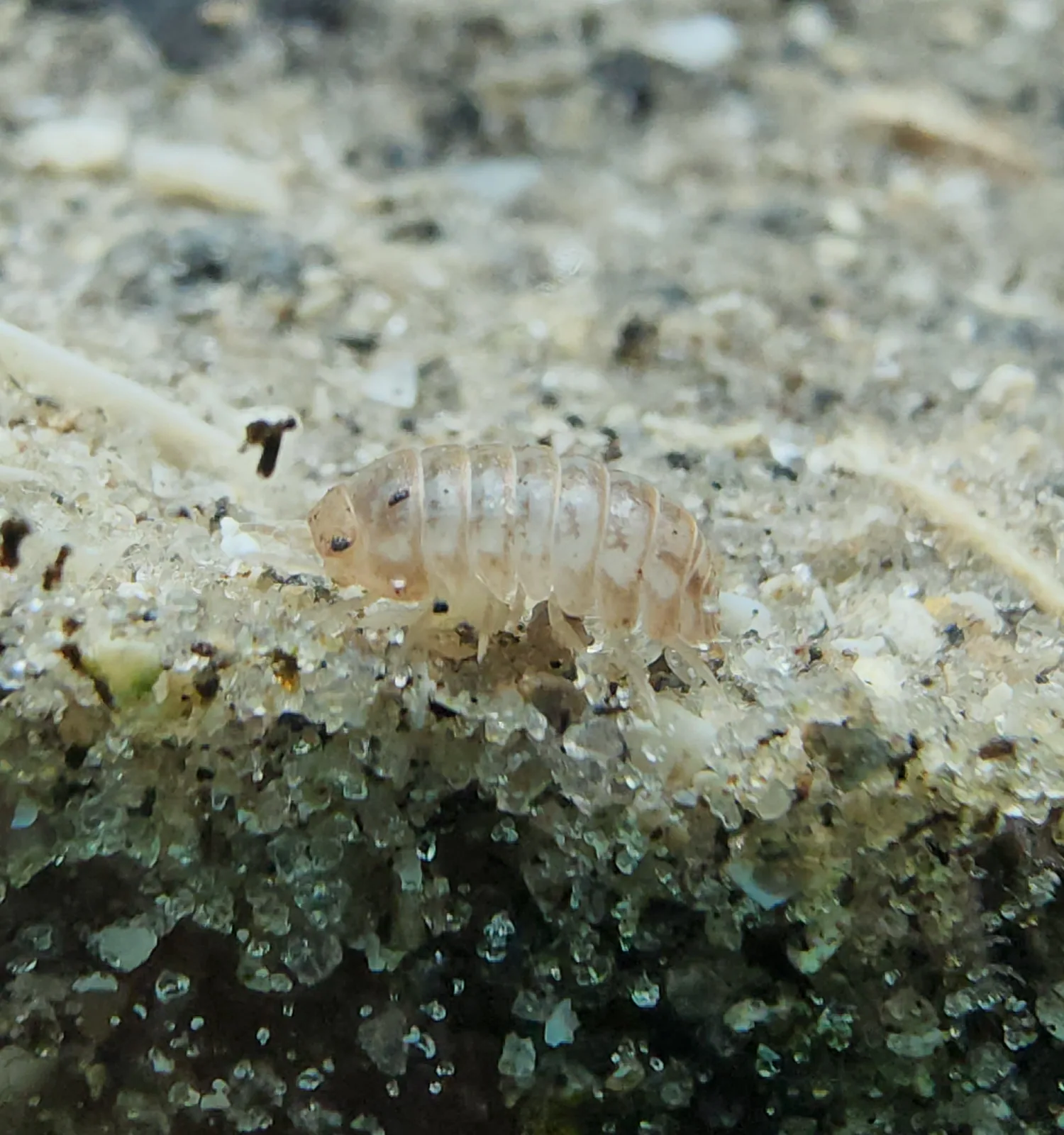
Oniscidea sp. (unidentified)

Pill Bug

Pill Bug is a small, rounded terrestrial isopod found among roots and litter in all miniBIOTA land biomes; it has no obvious rear tail projections and does not roll up, while its species remains unidentified.

Realm
Terrestrial
Population
Uncertain
Primary biome
Marine Shore

Overview

Pill Bug is a small, rounded terrestrial isopod found among roots and litter in all miniBIOTA land biomes; it has no obvious rear tail projections and does not roll up, while its species remains unidentified.

Identity

  • Common name: Pill Bug
  • Alternate names: pill bug, pillbug
  • Scientific name: Oniscidea sp. (unidentified)
  • Identification confidence: Suborder-level only; family, genus and species unidentified
  • Uncertainty label: Observed

Taxonomy

  • Kingdom: Animalia
  • Phylum: Arthropoda
  • Subphylum: Crustacea
  • Class: Malacostraca
  • Order: Isopoda
  • Suborder: Oniscidea
  • Family: Unidentified
  • Genus: Unidentified
  • Species: Unidentified

Natural History

Oniscidea are terrestrial isopod crustaceans associated with soil, litter and other sheltered land habitats. Moisture balance and humid refuges are broadly important to these animals. Their diversity includes different body shapes and defensive behaviors, so a common name or rounded outline does not identify a family or genus.

Many terrestrial isopods consume decomposing plant material, fungi and organic debris, fragmenting litter as part of a detrital food web. These are general ecological possibilities for the unidentified miniBIOTA form, not species-specific feeding observations. Terrestrial isopods generally brood their young and develop without a free-swimming marine larval stage; reproduction by this particular form has not been documented.

Coastal specialization, salt-spray tolerance and the ability to withstand tidal inundation have not been established. Its actual tolerances remain unmeasured.

Ecological Role

Pill Bug lives among roots and litter in Lakeshore, Prairie, Mangrove Forest and Marine Shore. Like other terrestrial isopods, it may help fragment decaying plant material. Its particular diet and contribution to decomposition have not yet been observed.

miniBIOTA Evidence

Introduction: No date, source or method is established.

Observation timeline:

  • January 24, 2026: Pill Bugs were filmed among roots and litter. Their rounded bodies lack the obvious rear tail projections of Woodlouse, and they do not roll up.

Confirmed:

  • Pill Bug does not roll up and has no obvious rear tail projections; Woodlouse has visible tail projections.
  • Pill Bug is found in all land biomes: Lakeshore, Prairie, Mangrove Forest and Marine Shore.

Inferred:

  • A detrital role is plausible from broad Oniscidea ecology; specific feeding remains unverified.

Unknown:

  • Family, genus and species, introduction date and source, abundance and reproduction.
  • Whether Unknown Terrestrial Isopod describes this same form; the available comparison does not justify merging the accounts.