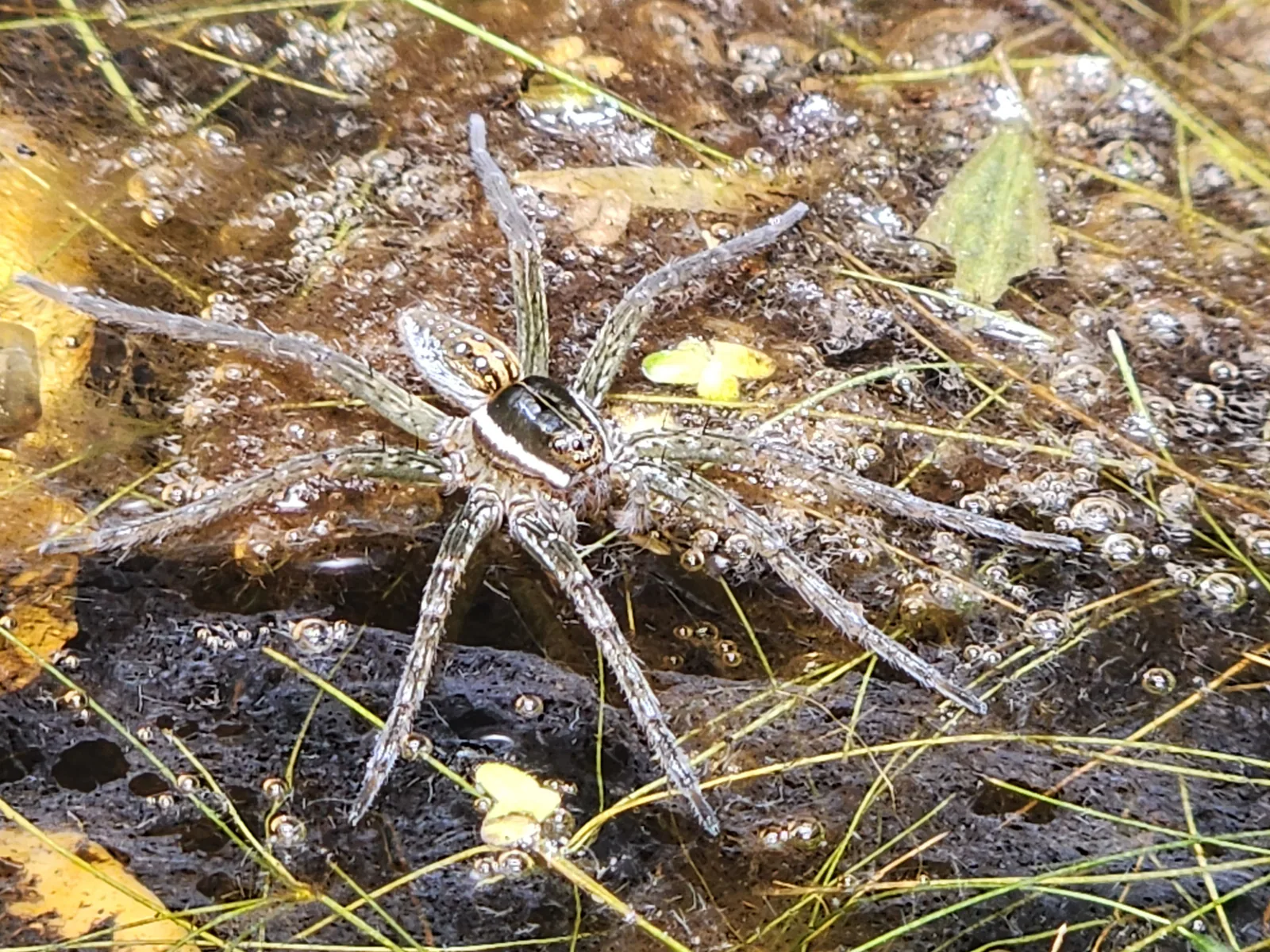
Dolomedes sp. (unidentified)

Fishing Spider

A large semi-aquatic hunting spider at the Lakeshore margin, Dolomedes detects prey through water surface vibrations and can walk on water to ambush insects, tadpoles, and small fish; one of the most visible invertebrate predators at the freshwater edge.

Visual Data Unavailable

Overview

A large semi-aquatic hunting spider at the Lakeshore margin, Dolomedes detects prey through water surface vibrations and can walk on water to ambush insects, tadpoles, and small fish; one of the most visible invertebrate predators at the freshwater edge. No dedicated observation record has been found in the miniBIOTA observation records.

Identity

  • Common name: Fishing Spider
  • Alternate names: raft spider, dock spider, water spider, giant water spider
  • Scientific name: Dolomedes sp. (unidentified)
  • Identification confidence: Genus-level (Dolomedes); common name and alternate name "dolomedes" point unambiguously to this genus; species-level requires color pattern and size examination
  • Uncertainty label: Observed

Taxonomy

  • Kingdom: Animalia
  • Phylum: Arthropoda
  • Class: Arachnida
  • Order: Araneae
  • Family: Pisauridae
  • Genus: Dolomedes
  • Species: Unidentified (D. triton and D. vittatus are the primary Florida candidates)

Natural History

Dolomedes (fishing spiders, dock spiders, raft spiders) are large semi-aquatic hunting spiders in the family Pisauridae, native to freshwater habitats throughout eastern North America. They are among the largest spiders encountered in Florida freshwater habitats, with females reaching body lengths of 15 to 26 mm or more and leg spans proportionally large. The body is typically brown to grayish-brown with pale lateral stripes or mottling that provides camouflage on bark and vegetation near water.

Dolomedes do not build prey-catching webs. Instead, they hunt by resting with their legs touching the water surface, detecting the surface vibrations produced by struggling insects, small fish breaking the surface, or tadpoles moving near the waterline. When prey is detected, the spider rushes across the water surface to capture it. Dolomedes can walk and run on the water surface using surface tension and hydrophobic leg hairs. They are capable of capturing prey substantially larger than typical arthropod prey, including small fish and tadpoles.

In the Lakeshore biome, Dolomedes occupies the shoreline margin and emergent vegetation zone, resting at the waterline and hunting across the water surface. They are most active at dusk and night but can be observed during daylight. The combination of aquatic and semi-terrestrial hunting makes Dolomedes an important predator that bridges the freshwater-terrestrial interface.

Florida species include Dolomedes triton (six-spotted fishing spider), recognizable by the row of pale spots on the abdomen, and Dolomedes vittatus (striped fishing spider), with prominent lateral pale stripes. Both are common on Florida lakeshores and pond margins.

Ecological Role

At the Lakeshore, Fishing Spider functions as an apex invertebrate predator at the water margin. It consumes aquatic insects, small fish, tadpoles, and other invertebrates encountered at the water surface or shoreline, transferring aquatic and semi-aquatic prey biomass into a large-bodied terrestrial predator. No Fishing Spider predators have been confirmed at the Lakeshore, placing it near the top of the invertebrate predator chain at the freshwater edge.

miniBIOTA Evidence

Introduction context: No introduction event is recorded. Dolomedes is a native Florida genus that would naturally colonize any freshwater lakeshore or pond margin. No introduction date, source, or method is on file.

Observation timeline:

  • No dedicated observation records have been found in the miniBIOTA observation records for Fishing Spider.

Confirmed:

  • Species node exists for Fishing Spider in the Lakeshore; genus-level identification as Dolomedes from common name and alternate_names entry

Inferred:

  • Water-surface hunting at the Lakeshore margin, inferred from Dolomedes biology and Lakeshore biome assignment

Unknown:

  • Whether Fishing Spider is currently present at the Lakeshore
  • Which Dolomedes species is present (D. triton, D. vittatus, or other)
  • Whether large-bodied females, egg sacs, or nursery webs have been observed