Wave & Tide System
The Wave and Tide System is the only mechanical water movement source for the Seagrass Meadow.
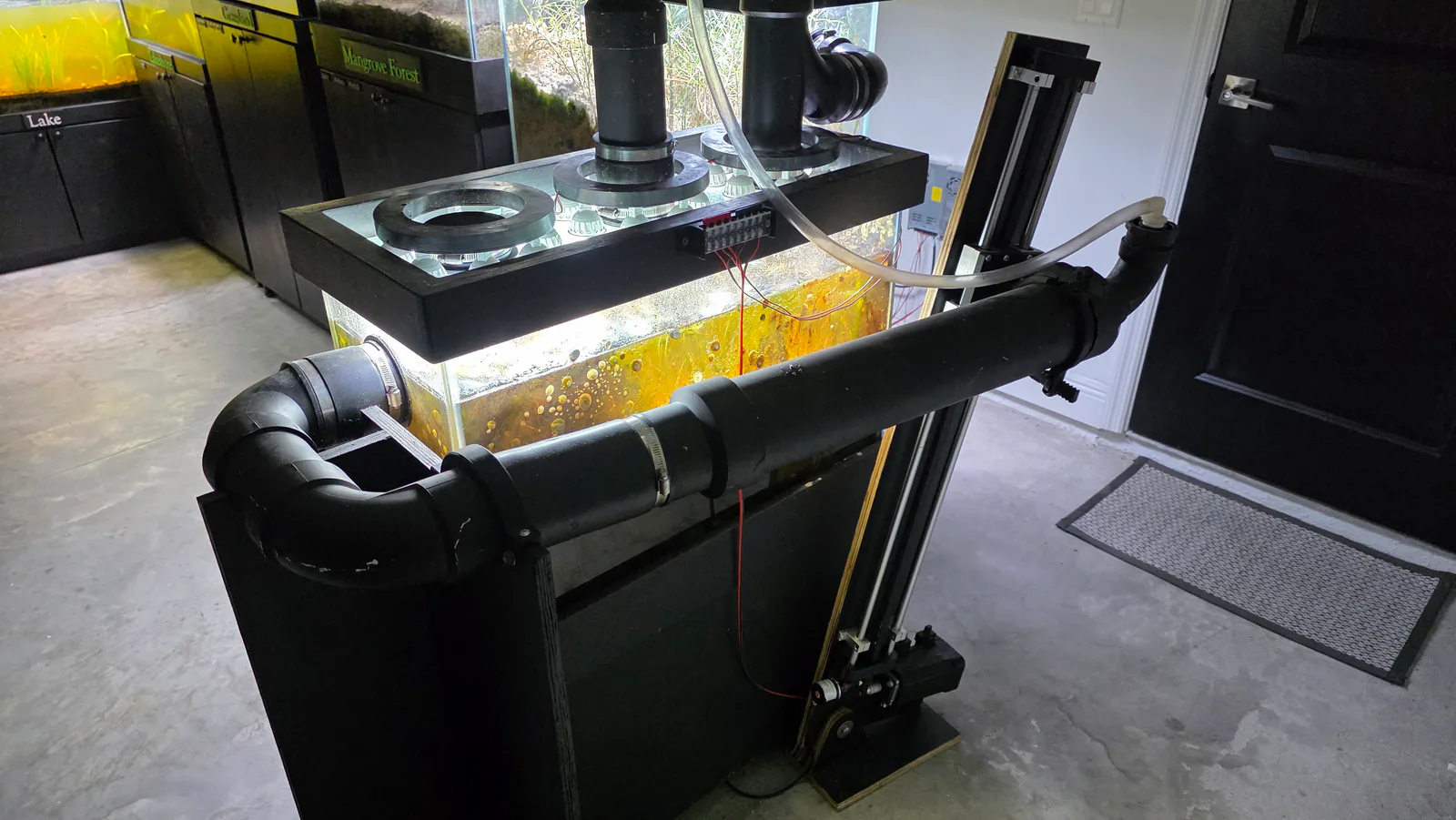
The Wave and Tide System is the only mechanical water movement source for the Seagrass Meadow.
The Wave and Tide System is the only mechanical water movement source for the Seagrass Meadow.
The Wave and Tide System is the only mechanical water movement source for the Seagrass Meadow. Without it, the saltwater water column relies on organism activity (crab movement, shrimp swimming, fish if present) and convection for oxygen distribution. Mud Crab substrate disturbance is the most documented form of biological aeration in the Seagrass Meadow, but biological disturbance does not substitute for bulk water column movement in oxygenating the deep substrate where seagrass roots and where anaerobic conditions can develop. On June 10 to 11, 2026, a programming change during remote wave-control integration work altered the wave pattern to an extremely slow setting, greatly reducing water movement overnight. The following morning, noticeably cloudy water, many Marine Scuds positioned on the glass, and the Variegated Sea Urchin almost completely out of the water were observed. Wave and tide motion was restored to a more appropriate level. Reduced circulation, bacterial bloom, and lowered dissolved oxygen are possible contributing factors; none were measured. This is the first documented instance of an ecological consequence associated with reduced Wave and Tide System output. On June 13, 2026, one day after the largest single marine introduction in miniBIOTA history (75 Florida Glass Shrimp and 18 hermit crabs added June 12), several hermit crabs were found partially or completely outside their shells and the shrimp population appeared unusually lethargic. Both symptoms were attributed to low dissolved oxygen and insufficient water movement; the large biomass addition substantially increased overnight metabolic oxygen demand. Wave system programming was modified to produce stronger water movement in response. Results were confirmed positive on June 14, 2026. This is the second documented instance linking reduced or insufficient wave output to an ecological stress event in the marine biome. On June 19, 2026, one Mottled Shore Crab was observed at the wave system mouth, occupying the zone of strongest current output in the biome and continuously grazing. A second individual was confirmed at the opposite end of the Marine Shore. This is the first observation documenting a specific organism using the wave system output zone as a preferred foraging microhabitat, indicating that the wave current is actively structuring spatial distribution of at least one grazer species in the marine biome. On July 1, 2026, freshly hatched shrimp zoea were observed drifting through the Seagrass Meadow water column under wave system influence, the first such sighting since the wave and tide system was strengthened in mid-June 2026. The observer read this as validation of one of the system's core design goals: keeping planktonic organisms suspended in the water column without exposing them to mechanical hazards such as pumps. Parent species could not be identified from the footage; both Daggerblade Grass Shrimp and Florida Glass Shrimp are present in the Seagrass Meadow. Whether the larvae survive past this earliest life stage is unconfirmed. On July 29, 2026, wave action was identified as one of two forces holding the Graceful Redweed floating mat down in the water column overnight, the other being the weight of hermit crabs crowding onto it. Through the photoperiod, photosynthetic oxygen bubbles accumulate within and beneath the mat and lift it back to the surface. This is the first documented case of wave output acting on a producer's physical position rather than on animal behaviour or water chemistry, and it means the system participates in a daily vertical cycle that also determines what the mat shades beneath it. The relative contribution of wave action versus hermit crab weight has not been isolated, and no wave setting change was made in response; the effect was observed rather than engineered. On August 29, 2026, a partial holocarpic die-off of the Seagrass Meadow Caulerpa mass added a transient organic decomposition load to the saltwater realm (green cloudy water, sour to rotting odor, suspected but unmeasured nitrogenous pulse). Maintaining water movement through this system, to keep dissolved oxygen distributed while the algal biomass decomposed, was identified as a priority for the duration of the event. No wave setting change was recorded, and no dissolved oxygen measurement was taken. This is the first documented instance of the system's oxygenation role being flagged as acutely important during a decomposition-load event rather than during a stocking or circulation change. Over the same window, from the night of August 29 into August 30, 2026, the system failed repeatedly and stopped, removing marine water movement during the decomposition load. Josue diagnosed and repaired it (a mechanical drivetrain fault). The outage is a suspected contributor to the concurrent water-quality deterioration and to the Variegated Sea Urchin death confirmed September 1, 2026; no dissolved oxygen was measured. This is the first documented case of a Wave and Tide System outage coinciding with a decomposition-load event, and it is the ecological realization of the aeration risk this system exists to prevent. Whether the system is currently running, on what profile, and at what amplitude is not confirmed in this record. Deployed firmware is confirmed running (standalone AccelStepper), but the current operational schedule is unconfirmed. On August 3, 2026, the belt drive and pulley assembly failed again: a pulley flange broke from belt misalignment. The failure was inspected, root-caused, and repaired the same day, and the system runs normally after that repair. This is a recurring mechanical failure mode for the installed belt/pulley drivetrain, not an isolated event, and the current drivetrain is in maintenance and repair mode rather than durable long-term. The same day, a full drivetrain rebuild using a counterweighted ClearPath integrated servo motor was planned, directly motivated by this failure history. Separately, an unrelated reliability gap was documented August 3 to 4, 2026: neither the wave/tide controller nor its host computer reliably resumes operation after a power interruption without physical intervention. This is unresolved and has been recorded as a formal requirement for the ClearPath rebuild, and it also affects the currently installed system in the meantime.
Standalone firmware vs. ecosystem integration: The current firmware runs fixed wave and tide profiles without external command or telemetry publishing. MQTT control is planned but not implemented, which means data about current wave state, profile selection, or operational schedule are not available from the MQTT network. Whether the system is currently running requires direct observation. The June 10 to 11, 2026 slow-setting event demonstrates the ecological consequence of an undetected profile change and reinforces the need for MQTT telemetry to make wave state visible.
Seagrass Meadow substrate aeration: If the system is not currently running, oxygen distribution in the Seagrass Meadow depends on biological water movement and convection alone. The combination of cyanobacteria-like surface growth, detritus accumulation in the producer succession arc, and low water movement creates conditions favorable for anaerobic zone development in the deep substrate. This is the most consequential potential ecological consequence of Wave and Tide System downtime. A transient decomposition load from the August 29, 2026 partial Caulerpa die-off briefly raised the stakes on this, with maintaining wave-system water movement identified as a priority through the event.
Marine Shore intertidal cycling: Without tide profile operation, the Marine Shore community (Eastern Melampus at approximately 42 individuals, newly introduced Mangrove Periwinkle, Gulf Marsh Crab, Mottled Shore Crab) experiences a static water level rather than periodic wetting and drying. Whether the community persists without periodic intertidal cycling, or whether it reorganizes around a fixed-waterline habitat, is not documented.
Future R&D scope: The planned tide chart synchronization (pull real-time tide data from a Florida Gulf Coast location) and weather integration (storm surge amplitude modulation) are future R&D capabilities, not current operational features. These would, if implemented, make miniBIOTA's marine side the only known enclosed ecosystem synchronized to real coastal tide data.
Recurring belt/pulley failure and planned rebuild (August 3, 2026): The installed belt/pulley drivetrain failed again on August 3, 2026 (pulley flange broken by belt misalignment), repaired the same day. This is a recurring failure mode, not an isolated event, and the current drivetrain is in maintenance and repair mode rather than durable long-term. The failure history directly motivated the same-day plan for a full drivetrain rebuild using a counterweighted ClearPath integrated servo. Nothing about the rebuild is purchased, fabricated, installed, tested, or commissioned; construction timing remains bundled with the Estuary build, with no firm date.
Power-loss recovery gap (new, August 3 to 4, 2026): Neither the wave/tide controller nor its host Wyse computer reliably resumes operation after a power interruption (an outage or a brief flash) without physical intervention. This is unresolved, with no fix selected as of August 4, 2026, and affects the currently installed system in addition to being recorded as a formal requirement for the ClearPath rebuild. The August 29, 2026 Caulerpa die-off sharpened this: a power interruption that halted water movement during a decomposition-load event would remove oxygenation exactly when dissolved oxygen demand is elevated. The August 29 to 30, 2026 outage was a mechanical fault rather than a power loss, but it demonstrated exactly that scenario, with the system stopped during a decomposition load and a suspected contribution to concurrent marine mortalities.
After the June 12, 2026 introduction of 75 Florida Glass Shrimp and 18 hermit crabs caused overnight low-oxygen stress, Josue increased the wave and tide...
Wave system reprogrammed June 13 to stronger, more sustained currents; sustained flow prevents cyanobacteria mat from resealing after physical disruption.