Sporobolus alterniflorus

Smooth Cordgrass

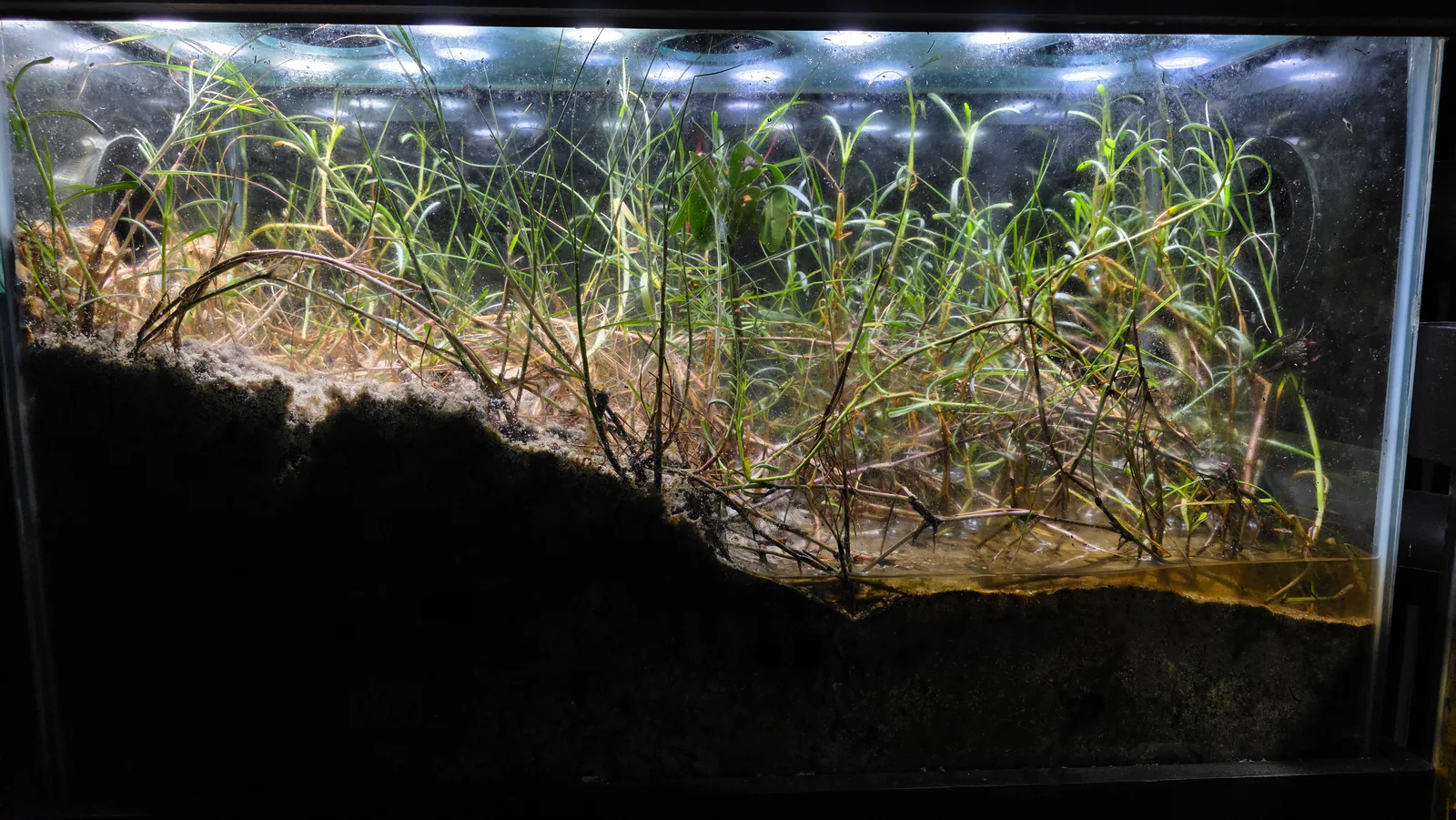
The foundation grass of Atlantic salt marshes, growing in the tidal margin of the Marine Shore where its dense rhizome mat stabilizes sediment and its senescing blades feed a chain of snails, crabs, and detritivores that depend on decomposing cordgrass as a primary food source.
Visual Data Unavailable

Overview

Smooth Cordgrass (Sporobolus alterniflorus, formerly Spartina alterniflora) is the foundational grass of Atlantic and Gulf coast salt marshes, forming dense intertidal stands that anchor sediment, export enormous quantities of organic matter to coastal food webs, and provide physical structure for invertebrates and fish. It was introduced to miniBIOTA's Marine Shore on July 9, 2025, but no observation documents its establishment, growth, or current status.

Identity

  • Common name: Smooth Cordgrass
  • Alternate names: salt marsh cordgrass, saltmarsh cordgrass, cordgrass, spartina, marsh grass
  • Scientific name: Sporobolus alterniflorus
  • Previous scientific name: Spartina alterniflora (reclassified 2014; both names remain in wide use)
  • Identification confidence: Species-level. Sporobolus alterniflorus is inferred from the common name and is the only smooth cordgrass of the US Atlantic and Gulf coasts; the smooth leaf surface and intertidal habitat are diagnostic.
  • Uncertainty label: Uncertain. Species ID is confident; establishment and current status in miniBIOTA are undocumented.

Taxonomy

  • Kingdom: Plantae
  • Phylum: Tracheophyta
  • Class: Liliopsida
  • Order: Poales
  • Family: Poaceae
  • Genus: Sporobolus
  • Species: S. alterniflorus

Natural History

Range and Florida Relevance

Sporobolus alterniflorus is native to the Atlantic and Gulf coasts of North America from Newfoundland south through Florida, Texas, and into the Gulf of Mexico. It is one of the most ecologically important plants in North American coastal wetlands, forming the structural foundation of salt marshes throughout its range. In Florida, it dominates low-marsh intertidal zones along both coasts and is a primary habitat-forming species in the estuarine systems that surround and connect to miniBIOTA's coastal biomes.

Habitat

Smooth Cordgrass grows in the intertidal zone of salt marshes, tolerating twice-daily submersion by tidal water and exposure to full seawater salinity. It forms dense monoculture stands through rhizome expansion, with individual rhizomes extending meters through the sediment. The dense root and rhizome mat stabilizes soft sediment and traps suspended particles, building new marsh substrate over time. In miniBIOTA's Marine Shore, the plant would be expected to occupy the lower intertidal margin where saltwater regularly reaches.

Diet and Primary Production

Sporobolus alterniflorus is a C4 photosynthesizer with high productivity under warm, sunny, high-salinity conditions. It fixes carbon through photosynthesis and exports large quantities of organic matter as leaf litter (wrack) and dissolved organic carbon when leaves senesce and decompose. This exported organic matter is a major food subsidy to adjacent marine food webs -- a disproportionately large fraction of salt marsh secondary production is fueled by decomposing cordgrass detritus rather than direct grazing.

Reproduction

Sporobolus alterniflorus spreads primarily through rhizome expansion; sexual reproduction via seed is less common in established populations. In miniBIOTA, rhizome-based spread is the expected growth mechanism after introduction.

Tolerance Ranges

Highly salt-tolerant; thrives at full marine salinity (35 ppt) and tolerates hypersaline conditions in some settings. Requires full or near-full sun. Tolerates waterlogged, anaerobic, sulfide-rich sediment through aerenchyma tissue in roots. Not frost-tolerant at Florida latitudes.

Ecological Role

Smooth Cordgrass is the structural engineer of the Marine Shore intertidal zone. Its roots and rhizomes stabilize sediment and prevent erosion; its above-ground biomass provides physical cover and attachment surfaces for invertebrates such as Marsh Periwinkle (id 10), Ladder Hornsnail (id 175), Gulf Marsh Crab (id 174), and Atlantic Sand Fiddler Crab (id 58). Its leaf litter is a primary detrital food input: when blades senesce and fall, bacteria and fungi colonize the decomposing material, and detritivores ranging from snails to amphipods to crabs consume the enriched organic matter.

Gulf Marsh Crab (Sesarma schubarti, id 174) was introduced to the Marine Shore in April 2026 specifically as a cordgrass herbivore and leaf-litter processor; if Smooth Cordgrass is established, it would be the direct food source for that species.

miniBIOTA Evidence

Introduction Context

Smooth Cordgrass was introduced to the Marine Shore on July 9, 2025. No introduction method or source is recorded. This is the only data point linking the species to a specific event in miniBIOTA.

Observation Timeline

No observation files found for this species directly. Gulf Marsh Crab introduction note (April 22, 2026) lists cordgrass as a primary dietary item in the species' native habitat, implying cordgrass presence was anticipated or present at that time.

What Is Confirmed

  • Smooth Cordgrass was introduced to the Marine Shore on July 9, 2025, based on the date_first_introduced database field.

What Is Inferred

  • Introduced deliberately as an intertidal plant layer in the Marine Shore.
  • If established, provides physical structure and detrital food input for intertidal invertebrates including Marsh Periwinkle, Ladder Hornsnail, Gulf Marsh Crab, and Atlantic Sand Fiddler Crab.

What Remains Unknown

  • Whether the plant survived and established after introduction.
  • Current growth status, height, and stem count.
  • Whether rhizome expansion has occurred.
  • Relationship to id 75 (Saltmarsh Cordgrass, same scientific name, Terrestrial realm).