
Sargassum sp. (unidentified)

Sargassum Seaweed

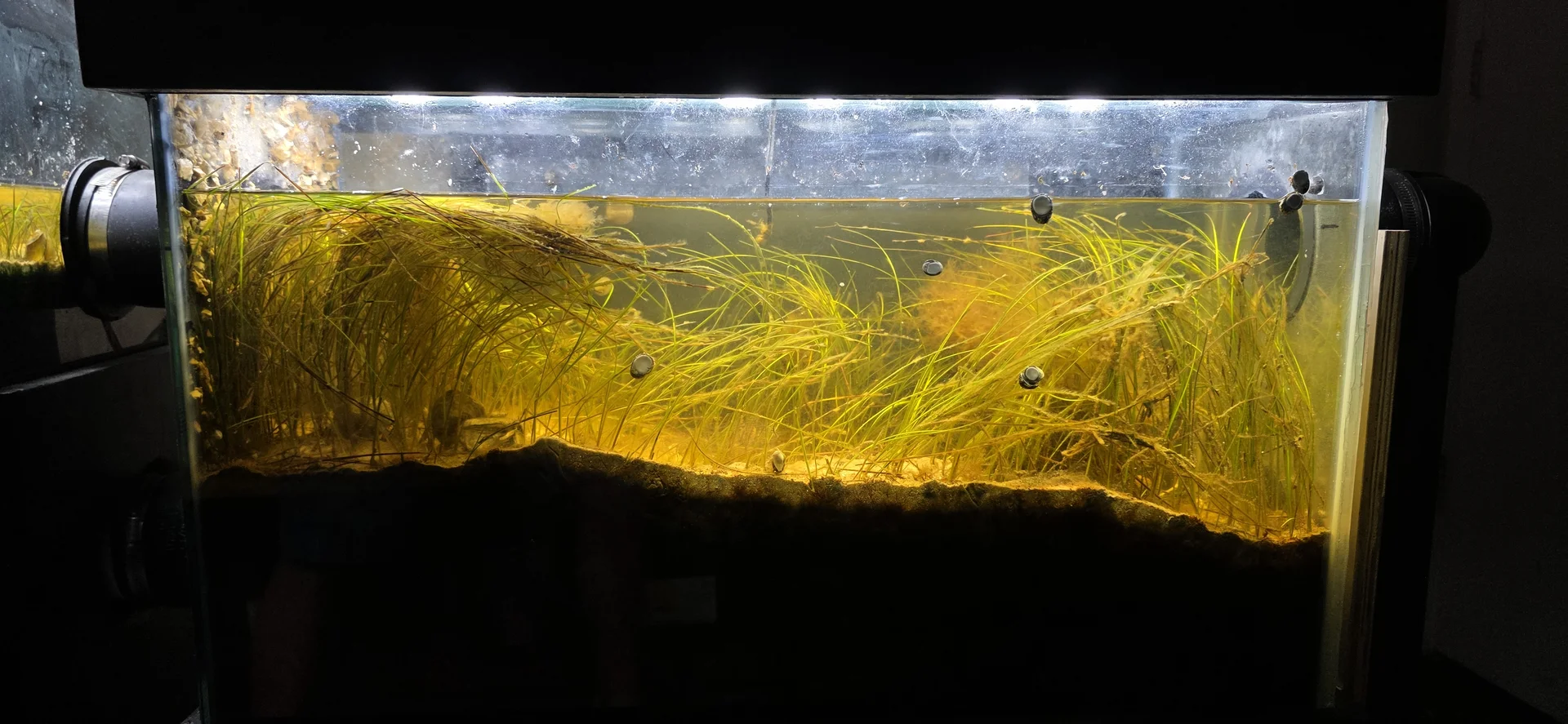
A branching golden-brown macroalga with air-filled bladders along its fronds, growing on hard substrate in the Seagrass Meadow and providing three-dimensional structure and shelter for small crustaceans and invertebrates.
Visual Data Unavailable

Overview

A branching golden-brown macroalga with air-filled bladders along its fronds, providing three-dimensional structure and habitat for small invertebrates in the Seagrass Meadow; Florida Sargassum species grow both as benthic forms attached to hard substrate in coastal habitats and as free-floating pelagic mats in the open Atlantic. No species-level identification has been made from any archived observation.

Identity

  • Common name: Sargassum Seaweed
  • Alternate names: sargasso seaweed, gulfweed, sargassum, floating seaweed
  • Scientific name: Sargassum sp. (unidentified)
  • Identification confidence: Genus-level (Sargassum); species unidentified
  • Uncertainty label: Observed

Taxonomy

  • Kingdom: Chromista
  • Phylum: Ochrophyta
  • Class: Phaeophyceae
  • Order: Fucales
  • Family: Sargassaceae
  • Genus: Sargassum
  • Species: Unidentified (S. filipendula or S. polyceratium probable if benthic; S. natans or S. fluitans if pelagic)

Natural History

Sargassum is a genus of brown macroalgae with a global distribution in tropical and subtropical coastal and pelagic waters. Unlike the green algae common in the miniBIOTA saltwater system (Caulerpa species, Filamentous Macroalgae), Sargassum belongs to the brown algae (Phaeophyceae) and derives its golden-brown to olive color from the carotenoid pigment fucoxanthin, which masks the underlying chlorophyll.

The characteristic features of Sargassum are its dichotomously branching fronds and the pneumatocysts: small air-filled bladders attached to the fronds that provide buoyancy. In benthic coastal species, the pneumatocysts allow the fronds to float upright in the water column while the holdfast (a root-like attachment structure) anchors the plant to rock, rubble, or hard substrate. In the pelagic species (S. natans and S. fluitans), the plant grows entirely unattached, forming extensive floating mats in the open ocean.

The pelagic Sargassum mats of the Sargasso Sea and the Gulf of Mexico support a complex and unique community of organisms: sargassum fish (Histrio histrio), sargassum shrimp, pipefish, and many invertebrates, adapted to life among floating algae. In coastal systems, benthic Sargassum provides structurally complex habitat for amphipods, isopods, small crustaceans, and epifaunal invertebrates.

Reproduction in Sargassum is complex: benthic species reproduce sexually via differentiated gametes (oogamy) released from receptacles at the tips of fertile fronds, as well as vegetatively through fragmentation. Pelagic species reproduce almost entirely through vegetative fragmentation, rarely if ever producing sexually.

Ecological Role

In the Seagrass Meadow, Sargassum Seaweed functions as a habitat-forming macroalga providing three-dimensional frond structure above the substrate. Its branching fronds offer attachment points and shelter for amphipods (Marine Scud), isopods (Eelgrass Isopod), and other small epifaunal invertebrates. Sea urchins (Variegated Sea Urchin) are the primary macroalgae grazers in the Seagrass Meadow community and would graze Sargassum fronds if present.

As a brown alga, Sargassum contains alginic acid (alginate) in its cell walls, a compound that differs chemically from the cellulose of green algae, giving it different palatability and decomposition rates in the food web.

miniBIOTA Evidence

Introduction context: No introduction event is recorded. Sargassum may have arrived as a natural colonizer, been introduced attached to live rock or substrate material, or been deliberately added as a macroalgae component for the Seagrass Meadow. No introduction date, source, or method is on file.

Observation timeline:

  • No dedicated observation records have been found in the miniBIOTA observation records for Sargassum Seaweed.

Confirmed:

  • Species node exists for Sargassum in the Seagrass Meadow; genus-level identification as Sargassum sp.

Inferred:

  • Photosynthetic macroalgal production and structural habitat in the Seagrass Meadow if currently present
  • Benthic attachment to hard substrate, inferred from Seagrass Meadow biome assignment

Unknown:

  • Species within Sargassum (benthic coastal form vs. pelagic form)
  • Whether Sargassum is currently present in the Seagrass Meadow
  • Introduction date, source, and method
  • Whether it is attached to substrate or free-floating