Range and Florida Relevance
Nerita fulgurans is native to rocky intertidal and coastal habitats throughout the Caribbean, Florida, and the western Atlantic coast. In Florida, it is most common in coastal areas with rocky substrate, mangrove roots, and the hard surfaces of tidal zones. It is a fully marine species that tolerates a range of salinities as an adult, and it is one of several nerite species found in Florida's near-shore marine and intertidal habitats. Its reproduction depends on connection to open coastal water, where its larvae complete development in the plankton before returning to hard substrate to settle.
Shell and Appearance
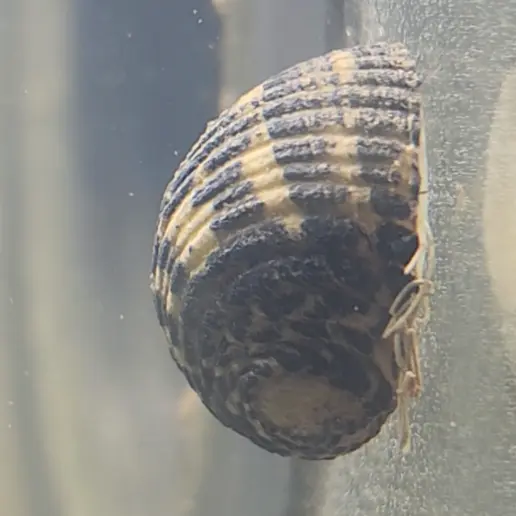
The lightning nerite's common name comes from the bold black zigzag or lightning bolt markings on its shell, set against a cream, gray, or white background. The shell is smooth, hemispherical, and relatively thick, an adaptation to wave exposure and the mechanical stresses of the intertidal zone. The operculum (a calcareous plate) seals the aperture tightly when the snail retracts, protecting it from desiccation and predation.
Habitat
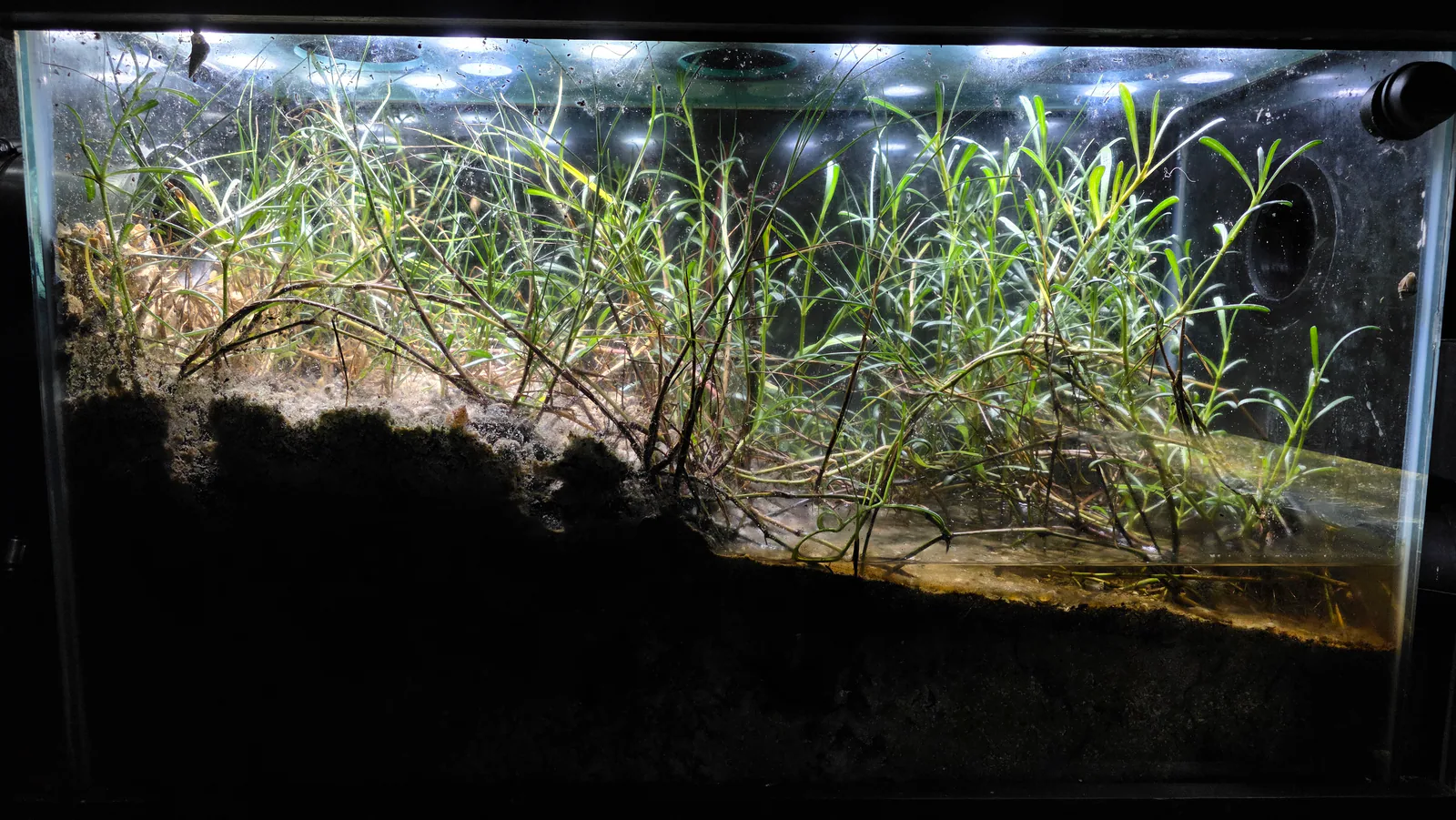
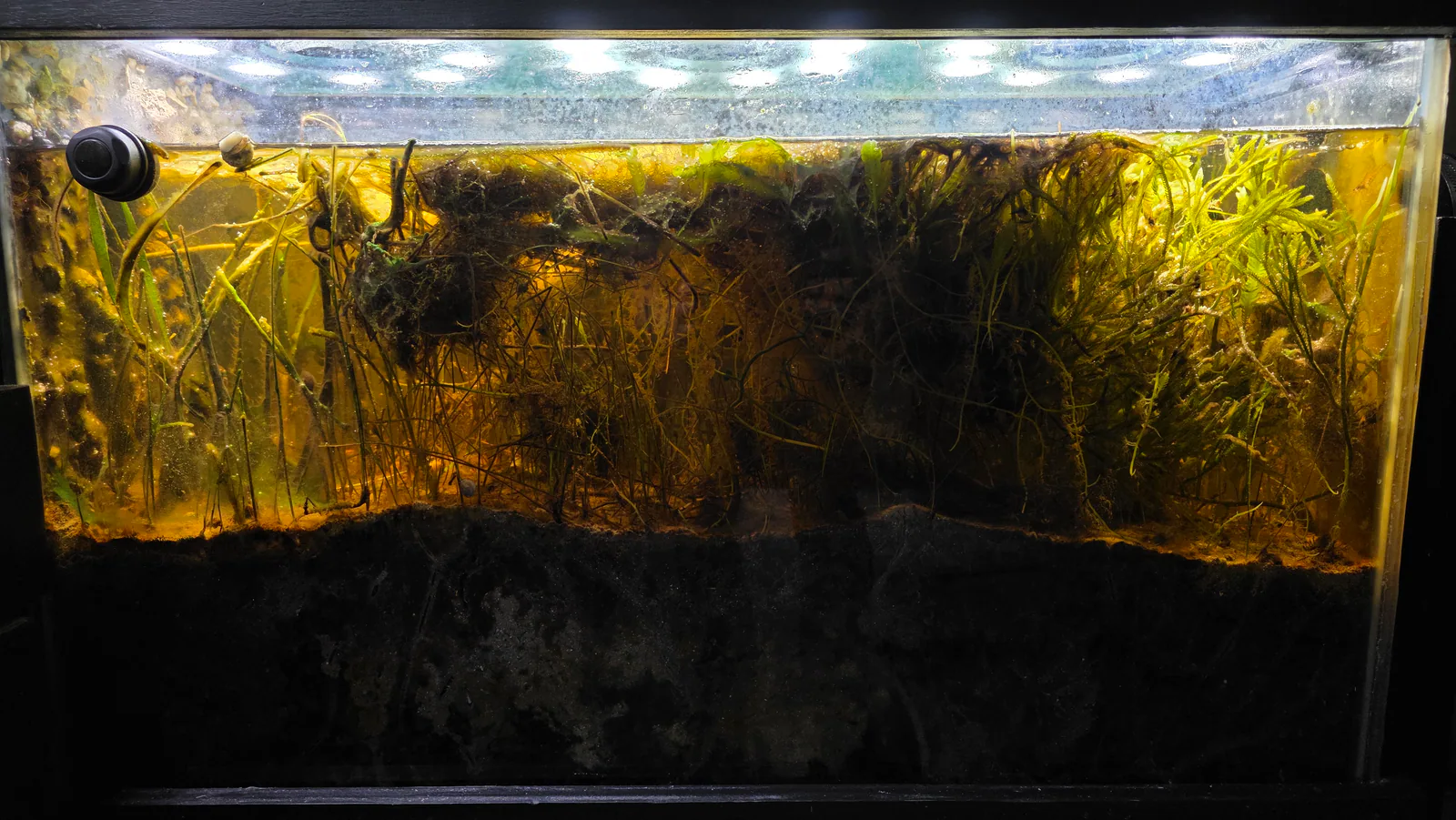
Nerita fulgurans is a true intertidal snail. It occupies the zone between low and high tide, where it alternates between emersion (out of water during low tide) and submersion (feeding when water is present). During the day, individuals typically rest above the waterline on hard substrate. At night or when submerged by the incoming tide, they move actively to graze algae and biofilm from rock, shell, root, and glass surfaces. In miniBIOTA, this species occupies the Marine Shore and Seagrass Meadow, where hard surfaces provide grazing substrate in the intertidal margin.
Diet
Lightning Nerites are herbivorous grazers. They use a rasping radula to scrape algae and biofilm from hard surfaces. Their primary food sources are encrusting algae, microalgal films, cyanobacterial growth, and associated organic biofilm on rock, shell, glass, and root surfaces. They do not consume living seagrasses or macroalgae in significant quantities; their primary role is keeping hard surfaces clear of thin algal growth.
Reproduction and the Planktonic Larval Constraint
Female nerites lay small egg capsules attached to hard substrate, each capsule enclosing multiple eggs. The larvae that hatch from those capsules are free-swimming planktotrophic veligers: they feed in the water column, and they must complete an extended period of growth there before they are able to settle onto hard substrate and metamorphose into juvenile snails. Species in the genus Nerita are documented as spending up to approximately six months in the plankton, which gives them very broad dispersal along open coastlines.
That larval stage is what a closed system cannot supply. It requires water volume, residence time, and a phytoplankton density that no enclosed marine habitat of this scale reproduces. In miniBIOTA, egg masses have been observed but no juvenile Lightning Nerite has ever appeared, which is the expected outcome.
An earlier version of this record attributed the recruitment failure to a Neritidae requirement for brackish or low-salinity conditions during larval development. That is a description of the freshwater and brackish genus Neritina, in which adults live and lay in fresh water and the veligers require salt water to develop, and it does not apply to a fully marine Nerita. The correction matters because the earlier framing implied that adding a brackish zone to the system might enable reproduction. It would not. The constraint is the planktonic phase itself, not salinity, and it is not addressable through any modification within reach of a closed system.
A second hypothesis, that Common Atlantic Marginella was consuming nerite egg masses before they could hatch, is no longer needed. Marginella was fully removed from the system by January 15, 2026, and no juvenile nerite appeared in the eighteen months that followed. Egg predation was not the operative constraint.
Tolerance Ranges
Nerita fulgurans is adapted to the environmental fluctuations of the intertidal zone, temperature swings, periodic desiccation, salinity variation, and variable oxygen exposure. Adults have persisted in miniBIOTA's full marine conditions for over two years, so environmental tolerance is not the limiting factor for this species here. The limiting factor is reproductive, and it applies to the larval stage rather than to adult function. No miniBIOTA-specific tolerance measurements have been taken.