
Ceriodaphnia dubia

Ceriodaphnia dubia

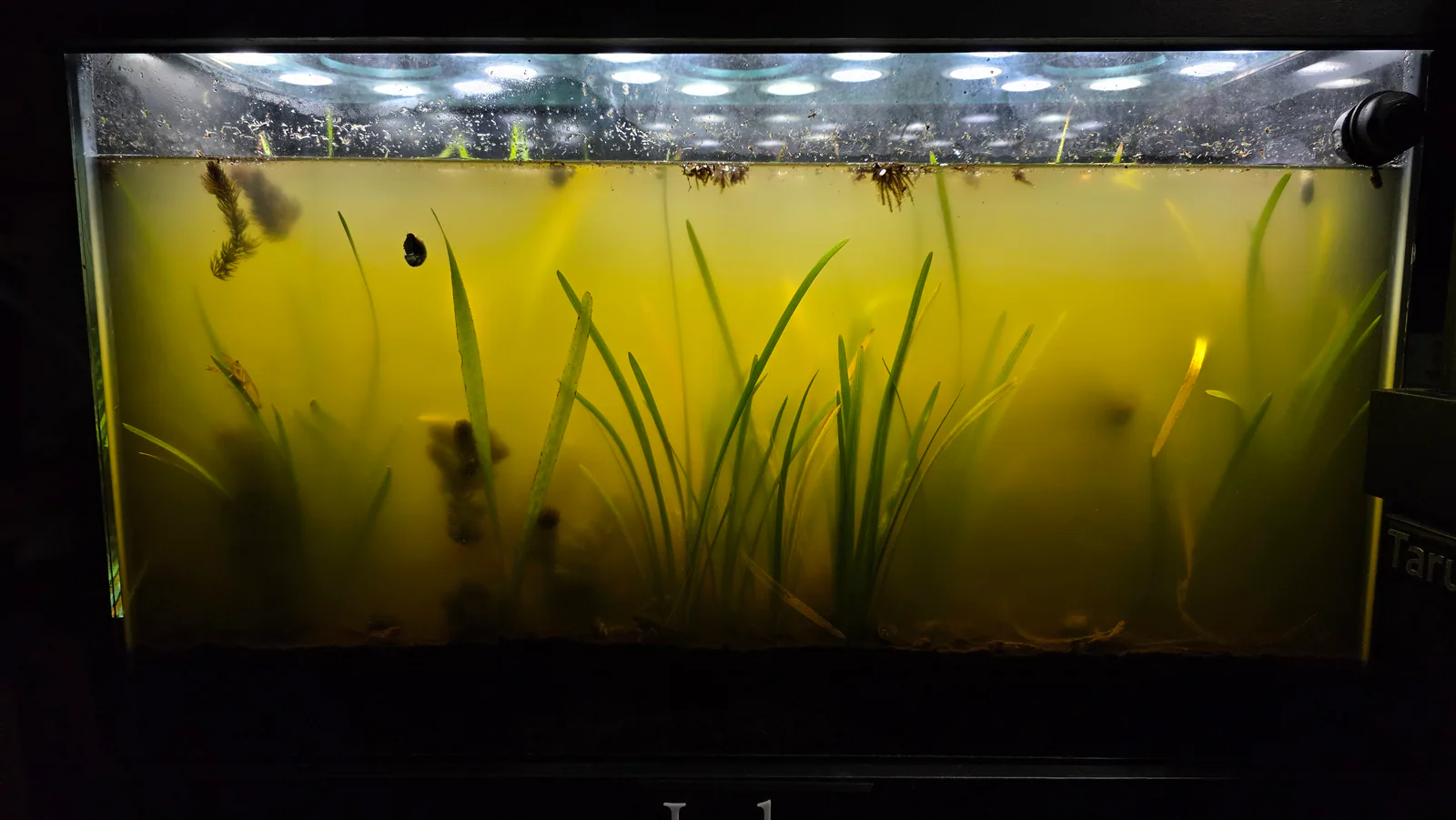
A tiny cladoceran identified as Ceriodaphnia dubia, present in thousands in the Freshwater Lake, clustering near the water surface by day and dispersing to feed through the water column at night, diving rapidly when illuminated; egg-bearing individuals observed in May 2026 first distinguished it from the larger Moina population.
Visual Data Unavailable

Overview

This species record covers a tiny Daphnia-like microcrustacean first distinguished from Moina on May 21, 2026, when close inspection revealed that very small individuals were already carrying eggs, ruling out the initial interpretation that they were juvenile Moina. On August 7, 2026, review of previously recorded footage together with an outside identification consultation identified the organism as Ceriodaphnia dubia. Thousands are present in the Freshwater Lake, clustering near the water surface by day and dispersing through the water column at night with strong light-avoidance behavior.

Identity

  • Common name: Ceriodaphnia dubia
  • Alternate names: tiny daphniid, small water flea, unidentified tiny daphniid (former working name), Daphnia-like organism
  • Scientific name: Ceriodaphnia dubia
  • Identification confidence: Species-level working identification, based on review of previously recorded footage together with an outside identification consultation on August 7, 2026; not yet confirmed by microscopy
  • Uncertainty label: Possible

Taxonomy

  • Kingdom: Animalia
  • Phylum: Arthropoda
  • Class: Branchiopoda
  • Order: Cladocera
  • Family: Daphniidae
  • Genus: Ceriodaphnia
  • Species: C. dubia

Natural History

Ceriodaphnia dubia is a small freshwater cladoceran in the same family as Daphnia, but noticeably smaller and more rounded, typically reaching only about 0.6 to 1 millimeter as an adult. It is one of the most widely used freshwater invertebrates in water-quality testing worldwide because of its short generation time, sensitivity to water chemistry changes, and ease of culturing. Like other cladocerans, eggs are retained within a brood pouch in the adult body and released as miniature juveniles rather than as free-swimming larvae, and reproductive adults can be recognized by the presence of eggs visible through the transparent carapace even at very small body sizes.

C. dubia is a filter feeder, drawing suspended algae, bacteria, and fine organic particles into a filtering chamber formed by its thoracic limbs. Under favorable conditions it reproduces by parthenogenesis, with females producing broods of genetically identical offspring every few days; generation time can be as short as three to four days at warm temperatures, among the fastest in the cladoceran family. Under stress, sexual reproduction produces resting eggs (ephippia) that can persist in sediment through unfavorable periods.

The species is strongly responsive to light, typically exhibiting diel vertical migration: clustering near the surface or water margins during low-light periods and retreating into deeper or more sheltered water when illuminated, a behavior that reduces exposure to visually hunting predators.

Ecological Role

Ceriodaphnia dubia likely filters suspended algae, phytoplankton, and fine organic particles from the Freshwater Lake water column, occupying a niche broadly similar to Moina but at a smaller body size. At thousands of individuals, their collective grazing would add meaningful pressure to the suspended-particle load, though whether this translates into measurable water-clarity improvement in miniBIOTA has not been assessed.

Egg-bearing individuals confirm active reproduction and suggest the population is self-sustaining rather than declining from a single introduction event. They are likely prey for Ghost Shrimp and other small freshwater predators in the Freshwater Lake, as is typical for small cladocerans, though no predation event has been directly documented for this species.

miniBIOTA Evidence

This organism was first formally recognized as distinct from Moina on May 21, 2026. It may have arrived earlier as part of the May 1, 2026 Moina trail-pool introduction, but the introduction mechanism is not confirmed.

May 21, 2026: Close inspection of organisms initially taken for juvenile Moina revealed that these tiny individuals were already carrying eggs, ruling out the juvenile interpretation. The population was described as extremely abundant, with thousands present throughout the water column. During the day they were observed forming dense clusters along the water surface near the biome edges; at night they dispersed more evenly through the water column and appeared to actively feed. A strong light-avoidance response was noted: individuals rapidly swam downward when illuminated. Video evidence: short close-up clips showing clusters near the water surface.

August 7, 2026: Review of previously recorded footage together with an outside identification consultation identified this organism as Ceriodaphnia dubia, a small, fast-reproducing cladoceran widely known from freshwater ecology. This is a working identification, not a microscopy-confirmed determination.

Confirmed:

  • Presence in the Freshwater Lake by May 21, 2026
  • Population of thousands on May 21, 2026
  • Egg-bearing individuals observed; reproductive adults confirmed
  • Distinct from Moina by size and egg-carrying status
  • Daytime surface-edge clustering behavior
  • Nighttime dispersal and apparent active feeding through the water column
  • Strong negative phototaxis: rapid downward swimming when illuminated
  • Video evidence from May 21, 2026
  • Working identification as Ceriodaphnia dubia, August 7, 2026, from footage review and outside consultation

Inferred:

  • Active reproduction in the Freshwater Lake; egg-bearing implies the population is self-sustaining
  • Filter feeding on suspended algae and fine organic particles, consistent with Ceriodaphnia biology
  • Likely arrived via the May 1, 2026 Moina trail-pool sample as a hitchhiker

Unknown:

  • Microscopy confirmation of the Ceriodaphnia dubia identification
  • Whether the organism is native to Florida or introduced
  • When it first appeared in the Freshwater Lake
  • Current population status beyond May 21, 2026
  • Whether Mesostoma, Ghost Shrimp, or other lake predators are consuming individuals