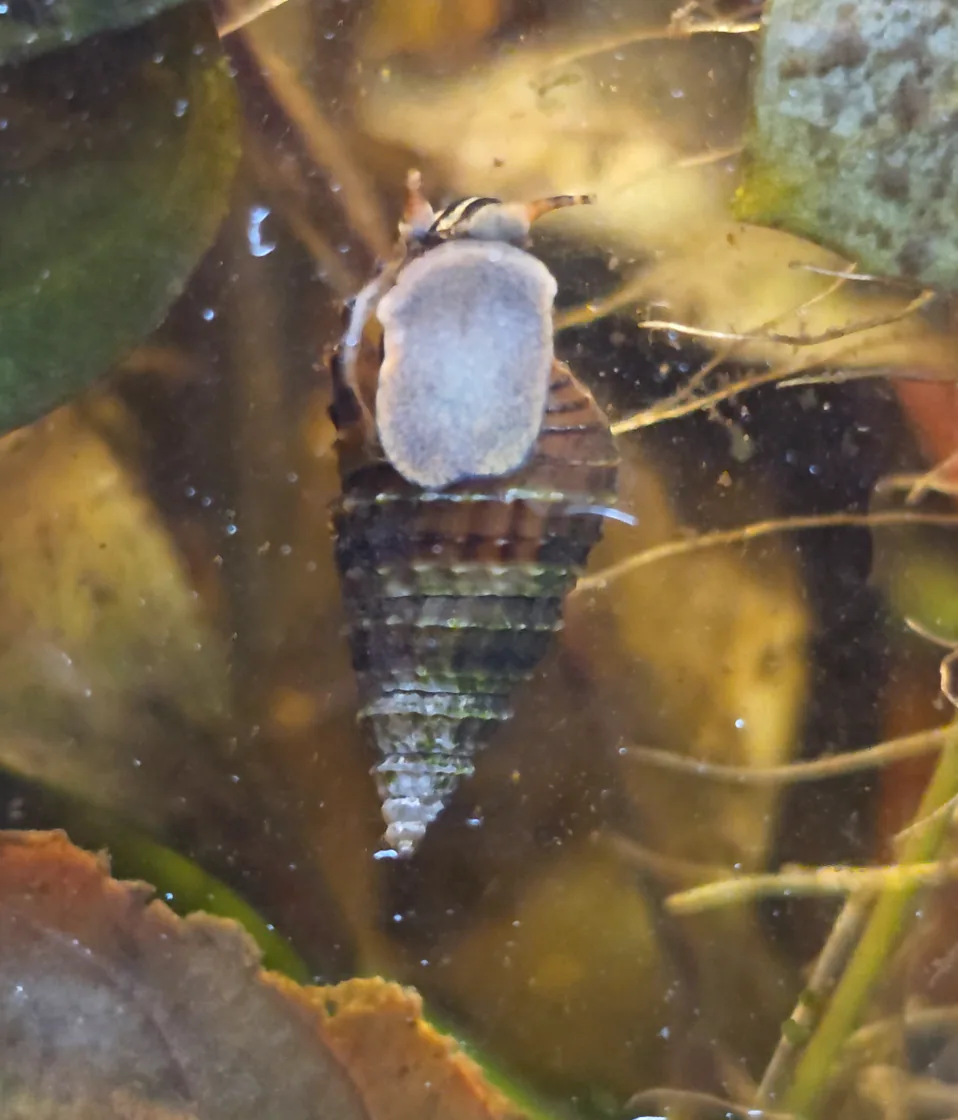
Elimia floridensis
Rasp Elimia
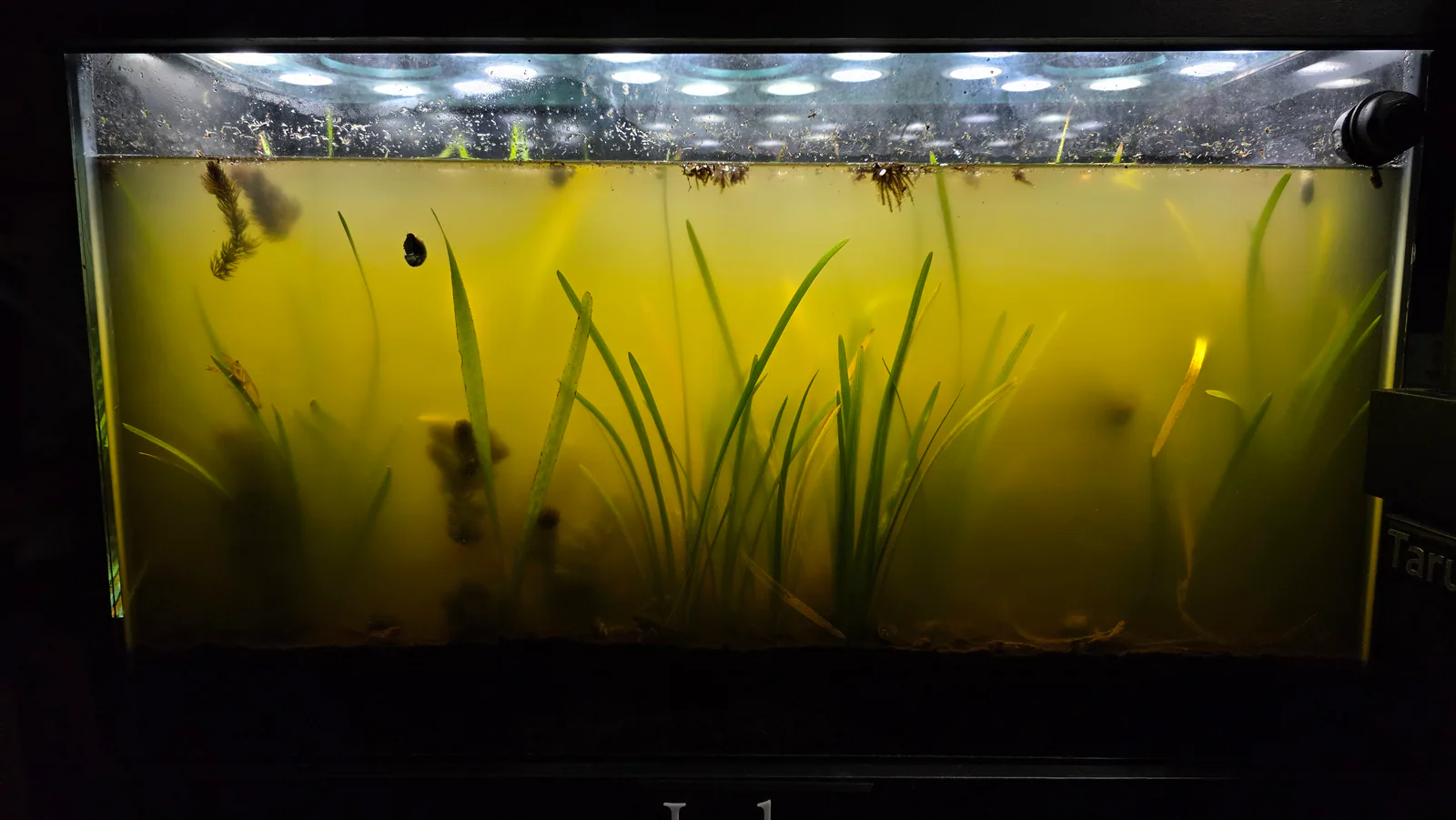
Introduced to the Freshwater Lake in a batch of ten to diversify the detritivore layer, this elongated hornsnail rasps algae and biofilm from substrate and glass surfaces and was noted locally as Ferret Snails.
Elimia floridensis
Introduced to the Freshwater Lake in a batch of ten to diversify the detritivore layer, this elongated hornsnail rasps algae and biofilm from substrate and glass surfaces and was noted locally as Ferret Snails.
A Florida native freshwater hornsnail (Elimia floridensis) introduced to the Freshwater Lake on July 20, 2025, as a batch of ten individuals alongside Malaysian Trumpet Snails and Apple Snails. The introduction was described as diversifying the detritivore population and enhancing nutrient cycling; the snails were referred to locally as Ferret Snails in the observation record. No observation has been filed specifically for Rasp Elimia after the introduction date, and their persistence in the system is unconfirmed.
| Field | Value | |---|---| | Common name | Rasp Elimia | | Alternate names | Florida elimia, Florida hornsnail, hornsnail, Ferret Snail (locally) | | Scientific name | Elimia floridensis | | miniBIOTA ID | 152 | | Slug | rasp-elimia | | ID confidence | Species level | | Uncertainty label | Uncertain | | Identity notes | Elimia floridensis, a native Florida pleurocerid freshwater snail, listed as "Rasp Elimia" in the DB and referred to as "Ferret Snails" in the July 20, 2025 observation record. Species-level identification is accepted from the DB record. The alternate_names list in the original record included "pleuroceridae" (the family name, not a common name; removed) and "freshwater snail" (too generic; removed). |
| Rank | Name | |---|---| | Kingdom | Animalia | | Phylum | Mollusca | | Class | Gastropoda | | Order | Caenogastropoda | | Family | Pleuroceridae | | Genus | Elimia | | Species | Elimia floridensis |
Elimia floridensis is a native Florida freshwater snail belonging to the family Pleuroceridae, commonly called hornsnails. It is endemic to Florida's freshwater systems, particularly clear, spring-fed streams, spring runs, and limestone-bottomed rivers where flow rates are moderate and dissolved oxygen is high. Like most pleurocerids, it has a distinctively elongated, turreted shell that tapers to a point, typically reaching 15 to 25 millimeters in length, with spiral ridges along the whorls. The shell shape and surface texture vary among individuals and populations.
Rasp Elimia are algae and biofilm grazers. They feed by rasping the surface layer of algae, diatoms, bacteria, and fine organic matter from hard substrates using a toothed radula, the molluscan feeding organ. This scraping, rasping motion is efficient on smooth surfaces like glass, rocks, and aquarium substrate, and gives the species its common name. They are primarily substrate-bound crawlers and do not swim.
Reproduction occurs through egg capsules deposited on hard surfaces. Each capsule typically contains one to several eggs; hatching produces small crawling juveniles without a larval stage, so all recruitment is local. Growth is slow; individuals may take one to several years to reach adult size under good conditions. Life span in wild populations is estimated at two to five years.
In their native Florida springs, Elimia floridensis prefers cool to warm water (spring temperatures in Florida are typically near 20 to 22 degrees C year-round), clear water with low turbidity, and moderate to strong dissolved oxygen. They are considered moderately sensitive to water quality degradation and perform best in clean, well-oxygenated water. Most Pleuroceridae species prefer flowing water, and the Rasp Elimia's native habitats are almost exclusively lotic (flowing) systems. Introduction into still water is outside their natural range of conditions and may affect long-term survival.
Rasp Elimia are primary consumers that graze algae and biofilm from hard surfaces, controlling surface algal growth and transferring primary production into snail biomass available to predators. In Florida's spring-run systems, pleurocerids often reach high densities and are significant grazers of diatom and algal mats on submerged surfaces. In a closed freshwater system like miniBIOTA, their ecological role parallels that of Malaysian Trumpet Snails: both are substrate grazers that help control algal and biofilm accumulation on glass and substrate.
The key ecological tension for Rasp Elimia in the Freshwater Lake is the shift from their native flowing-water habitat to a still-water closed system. Pleurocerids are lotic specialists: they are adapted to the oxygen supply and food delivery that comes with flowing water moving across surfaces. In still water with aeration and filtration, conditions may be acceptable, but they are not the natural conditions this species is adapted to. Whether Rasp Elimia successfully survived and persisted in the Freshwater Lake is unknown; no follow-up observation was filed after the July 20, 2025 introduction.
In the context of the introduction batch, Rasp Elimia complement Malaysian Trumpet Snails (ID 79) in the grazing and detritivore guild: Malaysian Trumpet Snails burrow into and disturb substrate while Rasp Elimia crawl on and rasp hard surfaces. Together, the two species were intended to diversify the nutrient-cycling layer in the lake.
The local name "Ferret Snails" is a miniBIOTA-specific nickname; it does not correspond to any known trade or regional common name for Elimia floridensis.
Introduction context: Ten Rasp Elimia were introduced to the Freshwater Lake on July 20, 2025, alongside approximately 20 Malaysian Trumpet Snails and 2 Apple Snails, described in the observation note as diversifying the detritivore population and enhancing nutrient cycling. The snails were referred to in the obs as "Ferret Snails." This is the only observation record for this species in the archive. Rasp Elimia was not the primary routing target of obs-0062 (Malaysian Trumpet Snail was the primary routing); it appears as a context mention. (obs-2025-07-20-0062)
Ten Rasp Elimia were introduced to the Freshwater Lake on July 20, 2025, alongside Malaysian Trumpet Snails and Apple Snails. No observation has been archived specifically for this species after the introduction date. The species is a lotic (flowing-water) native in Florida and the still-water Freshwater Lake represents a departure from its natural habitat preference; whether this affected survival is unknown. Population status is Uncertain.
Elimia floridensis rasps algae, diatoms, and biofilm from hard surfaces using a toothed radula. In miniBIOTA, available grazing surfaces include the lake glass, substrate, and the surfaces of tapegrass and other submerged plants. The species feeds by crawling slowly across surfaces and scraping the algal layer with repeated radula strokes. Its grazing role in the Freshwater Lake overlaps with that of Malaysian Trumpet Snails (ID 79) but is complementary: Malaysian Trumpet Snails also burrow in substrate while Rasp Elimia are surface crawlers.
Elimia floridensis is native to clear, well-oxygenated, cool-to-warm Florida freshwater springs and spring runs. It is moderately sensitive to water quality degradation and sedimentation. The species is a lotic specialist adapted to flowing-water oxygen delivery; still-water aquarium conditions are tolerated by many pleurocerids but are not optimal. Tolerance for fully still, closed systems has not been studied for this species specifically.
Rasp Elimia reproduce by depositing egg capsules on hard surfaces, each containing one to several eggs. Hatchlings emerge as fully formed crawling juveniles with no free-swimming larval stage. Growth to adult size is slow, taking one to several years. No reproduction has been confirmed in miniBIOTA; the population was introduced as adults in July 2025 and has not been observed since.
Rasp Elimia function as substrate grazers in the Freshwater Lake, complementing Malaysian Trumpet Snails in the detritivore guild. They control algal and biofilm accumulation on hard surfaces. No symbiotic relationships have been confirmed in miniBIOTA.
Follow this species across the habitats where it currently appears in the miniBIOTA biosphere.