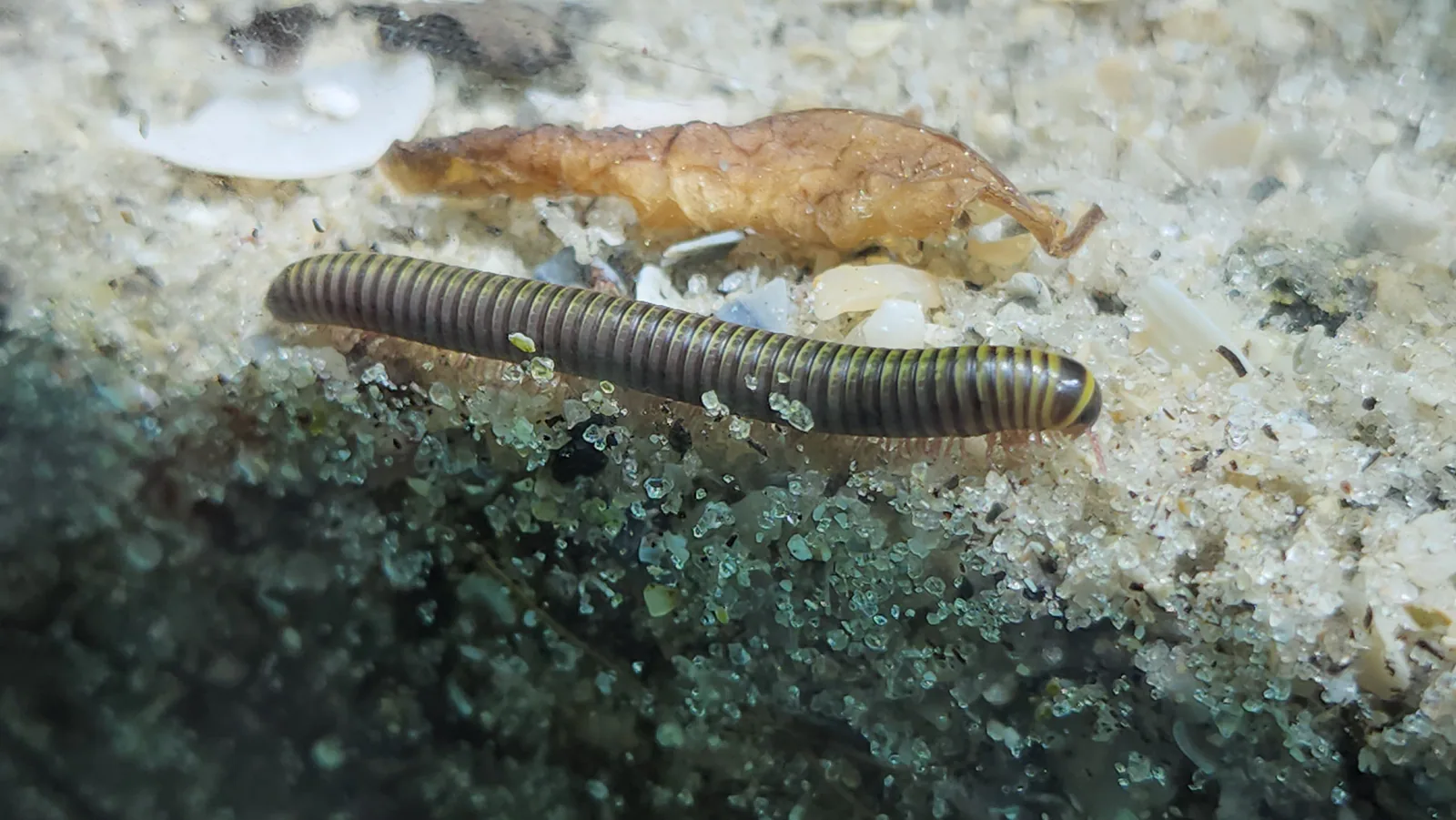
Anadenobolus monilicornis

Bumblebee Millipede

A strikingly patterned black-and-yellow cylindrical millipede introduced to the Mangrove Forest at an undocumented date; the population failed to persist and the species is now Extirpated, with no dedicated observation records in observation records.

Visual Data Unavailable

Overview

A strikingly patterned black-and-yellow millipede introduced to the Mangrove Forest at an undocumented date; the population failed to persist and the species is now Extirpated. No dedicated observation records exist, and introduction date, source, and the specific cause of extirpation are unknown. The species is retained in the record as a failed-persistence reference within the miniBIOTA millipede history.

Identity

  • Common name: Bumblebee Millipede
  • Alternate names: black and yellow millipede, striped millipede, yellow-banded millipede (misidentified)
  • Scientific name: Anadenobolus monilicornis
  • Identification confidence: Species level, inferred from common name. In Florida, "bumblebee millipede" is the standard common name for Anadenobolus monilicornis (Pocock, 1895), the only millipede species widely known by this name in the state. No specimen examination or voucher record is on file; identification is inferred from the common name. The alternate name "yellow-banded millipede (misidentified)" signals that this species has been confused with other yellow-patterned millipedes; see Identity notes below.
  • Uncertainty label: Observed

Taxonomy

  • Kingdom: Animalia
  • Phylum: Arthropoda
  • Subphylum: Myriapoda
  • Class: Diplopoda
  • Order: Spirobolida
  • Family: Rhinocricidae
  • Genus: Anadenobolus
  • Species: A. monilicornis

Natural History

Anadenobolus monilicornis is a medium-sized cylindrical millipede native to the Caribbean and Central America, widely established in South Florida as an introduced species. Adults typically reach 20 to 35 millimeters in length. The body is black with yellow, orange, or cream-colored segmental bands (the specific color varies among individuals and populations), and the legs are characteristically red-orange. The combination of yellow banding on a black body gives the species its "bumblebee" common name.

Habitat and Distribution

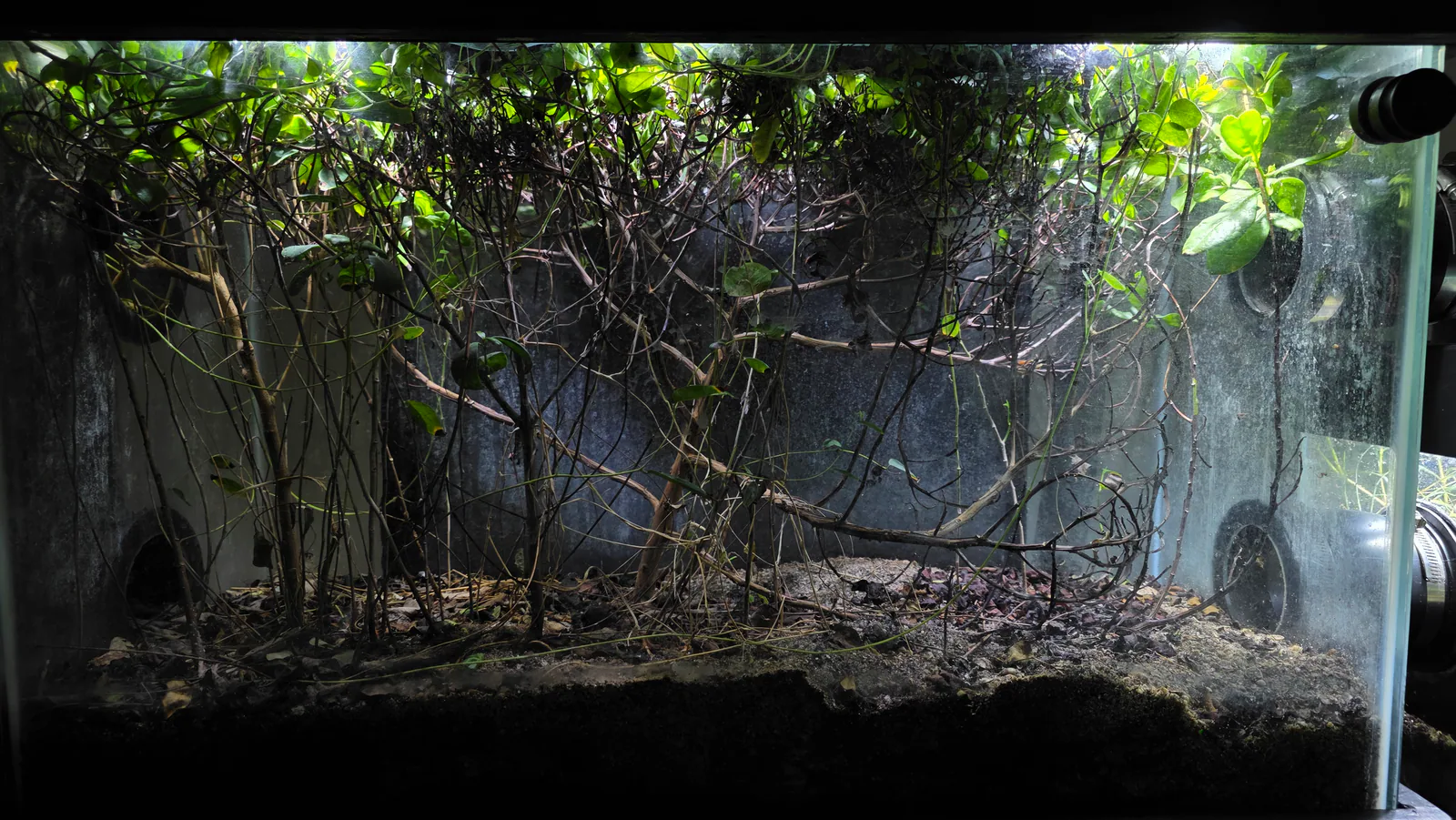
In Florida, A. monilicornis is one of the most common introduced millipedes in tropical and subtropical gardens, parks, and natural areas south of the frost line. It is most abundant in moist tropical environments with organic soil and leaf litter; it is strongly associated with compost-rich garden soil, mulch, and the litter layer beneath vegetation. In South Florida, it is frequently found in Mangrove Forest margins and other humid tropical habitats.

Diet and Ecological Role

Like all Spirobolida, A. monilicornis is a leaf-litter detritivore, processing decaying plant material, fungi, and organic debris in the soil layer. It is a shredder: by physically fragmenting leaf litter and other plant debris, it accelerates decomposition and makes organic material accessible to smaller decomposers. Unlike some millipede species, A. monilicornis does not cause significant damage to living plant material; it is a detritivore rather than a herbivore in the strict sense.

Defense

Like many millipedes, A. monilicornis produces defensive secretions from repugnatorial glands along the body when disturbed. The secretion composition varies by species and group; in Spirobolida it typically includes hydrogen cyanide precursors (cyanogenic compounds) or quinones, making the millipede distasteful or toxic to most predators.

Comparison with Other miniBIOTA Millipedes

Among miniBIOTA's millipede community, A. monilicornis is ecologically most similar to Rusty Millipede, another introduced cylindrical Spirobolida detritivore. The two species are distinguished by color: A. monilicornis has black body with yellow bands and red legs; T. corallinus is uniformly coral-red. Flat-backed Millipede is a different order (Polydesmida) with a flattened body profile.

Ecological Role

Bumblebee Millipede's intended ecological role in miniBIOTA was as a leaf-litter detritivore and nutrient recycler in the Mangrove Forest. By fragmenting and processing fallen mangrove leaves and organic debris, it would have contributed to the detrital food web alongside Surinam Cockroach, Florida Woods Cockroach, Woodlouse, and Earthworm. The species did not persist in miniBIOTA, so no ecological role was realized.

miniBIOTA Evidence

Introduction

No introduction record, source, or date is on file. The species is recorded as Extirpated, with the notation that it is "retained as failed-persistence comparison context." This indicates the species was present at some point (hence Extirpated rather than simply absent) but the introduction event predates or is not documented in observation records.

Observation Timeline

No dedicated observation records exist for Bumblebee Millipede in miniBIOTA. The species is listed in a species composition mention in the April 8, 2026 species inventory note, but no dated sighting, introduction event, or disappearance event is on file.

What Is Confirmed

  • The species was present in miniBIOTA at some point, establishing Extirpated (rather than simply absent) as the correct population status.
  • The Mangrove Forest is the recorded biome.
  • No current population is claimed.

What Is Inferred

  • The introduction predates or falls outside the observation records.
  • The failed persistence is consistent with the documented pattern for introduced millipedes in miniBIOTA: Flat-backed Millipede also declined and was declared Extirpated.

What Remains Unknown

  • When the species was introduced and from what source.
  • How many individuals were introduced.
  • Why the species failed to persist: predation, dietary limitation, environmental stress, or a combination.
  • When the species was last seen.
  • Whether any individuals persisted into the documented period.