Rain System
The Rain System is the freshwater delivery mechanism for the terrestrial realm and its only active water input.
The Rain System is the freshwater delivery mechanism for the terrestrial realm and its only active water input.
The Rain System is the freshwater delivery mechanism for the terrestrial realm and its only active water input.
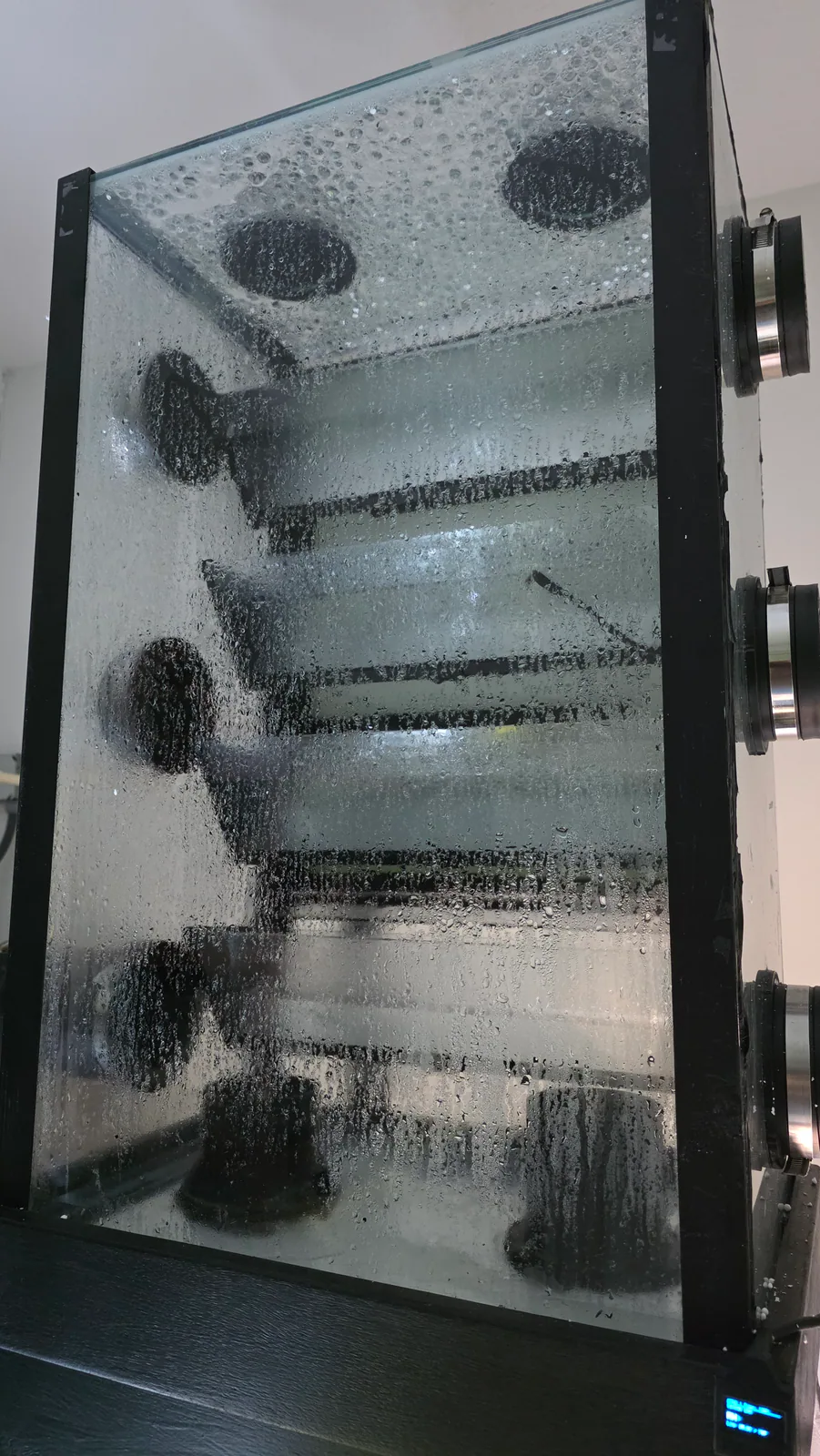
The Rain System is the freshwater delivery mechanism for the terrestrial realm and its only active water input. The Lowland Meadow has no freshwater source other than what arrives from the clouds above it: grasses, Mexican primrose, creeping beggarweed, and broadleaf forbs all depend on this delivery for soil moisture and plant growth. The Lowland Meadow plant community supports the grasshopper and cricket herbivore layer and the cockroach, millipede, and isopod detritivore layer; the plant community's health chains directly back to rain delivery continuity. Rain falling on the Lowland Meadow also drains downhill through the Lakeshore substrate toward the Freshwater Lake, carrying dissolved organic material, arthropod frass, and fine particles from the terrestrial system into the aquatic one. The Lowland Meadow, Lakeshore, and Freshwater Lake form one connected freshwater-side subsurface hydraulic network: the lower connections are passive and bidirectional and equalize water level across the three, and the normal connected level sits roughly 7 inches below the terrestrial substrate. Whether the surface drainage carries ecologically significant nutrient loads into the Freshwater Lake is unknown; the physical connection is confirmed by the elevation gradient and the presence of rainfall above. The marine side has its own equivalent, connecting the Mangrove Forest, Marine Shore, and Seagrass Meadow. Rain over the Mangrove Forest and the Marine Shore drains downhill from the Mangrove Forest through the Marine Shore toward the Seagrass Meadow, entering the connected saltwater volume the three share. The Marine Shore is the intermediate shoreline biome on that path, not its low point; the Seagrass Meadow is the lower aquatic end. This is a freshwater input to the marine side; with no tidal exchange there is no natural offset, and whether it measurably lowers salinity over time is unmeasured. The Mangrove Forest sits at the same elevation as the Lowland Meadow and is joined to it by air and by a normally-dry surface corridor, but is deliberately not joined to it below the substrate, so the two subsurface networks stay isolated and marine-side water cannot cross into the freshwater side. The Mangrove Forest's moist, sheltered microclimate is partially sustained by rain delivered through the atmosphere tank above it. The cockroach, isopod, scorpion, and spider community in the Mangrove Forest depends on maintained humidity; rain through the mangrove canopy and condensation on the glass surfaces are the moisture sources that sustain this community in a biome adjacent to both saltwater and open terrestrial habitat.
Climate System dependency: The Rain System produces rain only when the Climate System produces condensation. With the chiller under repair, condensation rate is reduced and rain cadence is extended. The terrestrial food web's most immediate abiotic risk is an extended rain gap: the Lowland Meadow plant community has no alternative freshwater input, and its response to reduced moisture delivery is the first visible ecological signal of Climate System downtime.
Manifold documentation gap: The downstream distribution path after the cloud reservoirs tip is not documented in detail. Whether rainfall distributes evenly across each biome below, or concentrates in specific substrate zones, affects how water reaches plant roots, maintains soil moisture, and supports organisms that track surface-wet conditions. This gap prevents confident claims about rainfall coverage or uniformity in any biome. A near-term fix direction was decided July 13, 2026 (a connector redesign on the existing soaker-hose system), but this closes a serviceability problem rather than the underlying documentation gap; exact manifold material, geometry, and per-biome outlet routing remain undocumented.
Long-term rain-delivery method (July 13, 2026): The current soaker-hose system is explicitly a near-term measure, not a durable long-term solution. No direction has been chosen for a rain-delivery method intended to run for 10 to 100-plus years inside a sealed system with no service access, and no test plan or timeline exists. The rain-delivery hardware inside the sealed biosphere is not yet considered a finished, permanent design.
Freshwater Lake and Seagrass Meadow coupling: Neither biome has a dedicated atmosphere tank. Whether rain from adjacent atmosphere tanks reaches these biomes through direct manifold outlets is undocumented. Both are the low-end basins of their side's subsurface hydraulic network: the Freshwater Lake receives water through the freshwater network (Lowland Meadow, Lakeshore, Freshwater Lake), and the Seagrass Meadow through the marine network (Mangrove Forest, Marine Shore, Seagrass Meadow), which receives both direct rain on the Marine Shore and Mangrove Forest drainage. Direct rain outlets into either chamber are neither confirmed nor ruled out.