
Eleocharis sp. (unidentified)

Dwarf Hairgrass

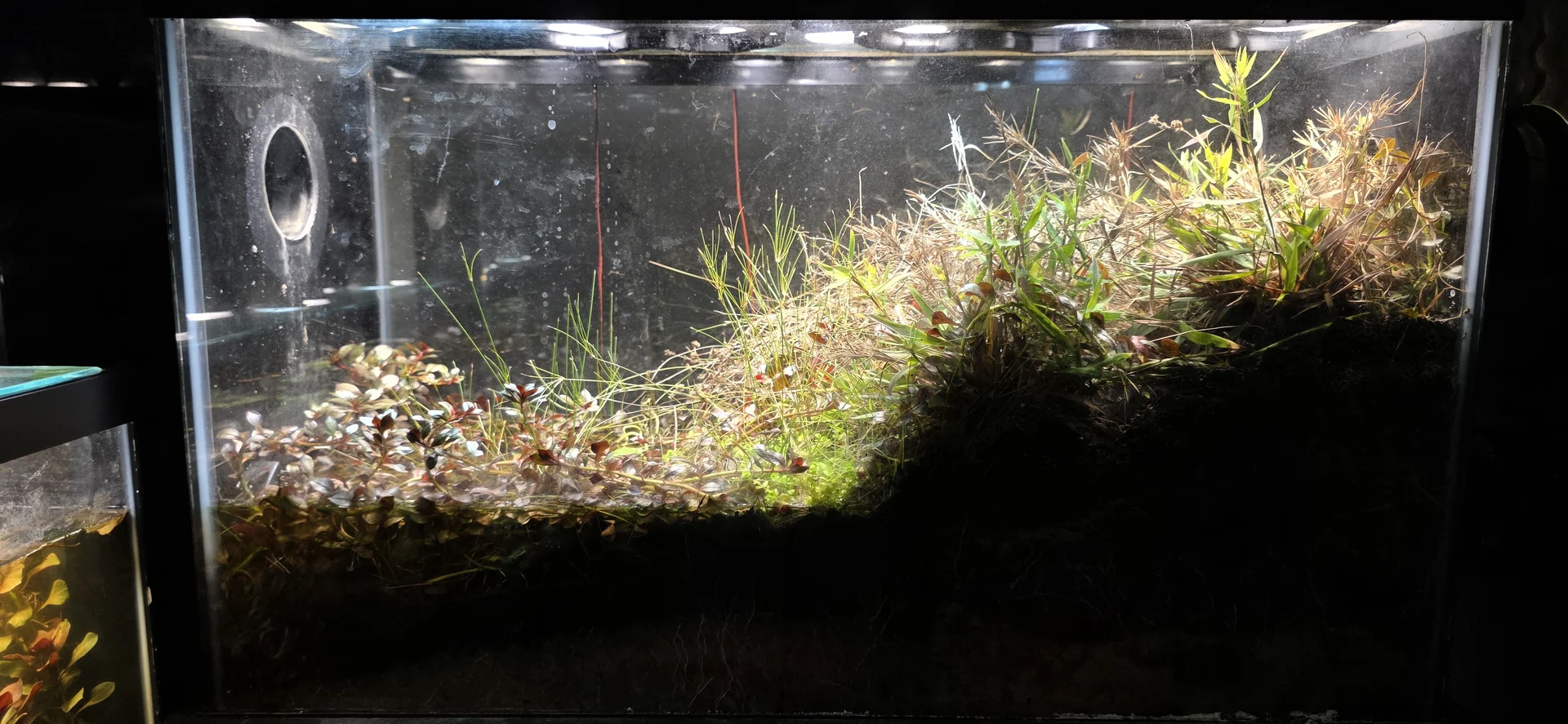
Collected from a shaded, moist hiking trail at UCF in August 2023 and introduced to the Lakeshore to match the conditions where it grew naturally, with seeds seeded along both the waterline and dry margin in April 2025; whether a sustained population has established in the system is unknown.
Visual Data Unavailable

Overview

A fine-bladed grass-like sedge collected from a shaded, moist hiking trail at UCF in August 2023 and introduced to the Lakeshore to match the habitat conditions where it was found growing naturally. Seeds were seeded into the Lakeshore in April 2025, targeting both the waterline and the terrestrial margin. Whether the plant has established a sustained population in the system is unknown.

Identity

  • Common name: Dwarf Hairgrass
  • Alternate names: dwarf hair grass, hair grass, DHG, mini hairgrass, micro sword (misidentified)
  • Scientific name: Eleocharis sp. (unidentified)
  • Identification confidence: Genus tentative. The common name "Dwarf Hairgrass" most commonly refers to Eleocharis parvula or Eleocharis acicularis in the aquarium trade and to various Eleocharis species in Florida wet habitats. the record lists scientific name as "Unknown species"; "Eleocharis sp." is proposed as the most consistent genus-level identification given the common name, habitat description (shaded, moist trail edge), and Florida context. Species-level identity has not been determined. "DHG" is the standard aquarium abbreviation.
  • Uncertainty label: Observed

Taxonomy

  • Kingdom: Plantae
  • Phylum: Angiospermae
  • Class: Monocotyledonae
  • Order: Poales
  • Family: Cyperaceae (sedge family)
  • Genus: Eleocharis (tentative)
  • Species: (unidentified)

Natural History

Eleocharis (spike-rush) is a large genus of sedge-family plants found in wet habitats throughout the world. In Florida, multiple Eleocharis species are common in pond margins, seasonal wetlands, drainage ditches, and moist trail edges, exactly the habitat described in the August 2023 UCF observation. The species most commonly called "Dwarf Hairgrass" in the aquarium trade are E. parvula (dwarf hairgrass) and E. acicularis (needle hairgrass), both of which are found in Florida and prefer moist to submerged conditions.

Growth Form

Eleocharis species produce fine, needle-like photosynthetic stems rather than true leaves; the stems are the primary photosynthetic surface. The plants form dense mats or tufts from a fibrous root system and spread horizontally via stolons, which allows them to carpet available substrate over time. In aquarium and riparian contexts, Dwarf Hairgrass forms a low green carpet in bright-to-moderate light with adequate substrate nutrients.

Habitat

Eleocharis species are amphibious: they grow in both fully submerged conditions and as emergent or terrestrial plants at the water margin. The 2025 seeding event planted seeds "both in the water and on land," reflecting this amphibious tolerance. The species collected at UCF was found growing specifically in shaded, moist conditions on a hiking trail, which is consistent with E. parvula or related species found in shaded riparian edges and moist depressions throughout Florida.

Shade Tolerance

The August 2023 observation specifically notes that the plant "only grew in shaded, moister conditions" in its natural location at UCF, and this habitat match was the stated reason for choosing the Lakeshore as its destination. Many Eleocharis species tolerate lower light than typical aquarium carpet plants, though they generally grow more sparsely and slowly under reduced light compared to high-intensity conditions.

Reproduction

Eleocharis species reproduce via stolons (vegetative spread) and seeds. Stolon-based spread is the primary propagation method in aquatic and riparian settings; seeds are produced in small spikelets at the stem tips. The April 2025 event added seeds to the Lakeshore, suggesting either that the original 2023 plant had produced seeds or that seeds were sourced separately.

Ecological Role

Dwarf Hairgrass functions as a low-growing marginal plant at the Lakeshore boundary. If established, it would form a fine-textured ground cover at the land-water interface, providing substrate stability, surface texture for invertebrate microhabitat, and low-profile photosynthetic production at the waterline and moist terrestrial margin.

In the aquarium hobby, Dwarf Hairgrass is valued as a carpet plant and shelter structure for small invertebrates and bottom-dwelling organisms. In the miniBIOTA Lakeshore context, established mats would provide similar microhabitat value at the shoreline margin, particularly for small invertebrates moving between the aquatic and terrestrial zones.

miniBIOTA Evidence

Introduction

Two separate introductions are documented:

1. Wild-collection, August 26, 2023: A plant collected from a shaded, moist section of a hiking trail at the University of Central Florida and transplanted directly to the Lakeshore. The observer explicitly matched the plant to the Lakeshore based on habitat similarity: "In its native location it only grew in shaded, moister conditions; matched to the shoreline for that reason."

2. Seeding, April 6, 2025: Dwarf Hairgrass seeds added to the Lakeshore biome, distributed both in the water and on the terrestrial margin of the shoreline. No documentation of the seed source.

Observation Timeline

  • August 26, 2023: Wild-collected Dwarf Hairgrass transplanted from a UCF hiking trail to the Lakeshore. Observer notes habitat match between native UCF growing conditions (shaded, moist) and the Lakeshore environment.
  • April 6, 2025: Seeds seeded into the Lakeshore, both in the water and on land. No subsequent observations document germination, establishment, or survival.

What Is Confirmed

  • One plant wild-collected at UCF and transplanted to the Lakeshore on August 26, 2023.
  • Seeds seeded into the Lakeshore on April 6, 2025, targeting the waterline and the terrestrial margin.

What Is Inferred

  • The plant was matched to the Lakeshore based on the observer's field observation of its native shade and moisture preferences.
  • The 2025 seeding may represent a second establishment attempt after the 2023 transplant's fate was uncertain, or a supplemental seeding to expand coverage.

What Remains Unknown

  • Whether the 2023 transplant survived and persisted.
  • Whether the 2025 seeds germinated.
  • Whether any Dwarf Hairgrass is currently present in the Lakeshore.
  • The exact species: E. parvula, E. acicularis, or another Eleocharis.