Lytechinus variegatus

Variegated Sea Urchin

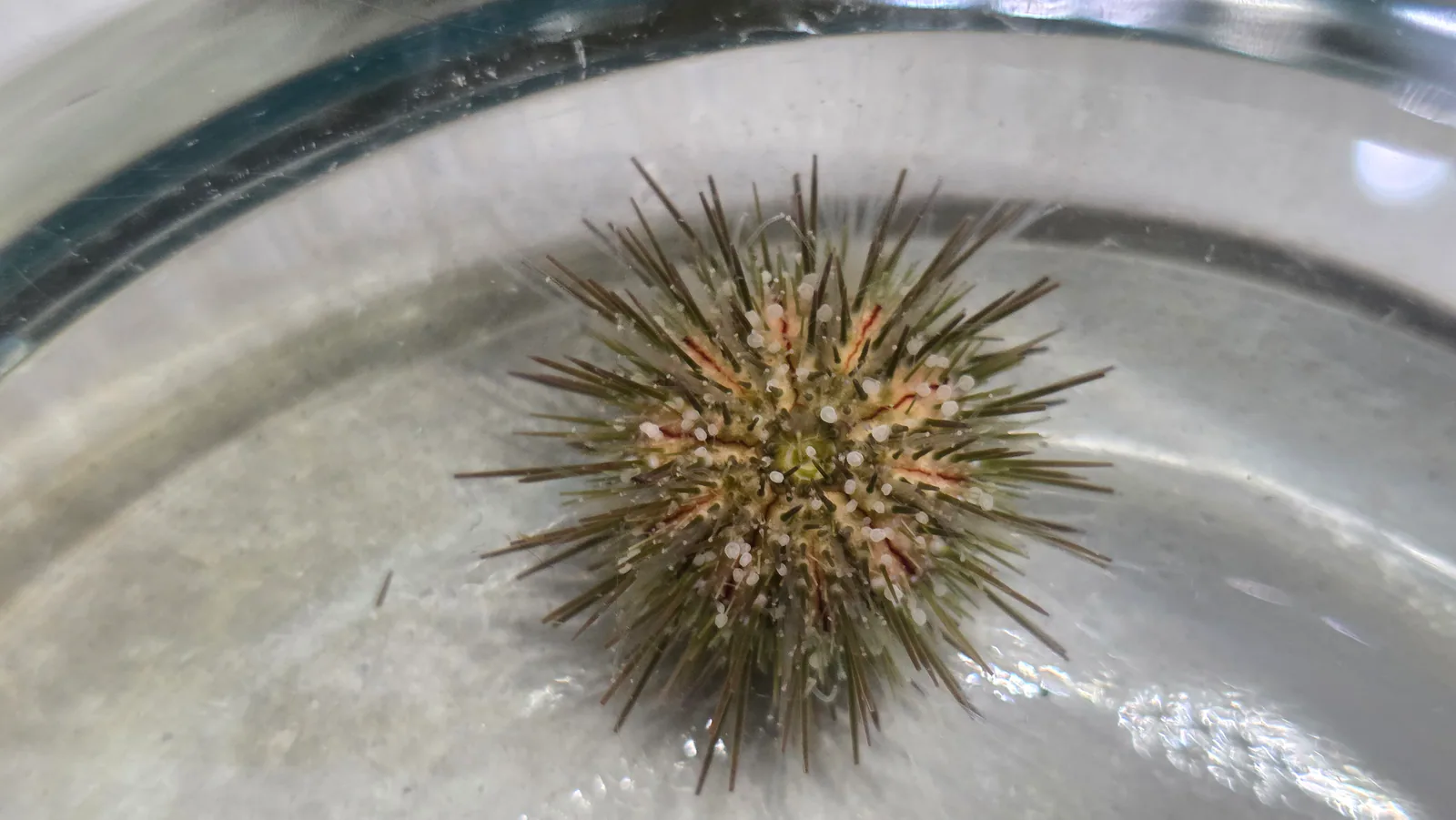
Found in shallow seagrass habitat across Florida, this spiny grazer rasps macroalgae and detritus from benthic surfaces using a five-part jaw, and was introduced to the Seagrass Meadow to reduce Graceful redweed that had been shading the shoal grass.

Overview

The Variegated Sea Urchin (Lytechinus variegatus) is a Florida-native spiny echinoderm introduced to the miniBIOTA Seagrass Meadow on April 26, 2026 as a deliberate macroalgae-grazing intervention. Two individuals were collected and acclimated; both appeared dead by April 28, 2026 following suspected low nighttime oxygen, but one was confirmed alive and actively feeding on Graceful redweed by April 29. By May 13 and again on May 21, the surviving urchin was repeatedly found at the Marine Shore shoreline, partially out of the water, despite being manually relocated back to the Seagrass Meadow. As of May 21, 2026, it was alive but its spine density appeared reduced, raising concern that it may not be thriving. On June 11, 2026, the urchin was observed almost completely out of the water, coinciding with a cloudy-water event after overnight extremely slow wave motion; whether this represents a continuation of the same behavioral pattern or an acute stress response to water conditions is unresolved. Population status is Vulnerable.

Identity

  • Common name: Variegated Sea Urchin
  • Alternate names: green sea urchin, variegated urchin, pincushion urchin, sea egg, sea urchin, Lytechinus, Lytechinus variegatus
  • Scientific name: Lytechinus variegatus
  • Identification confidence: Confirmed
  • Uncertainty label: Confirmed, vulnerable

Taxonomy

  • Kingdom: Animalia
  • Phylum: Echinodermata
  • Class: Echinoidea
  • Order: Camarodonta
  • Family: Toxopneustidae
  • Genus: Lytechinus
  • Species: variegatus

Natural History

Range and Florida Relevance

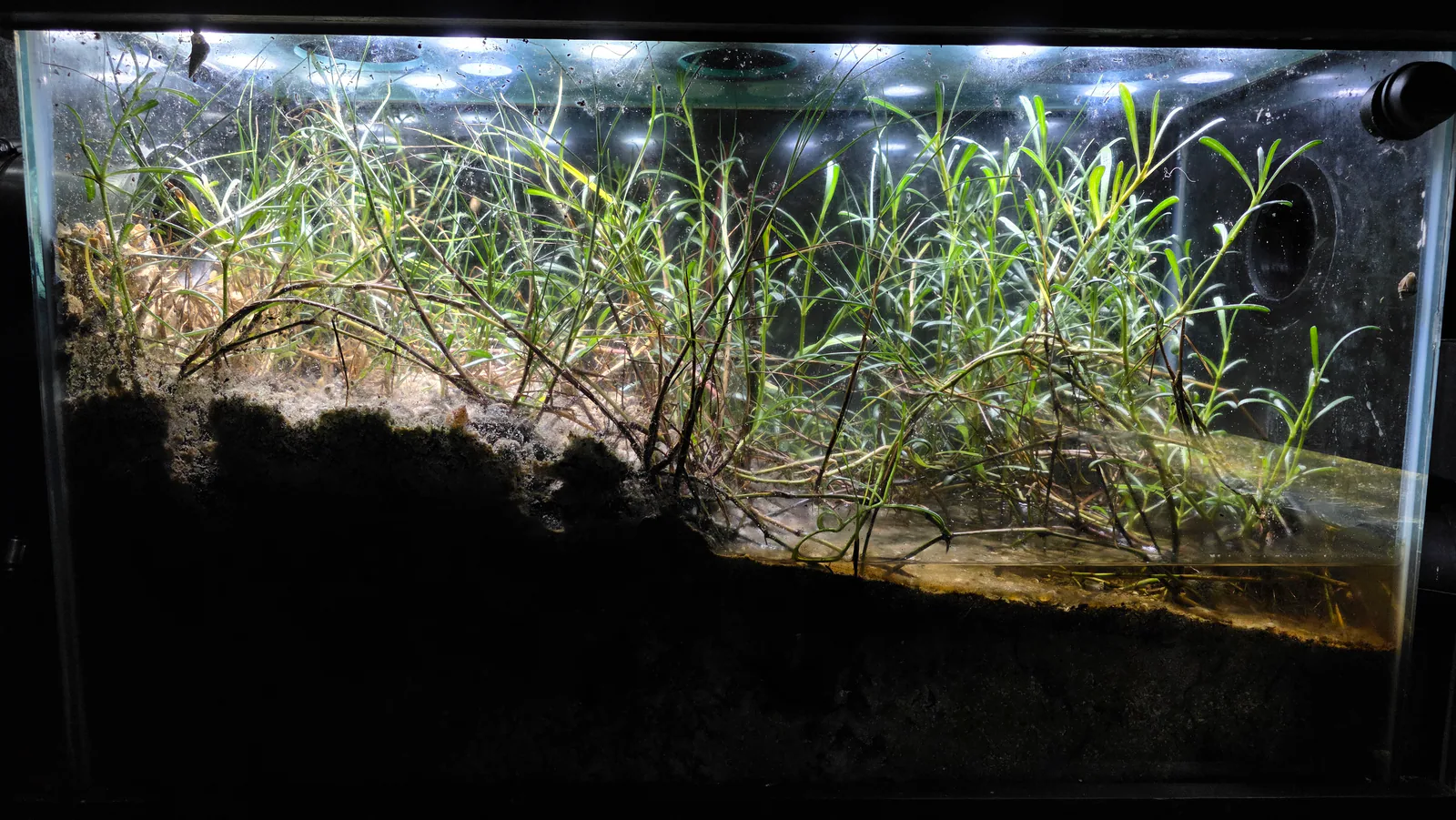
Lytechinus variegatus is native to shallow marine waters from North Carolina south through Florida, the Gulf of Mexico, the Caribbean, and along the Atlantic coast of South America to Brazil. It is one of the most common sea urchins in Florida's seagrass beds, particularly in shallow clear-water habitats with Turtle Grass, Manatee Grass, Shoal Grass, and associated macroalgae. The miniBIOTA Seagrass Meadow, which supports Shoal Grass and has experienced Graceful redweed overgrowth, is consistent with the shallow vegetated marine habitat this species occupies in the wild.

Habitat

Lytechinus variegatus lives on soft benthic substrate, seagrass blades, and macroalgae in shallow coastal marine environments, typically in water from less than one meter to around eight meters deep. It uses tube feet tipped with suction discs for locomotion and substrate attachment. It can move across seagrass beds, open sandy patches, and rocky or structured substrate. In miniBIOTA, the intended habitat is the Seagrass Meadow, but the surviving individual has repeatedly moved toward the Marine Shore shoreline interface.

Diet

Lytechinus variegatus feeds using Aristotle's lantern, a five-part jaw structure found in sea urchins that is capable of rasping plant tissue, algae, and organic material from hard and soft surfaces. Its diet includes macroalgae of multiple types, seagrass blades (especially older or decaying tissue), epiphytes growing on seagrass, benthic detritus, and organic films on substrate. It is not a specialist and will graze whatever macroflora and benthic organic material is available. In miniBIOTA, the confirmed food source is Graceful redweed, which the surviving urchin was observed feeding on actively from April 29 through at least May 2, 2026.

Reproduction

Lytechinus variegatus has separate sexes; individuals are either male or female and cannot be distinguished by external appearance. Spawning involves broadcast release of eggs and sperm into the water column. The resulting larvae (pluteus larvae) are planktonic for several weeks before settling to the benthos as juveniles. In miniBIOTA, with only one individual confirmed in the system, reproduction is not possible regardless of the individual's sex.

Tolerance Ranges

Lytechinus variegatus requires marine salinity and is sensitive to dissolved oxygen. The initial near-death of both miniBIOTA individuals on April 27 to April 28, 2026 is most consistent with low nighttime dissolved oxygen as the stressor; salinity was confirmed correct at introduction. Published culture references cite an optimal temperature range of roughly 22 to 28 degrees C, with broader experimental exposure tolerated down to approximately 16 degrees C. The urchin's repeated positioning at the Marine Shore shoreline, sometimes partially out of the water, is a behavioral concern not yet explained; causes could include environmental conditions (oxygen, flow, temperature, light), food searching, or stress responses.

Ecological Role

Lytechinus variegatus is a macroalgae grazer and benthic detritus processor. In seagrass ecosystems, urchins like Lytechinus variegatus can prevent macroalgae from overgrowing and shading seagrass by actively consuming algal tissue, and they process detritus from aging seagrass blades, returning organic matter to the food web. At high densities, urchins can overgraze and create barren areas; at low density in a macroalgae-dominated system, a single urchin acts as a targeted grazer rather than a wholesale habitat driver.

In miniBIOTA, the surviving urchin was confirmed grazing Graceful redweed, the macroalgae that had been shading Shoal Grass in the Seagrass Meadow. The May 2, 2026 observation documented the urchin remaining on Graceful redweed throughout the day and actively feeding, which is the clearest evidence of the intended ecological function being realized. Whether this grazing had any measurable effect on redweed abundance or distribution in the Seagrass Meadow is unresolved.

After May 2, the urchin's behavior shifted toward the Marine Shore shoreline, which complicates its role as a Seagrass Meadow macroalgae grazer. As of May 21, 2026, the urchin's spine condition was concerning. Whether the individual will stabilize, continue grazing, or decline further remains unresolved.

No symbiotic relationships have been documented in miniBIOTA. No predation of the urchin has been observed.

miniBIOTA Evidence

Introduction Context

Two small Variegated Sea Urchins were field-collected in Florida and drip-acclimated on April 26, 2026, using water from the Seagrass Meadow. They were introduced the same evening specifically to address persistent macroalgae dominance in the Seagrass Meadow, with the dual role of grazing macroalgae and processing Shoal Grass detritus identified as the rationale for selecting this species. The introduction was documented on video. The event was featured publicly in a short video published May 4, 2026.

Observation Timeline

  • April 26, 2026: Two small Variegated Sea Urchins collected and placed in drip acclimation with Seagrass Meadow water. Not yet in the system at time of observation. Video evidence of acclimation.
  • April 27, 2026: Both urchins found in a highly lethargic state, appearing close to death. One with slight tube foot movement; the other mostly unresponsive with tube feet retracted. Low dissolved oxygen overnight is suspected. Observer repositioned both higher in water column on Shoal Grass and added aeration. No media.
  • April 28, 2026: Both urchins appeared dead or near death, less than two days after introduction. At the time, both were believed to have died. Suspected causes: low dissolved oxygen or water parameter mismatch beyond salinity; salinity had been confirmed correct. This assessment was later corrected. No media.
  • April 29, 2026: One urchin confirmed alive and active in the Seagrass Meadow, correcting the April 28 mortality assessment. Early observations confirm it feeds on Graceful redweed. No media.
  • May 2, 2026: Surviving urchin remained on Graceful redweed throughout the day and was actively feeding. This is the strongest direct evidence of the intended grazing role being realized. Video evidence.
  • May 13, 2026: Urchin repeatedly migrating from the Seagrass Meadow to the Marine Shore shoreline interface. After being manually relocated to the far end of the Seagrass Meadow, it navigated back across the system and positioned itself near the shoreline, sometimes partially above the water surface. Reason unclear; observer decided to observe without further intervention. No media.
  • May 21, 2026: Urchin again in the Marine Shore zone, still alive and capable of movement, but spine density appeared reduced and less dense compared to introduction. Observer noted concern that the animal may not be thriving. Continued return to shoreline described as indicating a strong preference or behavioral drive toward that environment. Video footage of urchin at shoreline, partially out of water, slowly moving.
  • June 10, 2026: Recorded as date_last_observed in the Supabase species row; specific archived observation note not found. This date corresponds to when the observation archive files were last updated and may reflect an administrative processing date rather than a confirmed sighting. The most recent direct observation note prior to June 11 is May 21, 2026.
  • June 11, 2026: Variegated Sea Urchin observed almost completely out of the water, coinciding with noticeably cloudy Seagrass Meadow water after the Wave and Tide System had been running at an extremely slow setting overnight. Wave and tide motion was restored to a more appropriate level. Whether the urchin returned to a more submerged position is a watch item. Reduced circulation, bacterial bloom, and lowered dissolved oxygen are possible contributing factors; none were confirmed. No media.

What Is Confirmed

  • Two Lytechinus variegatus were introduced to the miniBIOTA Seagrass Meadow on April 26, 2026.
  • Both showed acute stress within 24 to 48 hours of introduction; low dissolved oxygen overnight is the most likely cause.
  • One individual was confirmed alive and active by April 29, 2026, correcting an initial assessment that both had died.
  • The surviving urchin was confirmed feeding on Graceful redweed on April 29 and actively grazing on May 2, 2026. Video evidence exists from May 2.
  • The surviving urchin repeatedly moved from the Seagrass Meadow to the Marine Shore shoreline, returning each time after manual relocation; documented on May 13 and May 21, 2026.
  • As of May 21, 2026, the urchin was alive and moving, but spine density appeared reduced.
  • The surviving urchin was observed almost completely out of the water on June 11, 2026, coinciding with a cloudy-water event after the Wave and Tide System had run overnight at an extremely slow setting.
  • The fate of the second urchin is not explicitly documented in a dedicated observation; it did not appear as a survivor in any observation after April 28.

What Is Inferred

  • Low dissolved oxygen overnight on April 27 is the most likely proximate cause of the initial stress event; salinity was confirmed correct and this is the only stressor identified in the observation notes.
  • The second urchin most likely died during or shortly after the April 27 to April 28 stress event.
  • The surviving urchin's repeated return to the Marine Shore shoreline despite manual relocation reflects a consistent behavioral preference, but its cause is unresolved.
  • Reduced spine density on May 21 may indicate a chronic stress response, nutritional deficit, or progressive decline; the cause and trajectory are unresolved.

What Remains Unknown

  • Whether the surviving urchin is in stable or improving condition after June 11, 2026. It was confirmed alive but observed almost completely out of the water on June 11 during a cloudy-water event; no subsequent sighting is on record.
  • Whether spine condition has stabilized, improved, or worsened after May 21.
  • What is driving the repeated movement toward the Marine Shore shoreline.
  • Whether the urchin's Graceful redweed grazing had any measurable effect on redweed abundance or distribution.
  • What killed the second urchin and whether that risk factor remains present.