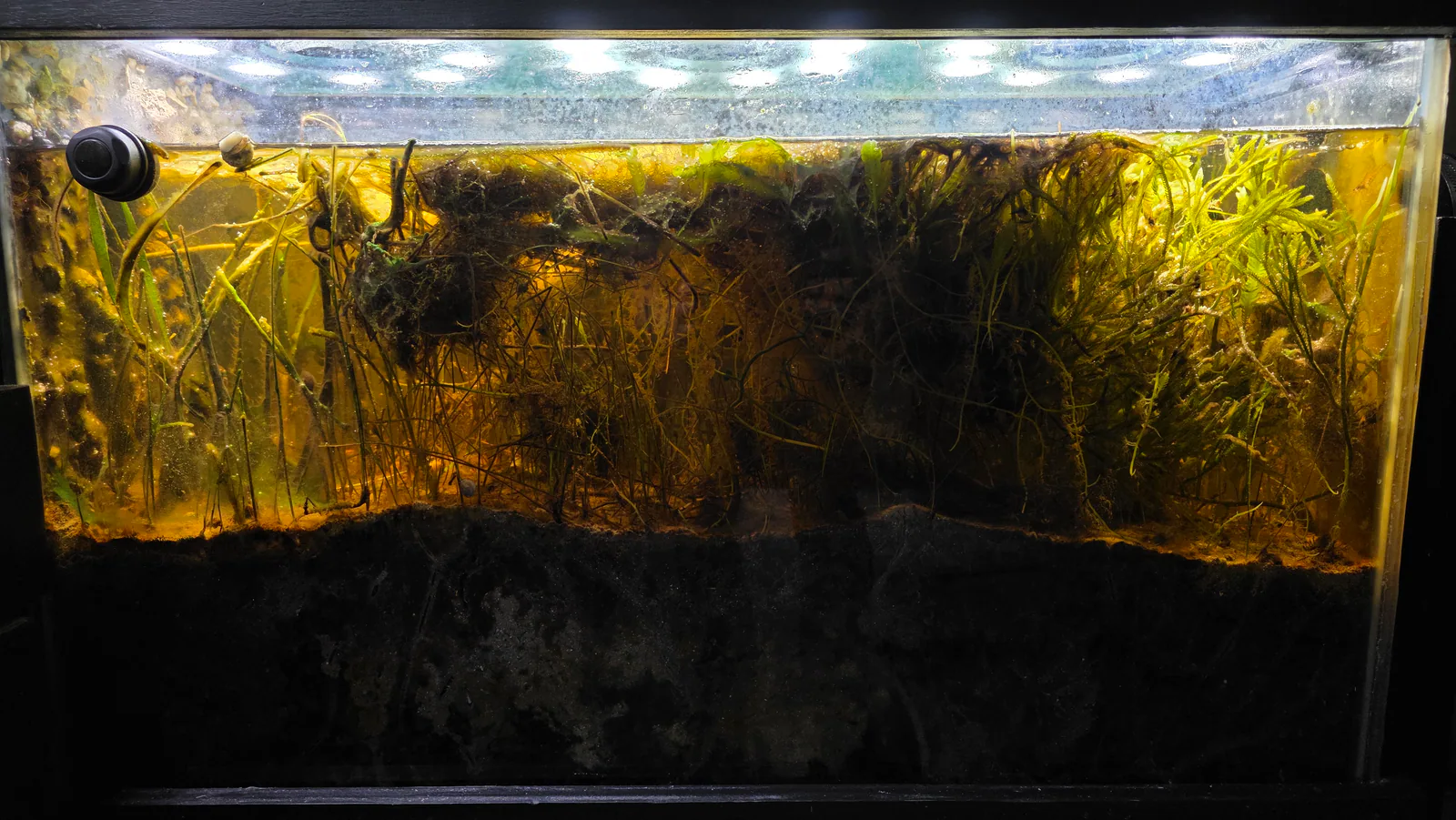
Gracilaria tikvahiae
Graceful redweed
A branching red macroalga that spread through the Seagrass Meadow light layer and became the main food target for the resident Variegated Sea Urchin, which was observed grazing on it actively through May 2026.
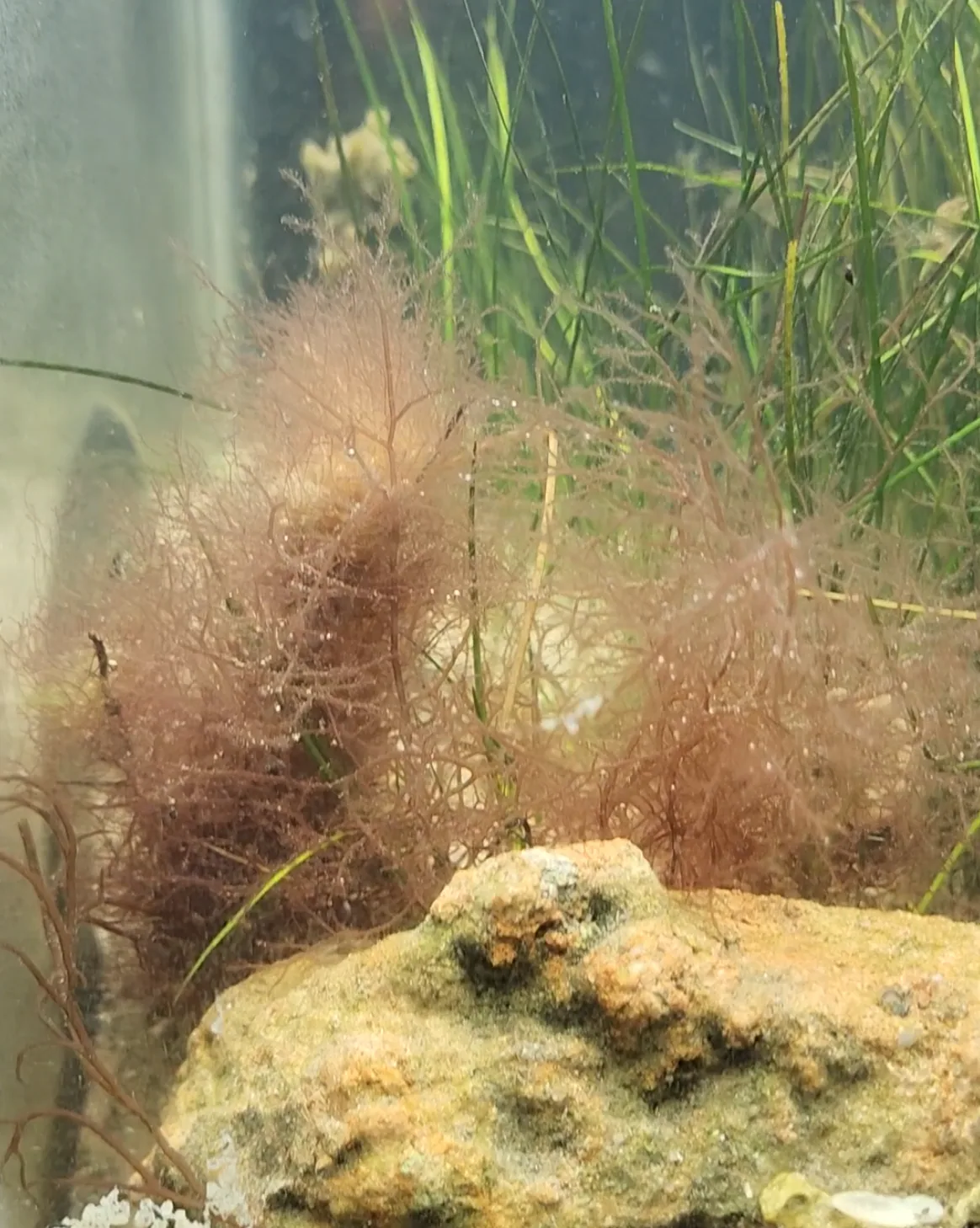
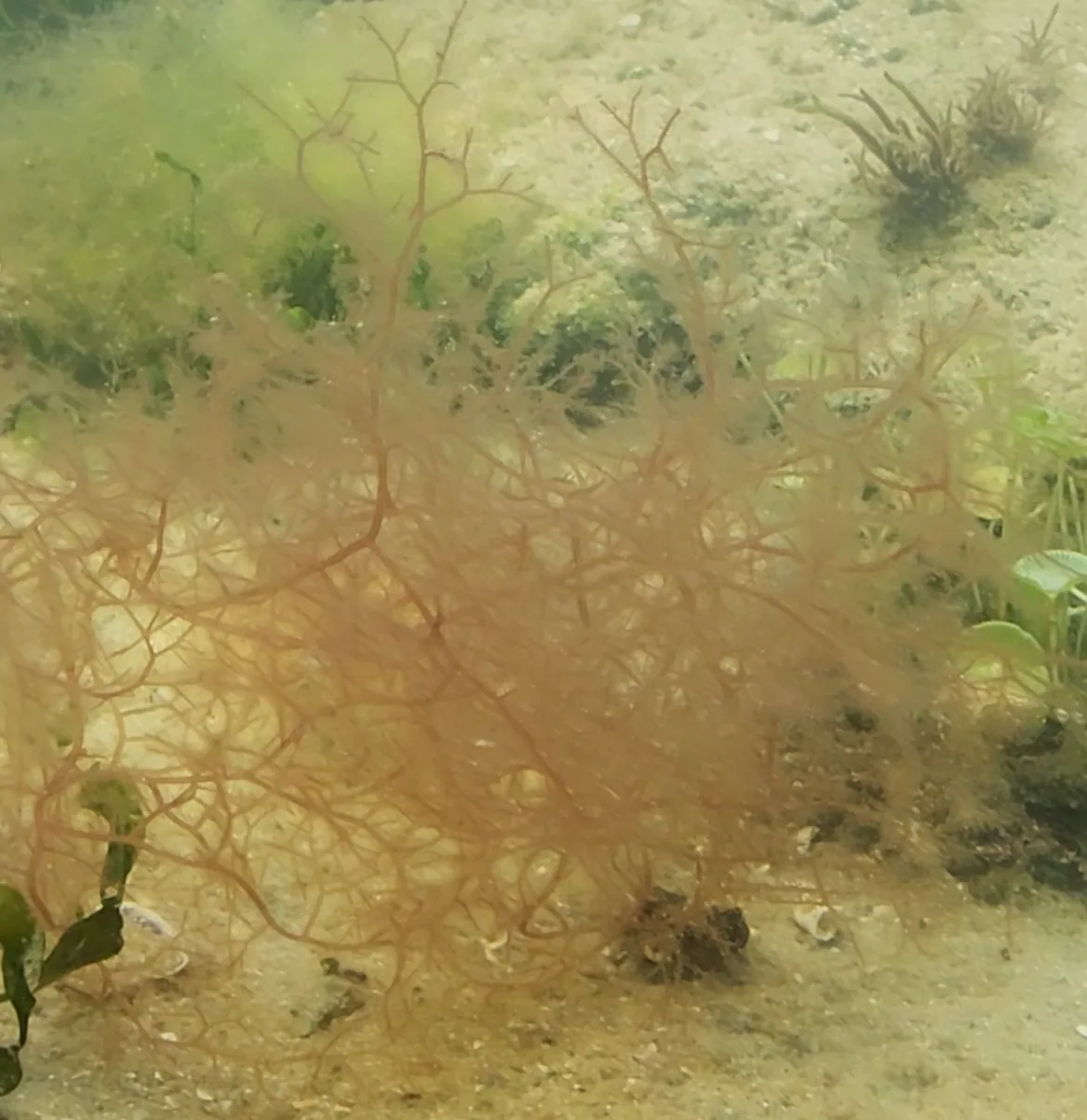

Gracilaria tikvahiae
A branching red macroalga that spread through the Seagrass Meadow light layer and became the main food target for the resident Variegated Sea Urchin, which was observed grazing on it actively through May 2026.
Graceful Redweed (Gracilaria tikvahiae) is a branching red macroalga established in the miniBIOTA Seagrass Meadow. It arrived on November 11, 2024 as a hitchhiker or sourced introduction and expanded rapidly into the upper light layer of the biome, competing with Shoal Grass for light and nutrients. Through mid-2026 it went into steep decline: grazed by the Variegated Sea Urchin from April 2026, fragmented by crabs and hermit crabs from June 2026, largely died away by June 30, 2026, and its remaining floating mat collapsed onto the substrate on July 10, 2026 as dead and decomposing tissue. The record carried an open question about whether the species had been extirpated. It had not. By July 29, 2026 Graceful Redweed was regrowing, confined to the very top of the water column running from the centre of the biome outward. Population status is Established. The same observation documented a previously unrecorded daily vertical cycle in the mat, driven by photosynthetic oxygen buoyancy during the photoperiod and pushed down overnight by hermit crab weight and wave action.
Gracilaria tikvahiae is distributed from the western Atlantic coast of North America through the Caribbean and into South America. It is common in Florida's shallow coastal and estuarine environments, including seagrass beds, oyster reefs, and sheltered bays. It is one of the most studied macroalgae in North American coastal systems, widely used in aquaculture as a food source for urchins, abalone, and other grazers. Its presence in miniBIOTA is consistent with natural Florida coastal dispersal and its tendency to arrive as a fragment on shells, live rock, or other introductions.
Gracilaria tikvahiae grows as a branching, cylindrical-stemmed thallus that can be anchored to hard substrate or shell fragments via a small holdfast, or free-floating as a buoyant mat. It typically colonizes shallow, high-light zones first and can extend into deeper benthic positions when light allows. In miniBIOTA, it was observed in both a lower benthic cluster (at the back corner of the Seagrass Meadow substrate) and as an upper mat near the water surface on the same side of the biome.
The free-floating mat form is not static in the water column. Documented July 29, 2026 with video, the miniBIOTA mat runs a daily vertical cycle. It rises to the top of the water column by end of day. Overnight it is pushed down to the middle of the column or near the floor and held there by two forces: the weight of hermit crabs crowding onto it, and wave action. It returns to the surface as photosynthetic oxygen bubbles accumulate underneath and within the tissue, with lift occurring after the lights come on.
The cycle is therefore coupled to the lighting photoperiod, which places a hardware-controlled parameter in direct control of where this producer sits in the light layer. The same footage showed abundant bubbles trapped in the adjacent Caulerpa mass as well, making the phenomenon a visible daytime proxy for photosynthetic output in a biome that has no dissolved oxygen instrumentation.
Gracilaria tikvahiae uses red phycoerythrin pigments to absorb light wavelengths that penetrate deeper water, allowing it to photosynthesize in conditions where green algae are less competitive. It directly absorbs dissolved nitrates, phosphates, and ammonium from the water column, making it a fast-growing opportunist in nutrient-enriched systems. Growth rates can reach biomass doubling within five to seven days under optimal light, flow, and nutrient conditions.
Gracilaria tikvahiae has a complex triphasic life history alternating between free-living gametophytes, microscopic carposporophytes, and free-living tetrasporophytes. In captive systems, reproduction is primarily vegetative: water movement fragments branches, and detached pieces anchor to shell fragments or substrate and regenerate into independent plants. In miniBIOTA, vegetative fragmentation is the documented mode of reproduction, and the population is classified as Confirmed Breeding.
Gracilaria tikvahiae is eurythermal and euryhaline, tolerant of subtropical to warm-temperate temperatures (approximately 12 to 31 degrees Celsius) and a range of salinities. It is highly tolerant of varying nutrient loads and can persist across typical marine pH (7.8 to 8.4). It is sensitive to prolonged darkness or severe shading, which causes tissue bleaching, fragmentation, and rapid cellular decay. It requires moderate to high light and constant water movement to sustain rapid growth.
Graceful Redweed is a fast-growing photosynthetic producer in the Seagrass Meadow that competes directly with Shoal Grass for light and dissolved nutrients in the upper water column. When well-established, it absorbs excess nitrate and phosphate from the water, potentially reducing the nutrients available to support further algal blooms. Its dense branching structure also provides shelter for amphipods, copepods, and marine scuds that use it to escape visual predators.
The competing risk in miniBIOTA is that Graceful Redweed can shade Shoal Grass and other producers if its growth goes unchecked, shifting the biome away from seagrass-dominated structure toward macroalgal dominance. The Variegated Sea Urchin was introduced partly to address this dynamic, and direct grazing was confirmed in late April and early May 2026. Whether the grazing was sufficient to substantially reduce or control the redweed, or whether the lower cluster's disappearance was due primarily to shading, decomposition, or a combination of factors, has not been resolved.
The mat also serves as physical habitat independent of its value as food. Hermit crabs crowd onto it in sufficient numbers to push it down through the water column overnight, and a Mottled Shore Crab was filmed on top of it foraging small epiphytic algae from its surface (July 29, 2026, video). Neither was consuming redweed tissue.
That distinction matters for how this species' grazing pressure is recorded. Living Graceful Redweed has one confirmed consumer in miniBIOTA, the Variegated Sea Urchin. The June 14 and July 10, 2026 records describing crabs and hermit crabs consuming and fragmenting redweed material refer to the die-back period, when the available material was dead or decomposing tissue. Direct observation on July 29, 2026 shows the crab community using the living mat as substrate rather than as forage.
Graceful Redweed arrived in the Seagrass Meadow on November 11, 2024, either as a hitchhiker on another introduction or as a sourced specimen from a shallow warm-temperate Florida estuary. No specific collection site or vendor has been recorded. The species established without deliberate management intent and expanded into the macroalgal pressure context that developed in the Seagrass Meadow through 2025 and 2026.
Graceful Redweed expanded into the Seagrass Meadow's upper light layer, becoming a prominent producer. The surviving Variegated Sea Urchin (Lytechinus variegatus) was confirmed actively grazing on it in late April and early May 2026. By May 3, 2026, the original lower benthic cluster had disappeared under shading and grazing pressure. On June 14, 2026, remaining redweed was actively consumed and fragmented by crabs and hermit crabs introduced June 12. By June 30, 2026, the species had largely died away; its remaining structural remnants served as a temporary framework for the rapidly expanding Fern Alga (Caulerpa taxifolia). By July 10, 2026, the remaining floating mat thinned dramatically and collapsed onto the substrate, with hermit crabs and shrimp feeding throughout the decomposing material; accelerated Caulerpa growth documented the same day is a plausible contributing factor. On July 29, 2026 the species was observed regrowing, confined to the very top surface of the water column from the centre outward, confirming that viable thallus persisted through the collapse and resolving the open question of whether the species had been extirpated. Status moved from Uncertain to Established. The same observation documented a daily vertical cycle in the mat: surface by end of day, pushed to mid-column or near the floor overnight by hermit crab weight and wave action, lifted again by photosynthetic oxygen bubble accumulation after lights on.
Rapidly absorbs dissolved nitrates, phosphates, and ammonium directly from the water column, using red pigments (phycoerythrin) to capture light energy for photosynthesis. It provides a highly nutritious, calcium-rich food source for grazing invertebrates, particularly the Variegated Sea Urchin.
Extremely tolerant of varying salinities (euryhaline) and high nutrient loading. It is highly sensitive to prolonged darkness or severe shading, which causes tissue bleaching, fragmentation, and rapid cellular decay.
Undergoes a complex three-phase life history alternating between haploid gametophytes and diploid tetrasporophytes, mediated by a microscopic female-associated carposporophyte phase. In the closed biosphere, reproduction occurs primarily through vegetative cloning, where water movement fragments the branches, and the detached pieces anchor to sandy shell fragments to establish new clones.
Serves as a vital nutrient bioremediator in the Seagrass Meadow, absorbing excess nitrate and phosphate to prevent water-column eutrophication and micro-algae blooms. Its dense branching structures act as essential shelter for benthic invertebrates, while offering a major food-web link as highly digestible forage for large grazers.
Follow this species across the habitats where it currently appears in the miniBIOTA biosphere.