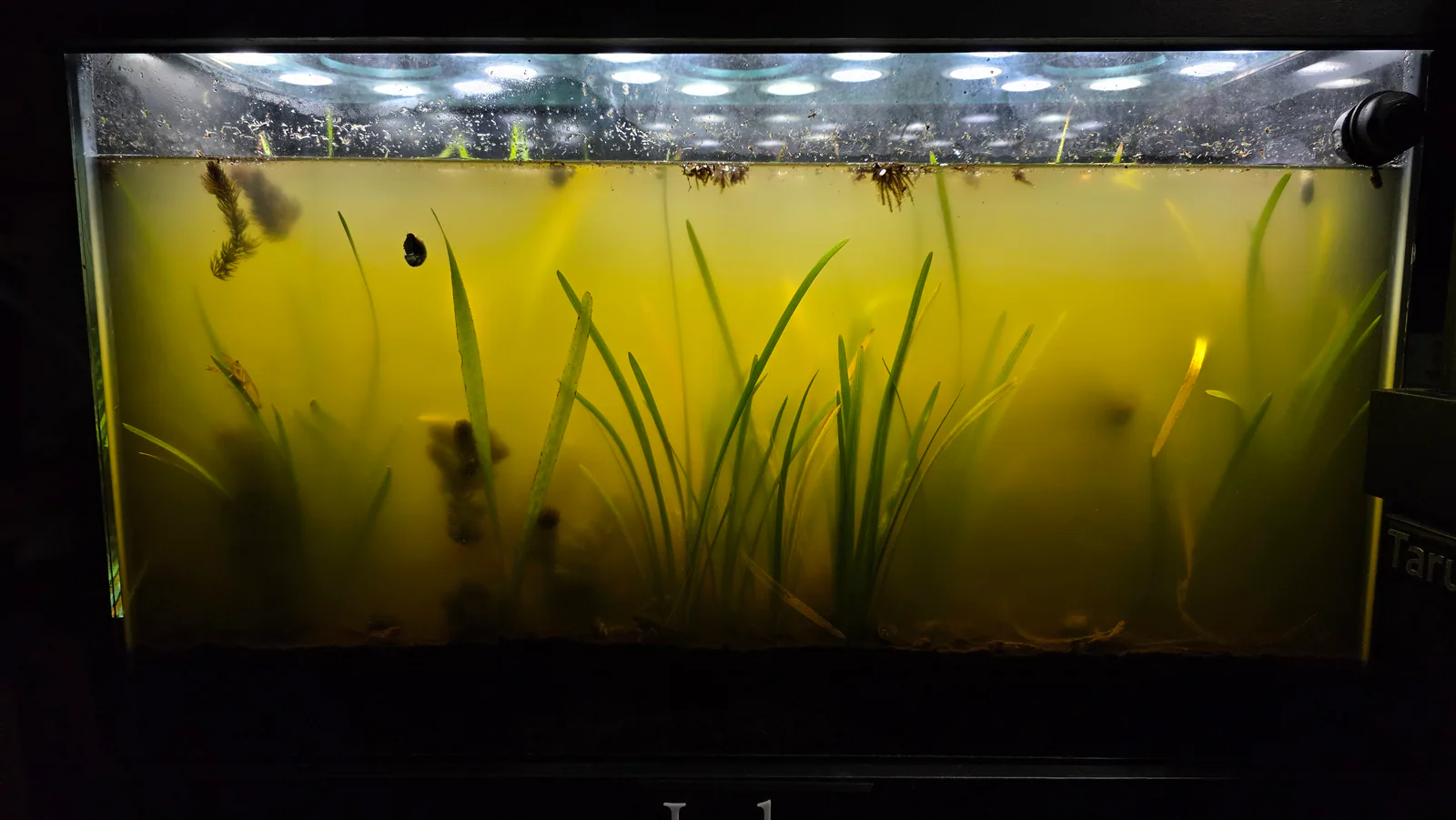
Sagittaria kurziana

Strap-leaf Sagittaria

Introduced to the Freshwater Lake in January 2026 in rough condition, this native Florida aquatic plant survived immediate crayfish grazing as tapegrass diverted predation pressure, then spread across the lake before Slough Crayfish excavated the roots system-wide in April 2026; it has since continued an ongoing growth-and-dieback cycle whose dead leaves are a recurring food source for snails and other lake invertebrates.

Realm
Freshwater Species
Population
Uncertain miniBIOTA population category
Introduced
January 2026 First introduction record
Primary Biome
Freshwater Lake 1 habitat

Role & Shared Habitat

Documented role fields and shared-biome neighbors are shown as explicit record links, not inferred species interactions.

Focal species

Strap-leaf Sagittaria

Substrate-rooted aquatic macrophyte in the Freshwater Lake; live prey for Slough Crayfish; structural contributor to the open-water-column plant community; detrital donor following root excavation

Documented role

Trophic level
Producer
Feeding method
Photosynthetic primary producer; substrate-rooted aquatic macrophyte drawing nutrients from below-surface sediment rather than from the water column.
Ecological role
Substrate-rooted aquatic macrophyte in the Freshwater Lake; live prey for Slough Crayfish; structural contributor to the open-water-column plant community; detrital donor following root excavation

Linked biomes

Shared-habitat inhabitants

Overview

Introduced to the Freshwater Lake in January 2026, this native Florida aquatic plant was nearly eliminated on its first day by Slough Crayfish but survived longer than expected after tapegrass diverted grazing pressure, allowing it to establish and reshape the lake's plant structure. By April 2026, Slough Crayfish had excavated the root systems throughout the entire lake bed, consuming the plants from below and initiating a detrital cascade that fed snails and other detritivores. The plant's survival past that root-excavation event was unresolved for nearly four months; an August 12, 2026 observation confirmed it not only survived but continues an active growth-and-dieback cycle, with dead, decomposing leaves now documented as a substantial, recurring food source for Seminole Ramshorn Snails.

Identity

  • Common name: Strap-leaf Sagittaria
  • Alternate names: spring tape, Florida sagittaria, strap-leaved sagittaria, Florida strap-leaf sagittaria
  • Scientific name: Sagittaria kurziana
  • Identification confidence: Species level. Sagittaria kurziana (spring tape, Florida sagittaria) is a species-level identification consistent with the common name "Strap-leaf Sagittaria" and the freshwater aquatic habitat. It is a native Florida species known from spring-fed rivers and clear freshwater systems.
  • Uncertainty label: Observed

Taxonomy

  • Kingdom: Plantae
  • Phylum: Angiospermae
  • Class: Monocotyledonae
  • Order: Alismatales
  • Family: Alismataceae
  • Genus: Sagittaria
  • Species: S. kurziana

Natural History

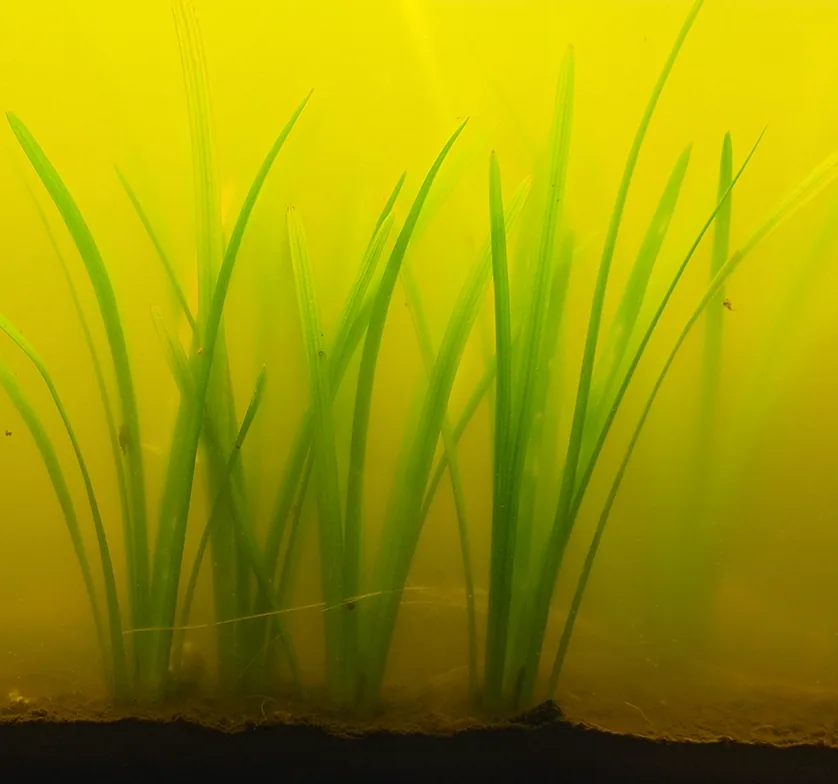
Sagittaria kurziana (spring tape, Florida sagittaria) is a native Florida aquatic macrophyte found in springs, spring runs, and spring-fed rivers throughout the Florida peninsula. It is one of several fully submerged Sagittaria species and produces long, ribbon-like strap-shaped leaves from a basal rosette anchored in the substrate. Unlike emergent Sagittaria species such as S. lancifolia, which produce the classic arrowhead-shaped leaves above the waterline, S. kurziana remains submerged and does not produce emergent leaf forms under typical conditions.

Habitat and Distribution

In its native range, S. kurziana grows in clear, spring-fed freshwater with moderate to high flow, typically in relatively cool and nutrient-poor water. It is a characteristic species of Florida spring systems such as those in the Suwannee River basin and the spring-fed rivers of north-central Florida. The species is less commonly found in warm, still, or nutrient-rich water bodies, which describes conditions closer to the miniBIOTA Freshwater Lake environment.

Growth Form and Substrate Rooting

S. kurziana is a substrate-rooted macrophyte; it draws nutrients from below through its root system rather than extracting nutrients directly from the water column. This is ecologically significant: substrate-rooted aquatic plants leave the water column relatively open and nutrient-available, in contrast to water-column-rooted plants like Ludwigia (Creeping Primrose Willow, formerly dominant in the Freshwater Lake) which compete directly with the water column and suppress suspended algae by limiting nutrients and light. The April 8, 2026 observation documented exactly this transition: when sagittaria and tapegrass replaced Ludwigia as the dominant plant structure, the water column became more open, lighter, and nutrient-rich, promoting suspended algae growth.

Palatability and Herbivory

Sagittaria species are highly palatable to freshwater herbivores including crayfish, waterfowl, and aquatic rodents. The tender leaf tissue and accessible root crowns make them a preferred food source in systems with active herbivores. In miniBIOTA, the Slough Crayfish attacked the sagittaria immediately at introduction and returned to excavate the root systems system-wide by April 2026.

Ecological Role

Strap-leaf Sagittaria played three distinct ecological roles in the Freshwater Lake over its tenure:

1. Live herbivore prey (January 2026): Crayfish grazed the leaf tissue immediately after introduction and resumed grazing once the tapegrass buffer declined.

2. Structural plant community contributor (February to April 2026): After surviving the initial crayfish grazing phase, sagittaria (alongside tapegrass) replaced Ludwigia as the dominant plant structure in the Freshwater Lake. This shift fundamentally changed the lake's nutrient dynamics: substrate-rooted plants left the water column open to light and dissolved nutrients, creating conditions favorable to suspended algae growth. The sagittaria contributed to the visual and physical structure of the lake floor.

3. Root-to-leaf detrital donor (April 2026 onward, ongoing): As crayfish excavated the root systems throughout the lake, dying leaves became a detrital food source for Seminole Ramshorn Snails, crayfish, and other detritivores. The April 17, 2026 observation explicitly documented this transition from living plant biomass to decomposing organic matter entering the food web. An August 12, 2026 observation confirmed this is not a one-time event but an ongoing, recurring pathway: as individual leaves senesce, turn brown, and decompose, they become a substantial food source, with at least five Seminole Ramshorn Snails observed grouped on a single dead leaf and more feeding on other dead leaves elsewhere. The snails consume the softer fleshy tissue, leaving the tougher longitudinal fibers behind. Combined with the plant's continuing new-leaf growth, this functions as a "time-release" detrital food supply for the snail community.

miniBIOTA Evidence

Introduction

Deliberately introduced to the Freshwater Lake on January 26, 2026, alongside tapegrass (Tapegrass). The plants arrived in rough condition with broken leaves and holes, suggesting stress during transport. Source not documented in observation records.

Observation Timeline

  • January 26, 2026: Introduced to the Freshwater Lake alongside tapegrass. Arrived with broken leaves and holes. Slough Crayfish began consuming leaf tissue almost immediately. Observer expected the plant to be fully consumed within one week and unlikely to persist. Video: crayfish on sagittaria leaves, visibly taking bites from the grass blades.
  • February 15, 2026: Sagittaria still alive after approximately three weeks, producing a new leaf. This exceeded expectations given the immediate crayfish attack at introduction. The abundance of tapegrass is interpreted as having reduced grazing pressure on the sagittaria by providing an alternative food source, allowing it to establish and begin new growth. Video: short clip of strap-leaf sagittaria with newly emerging leaf.
  • April 8, 2026: Ecological assessment documents the Freshwater Lake as now dominated by strap-leaf sagittaria and tapegrass, both substrate-rooted. Contrasted with the prior Ludwigia-dominated structure: Ludwigia had extensive root structures in the water column that suppressed algae by competing for nutrients and limiting light; the current sagittaria and tapegrass structure leaves the water column open and light-accessible, resulting in a nutrient-rich, light-abundant water column favorable to suspended algae growth.
  • April 17, 2026: Sagittaria observed being consumed throughout the lake from the root structure upward. Crayfish digging beneath the substrate to access and feed on the roots, causing leaves to die. Dead leaves then decomposing and becoming food for Seminole Ramshorn Snails, crayfish, and other detritivores. Observer notes this as documentation of the crayfish role in accessing below-surface plant material and initiating the transition from living plant biomass to decomposing organic matter.
  • August 12, 2026: Sagittaria confirmed surviving well past the April 17, 2026 root-excavation event and continuing an active growth-and-dieback cycle. At least five Seminole Ramshorn Snails observed grouped and feeding on a single dead, browned, decomposing leaf, with more individuals feeding on other dead leaves elsewhere in the lake. Snails consume the softer fleshy tissue, leaving tougher longitudinal fibers behind. Interpreted as a recurring, "time-release" detrital food pathway: new leaves continually emerge while older leaves senesce and become available to detritivores. Observation record, August 12, 2026.

What Is Confirmed

  • Sagittaria kurziana introduced January 26, 2026, to the Freshwater Lake alongside tapegrass; plants arrived in poor condition.
  • Slough Crayfish immediately grazed leaf tissue at introduction; video documented.
  • The plant survived beyond the one-week expected window; new leaf growth observed February 15, 2026; video documented.
  • Tapegrass abundance is interpreted as the primary factor that reduced crayfish grazing pressure on sagittaria, enabling recovery.
  • By April 8, 2026, sagittaria and tapegrass together dominated the Freshwater Lake plant structure, replacing Ludwigia.
  • This substrate-rooted plant community opened the water column to light and dissolved nutrients relative to the prior Ludwigia structure.
  • By April 17, 2026, crayfish were excavating the root systems throughout the lake; dead leaves entering the detrital food web.
  • The plant survived the April 17, 2026 root-excavation event: as of August 12, 2026, it is confirmed present and actively cycling through growth and dieback.
  • Decomposing sagittaria leaves are a substantial, recurring food source for Seminole Ramshorn Snails, confirmed August 12, 2026.

What Is Inferred

  • The tapegrass-as-buffer hypothesis is interpreted, not directly measured; grazing pressure diversion from tapegrass to sagittaria is a plausible explanation for the survival outcome.
  • The suspended algae growth observed in April 2026 is connected to the shift from Ludwigia (water-column-rooted) to sagittaria and tapegrass (substrate-rooted), a structural change that reduced algal suppression.
  • The ongoing growth-dieback cycle functions as a "time-release" detrital food pathway for the snail community; whether it alone can sustain snail populations indefinitely is unresolved.

What Remains Unknown

  • The source supplier for the introduced plants.
  • Whether the plants had adapted to warm, nutrient-rich water conditions before introduction.
  • Whether the dead-leaf food pathway remains consistent over a longer observation window.
  • Whether this pathway alone can sustain the Seminole Ramshorn Snail population, or requires supplementary food sources.
  • Current population extent and distribution across the lake.