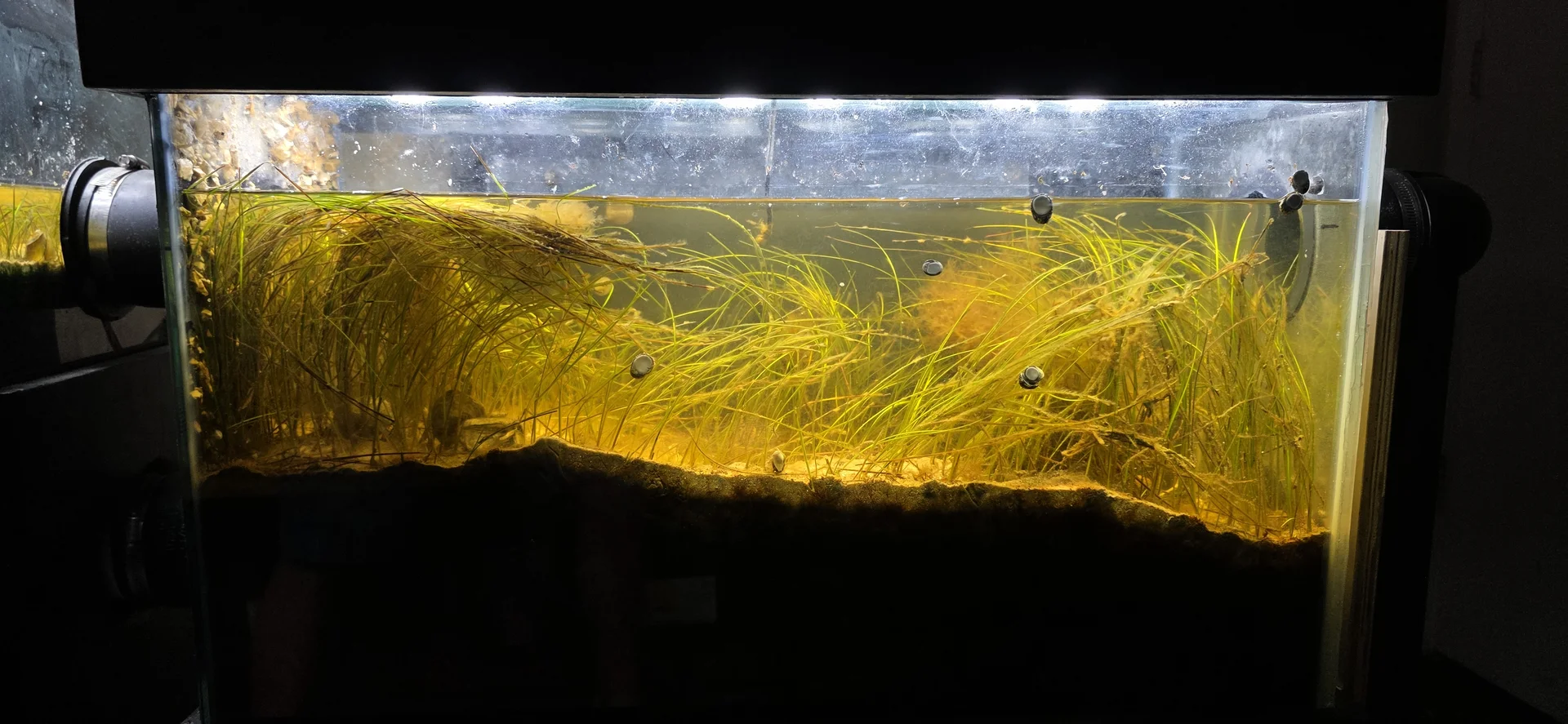
family Diadumenidae

Sea Anemone

Found attached to hard surfaces in the Seagrass Meadow, this small sessile predator extends rings of stinging tentacles to capture zooplankton and small crustaceans from the water column and reproduces by clonal fission to spread gradually across available substrate.
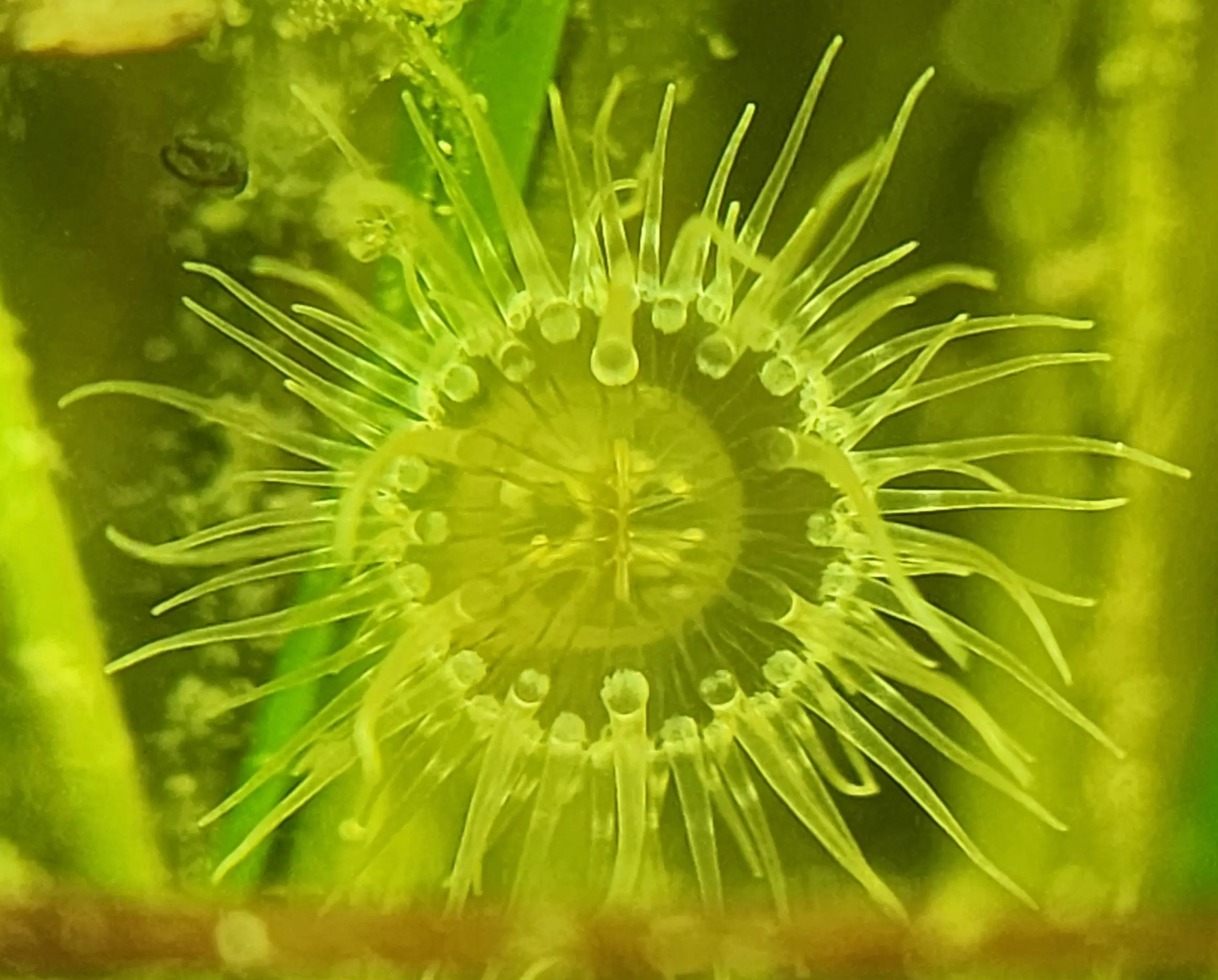
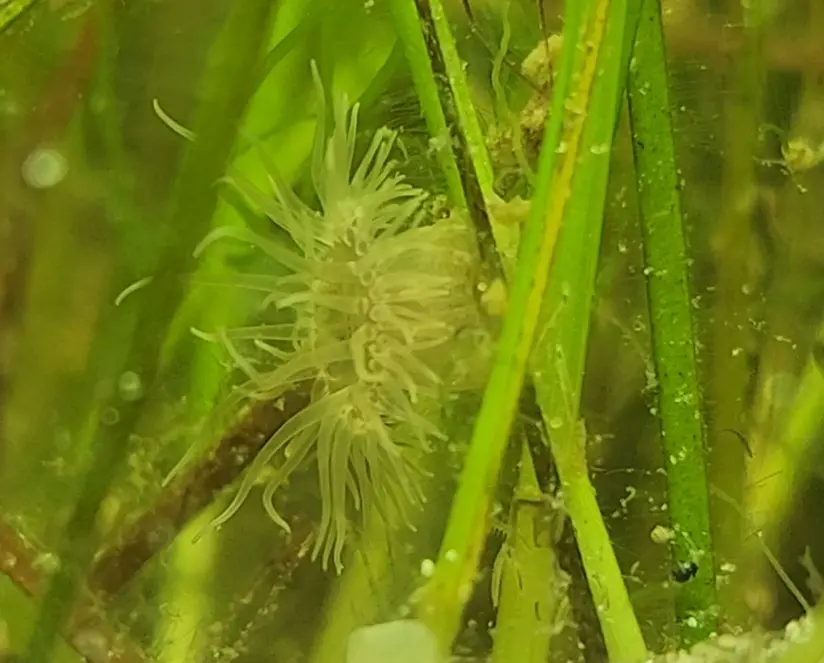
Overview

The Sea Anemone in miniBIOTA's Seagrass Meadow is a small sessile predator in family Diadumenidae, identified to family level only; exact genus and species remain unresolved. It arrived on November 11, 2024 as a hitchhiker on oysters and has since established a colony of approximately 15 individuals through clonal fission. A March 21, 2026 observation captured the anemone actively consuming an Eelgrass Isopod, the first documented feeding event in miniBIOTA. Cloning is confirmed; some clones fail and shrink, and the population appears to have reached a natural ceiling. Population status is Established.

Identity

  • Common name: Sea Anemone
  • Alternate names: anemone, diadumene, orange-striped anemone, green-striped anemone, striped anemone
  • Scientific name: Family Diadumenidae (genus and species unresolved)
  • Identification confidence: Likely at family level; genus and species not formally confirmed
  • Uncertainty label: Likely

Taxonomy

  • Kingdom: Animalia
  • Phylum: Cnidaria
  • Class: Anthozoa
  • Order: Actiniaria
  • Family: Diadumenidae
  • Genus: Unknown (likely Diadumene)
  • Species: Unknown (possibly D. lineata based on alternate names and hitchhiker vector)

Natural History

Range and Florida Relevance

Diadumenidae anemones, particularly members of the genus Diadumene, are found in coastal marine and estuarine habitats worldwide. Diadumene lineata, the orange-striped green anemone, is cosmopolitan: it originated in Pacific coastal Asia and has spread globally through shipping, aquaculture, and the live marine trade. It is well established in Florida's coastal marine habitats and is frequently found attached to oyster shells, dock pilings, aquarium glass, and hard substrate in shallow marine systems. It tolerates a wide range of salinity and temperature conditions, which explains its success as a global colonizer. If the miniBIOTA individual is D. lineata, the November 2024 arrival on oyster shells follows exactly the typical pattern for this species.

Habitat

Diadumenidae anemones are sessile; they attach to hard substrate and remain in place. They are found on glass, rock, shell, plastic, pipe, and other stable surfaces in shallow marine and intertidal zones. They extend their column and tentacles into the water column to feed and retract tightly when disturbed. In miniBIOTA, anemones occupy hard surfaces in the Seagrass Meadow and have spread from the original oyster attachment point to colonize nearby substrate through clonal fission.

Diet and Feeding

Sea anemones are active predators. They capture prey using stinging cells (nematocysts) embedded in their tentacles. When a small animal makes contact with an extended tentacle, nematocysts discharge and immobilize it; the prey is then drawn into the central oral disc and ingested. The diet of small Diadumenidae anemones typically includes zooplankton, copepods, amphipods, larvae, and small crustaceans small enough to be captured and restrained by the tentacles. In miniBIOTA, a direct feeding event was observed on March 21, 2026, when a sea anemone was captured on video actively consuming an Eelgrass Isopod, the first documented feeding event for this species in the system.

Reproduction

Diadumenidae anemones reproduce primarily through asexual clonal fission. An individual anemone splits along its base, producing a new genetically identical individual. This process allows rapid local colonization of substrate without requiring mates or external fertilization. In miniBIOTA, clonal reproduction is confirmed; the population has grown from the original hitchhiker introduction to approximately 15 individuals. Some clones are unsuccessful: they fail to establish, shrink, and wither. The population appears to have reached a natural ceiling under current system conditions, consistent with space or resource limitation.

Sexual reproduction is possible in Diadumenidae anemones and involves release of gametes into the water column, but no sexual reproduction has been observed or is suspected in miniBIOTA. The closed saltwater system and limited population likely make sexual reproduction unlikely unless conditions change significantly.

Tolerance Ranges

Diadumene anemones are notably tolerant of variable environmental conditions. D. lineata in particular is documented to tolerate wide salinity swings (from near-freshwater to hypersaline), temperature variation from cold temperate to subtropical conditions, and periodic oxygen depletion. This environmental tolerance is a major reason for its global spread. No miniBIOTA-specific tolerance measurements have been taken.

Ecological Role

Sea anemones function as sessile predators in the Seagrass Meadow food web. By capturing zooplankton, larvae, and small crustaceans with stinging tentacles, they intercept small mobile animals that would otherwise pass through the system. The March 2026 feeding event on an Eelgrass Isopod demonstrates active predation on mobile invertebrate prey larger than typical zooplankton targets. This places the Sea Anemone at a secondary consumer level, connecting the zooplankton and small crustacean community to a sessile predator anchored to the substrate.

The colony of 15 individuals distributed across Seagrass Meadow substrate represents a diffuse but consistent predation pressure on small animals moving through the water column. Clonal reproduction allows the colony to expand without external recruitment, making the population self-sustaining under current conditions.

No confirmed predators are known in miniBIOTA. In natural settings, anemones are eaten by nudibranch mollusks and some specialized fish; none have been confirmed in miniBIOTA's saltwater zone. No symbiotic relationships have been documented, though anemones in natural settings can host symbiotic algae (zooxanthellae) or commensal animals.

miniBIOTA Evidence

Introduction

Sea anemones arrived at miniBIOTA on November 11, 2024, attached to oyster shells introduced to the Seagrass Meadow. Introduction method: Hitchhiker. No deliberate seeding; the anemones were incidental arrivals.

Observation Timeline

  • November 11, 2024: Sea anemones arrive in miniBIOTA as hitchhikers on oyster shells added to the Seagrass Meadow. No observation file for the introduction date.
  • March 21, 2026: Sea anemone observed actively consuming an Eelgrass Isopod in the Seagrass Meadow; first documented feeding event for this species in miniBIOTA. Video documented.
  • June 10, 2026: Last observed date on record. No dedicated observation file for this date; date reflects a live record check.

What Is Confirmed

  • Sea anemones arrived as hitchhikers on oysters introduced November 11, 2024.
  • Population of approximately 15 individuals established through clonal fission.
  • Clonal reproduction confirmed; some clones are unsuccessful and shrink.
  • Population appears to have reached a natural ceiling.
  • Active predation on an Eelgrass Isopod confirmed March 21, 2026 (video).
  • Colony still on record as of June 10, 2026.

What Is Inferred

  • The alternate names (orange-striped anemone, green-striped anemone) and hitchhiker-on-oyster arrival vector are strongly consistent with Diadumene lineata, the most commonly encountered hitchhiker anemone in this introduction context.
  • The population ceiling likely reflects space or resource limitation in the Seagrass Meadow rather than predation pressure.
  • The colony has been self-sustaining through clonal reproduction since November 2024.

What Remains Unknown

  • Exact genus and species within Diadumenidae.
  • Current distribution across Seagrass Meadow substrate.
  • Whether sexual reproduction has occurred or is possible in the closed system.
  • Whether additional feeding events have occurred beyond the March 2026 documentation.
  • What environmental conditions constrain the population ceiling.