Margarites pupillus (unconfirmed to species level)

Margarita Snail

Bought by mistake for a warm seagrass meadow it was never built for, this cold-water grazer's group went back to the store within a day, all but one of them. That last snail stayed behind, and a week later it was found doing exactly what it does back home: grazing quietly across the glass.

Overview

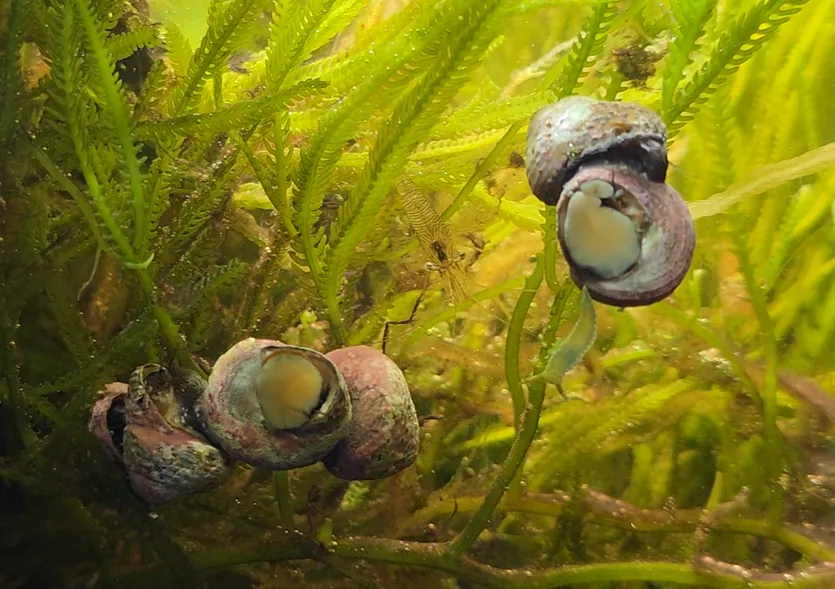
Six Margarita Snails (likely Margarites pupillus, family Trochidae) were purchased from a local saltwater aquarium store and introduced to miniBIOTA's Seagrass Meadow on July 31, 2026. The following day, the group was identified as a cold-water species native to the Pacific coast of North America, a naming mix-up with a similarly named Florida species, and unsuited to the biome's warm marine conditions. Five of the six were located and returned to the store on August 1, 2026. The sixth could not be found at the time and was never removed. It was directly observed alive and feeding in the Seagrass Meadow on August 7, 2026, one week after the rest of its group was removed.

Identity

  • Common name: Margarita Snail
  • Alternate names: margarite snail, blue top snail, puppet margarite, top snail
  • Scientific name: Margarites pupillus (not confirmed to species level)
  • Identification confidence: Trade-name level. "Margarita snail" is a common aquarium trade name most often applied to Margarites pupillus, a cold-water top snail from the Pacific coast of North America; no specimen has been directly examined.
  • Uncertainty label: Uncertain. Genus-level placement is reasonable from the trade name and cold-water range description; species-level identity is unconfirmed.

Taxonomy

  • Kingdom: Animalia
  • Phylum: Mollusca
  • Class: Gastropoda
  • Order: Trochida
  • Family: Trochidae
  • Genus: Margarites
  • Species: pupillus (unconfirmed)

Family note: Margarita Snail belongs to family Trochidae (the "top snails"), a distinct lineage from the Turbo and Astraea/Lithopoma snails (family Turbinidae) also present in the Seagrass Meadow.

Natural History

Range

Margarites pupillus is native to cold, rocky intertidal and subtidal habitat along the Pacific coast of North America, from Alaska to California. This range is the direct opposite of the warm, subtropical Florida/Caribbean conditions the Seagrass Meadow is designed to hold.

Habitat

Rocky intertidal and subtidal zones in cold temperate marine waters, grazing hard surfaces such as rock and shell. In miniBIOTA, the Seagrass Meadow and Marine Shore share connected water and are already documented as a corridor for other small grazers and scavengers (Mottled Shore Crab, Mud Crab, hermit crabs, Eelgrass Isopod), so the remaining individual could plausibly move into the Marine Shore as well. It has not been directly observed there.

Diet

Herbivorous grazer, using a radula to rasp diatoms, algae, and biofilm from hard surfaces, broadly similar in feeding mode to the Turbinidae grazers already in miniBIOTA. The remaining individual was directly observed feeding in the Seagrass Meadow on August 7, 2026; the specific items grazed were not recorded.

Reproduction

Trochidae species are generally understood to be broadcast spawners with planktonic larval development, though this has not been confirmed for this species or population in miniBIOTA.

Tolerance Ranges

Adapted to cold temperate marine water temperatures typical of the Pacific Northwest coast, not the warm subtropical marine conditions maintained in the Seagrass Meadow. This thermal mismatch is the documented reason the group was identified as unsuited and removed. The one individual left behind was directly observed alive and feeding one week later, on August 7, 2026, which shows it can tolerate Seagrass Meadow conditions at least in the short term; whether that holds over a longer period is unconfirmed.

Ecological Role

Margarita Snail was purchased impulsively, without prior species research, alongside the Chestnut Turban Snail and an unidentified hitchhiker sea slug, as part of a broader response to hard-surface algae accumulation in the Seagrass Meadow. Unlike those other introductions, it was found unsuited to the biome within a day and mostly removed. The one individual that could not be located was directly observed alive and feeding in the Seagrass Meadow on August 7, 2026, giving it a confirmed, if very minor, grazing presence; as a single individual it cannot meaningfully offset the biome's documented hard-surface algae shortfall on its own. The Seagrass Meadow and Marine Shore are directly connected, and other small grazers and scavengers move freely between them, so the individual could end up ranging into the Marine Shore as well; this is a plausible extension based on that shared water connection, not a confirmed sighting.

miniBIOTA Evidence

Introduction Context

Six Margarita Snails were purchased from a local saltwater aquarium store and introduced to the Seagrass Meadow on July 31, 2026, alongside two Chestnut Turban Snails and one unidentified hitchhiker sea slug, in response to ongoing hard-surface algae accumulation. The purchase was impulsive, without prior research into the species' suitability.

Observation Timeline

  • July 31, 2026: Six Margarita Snails purchased and introduced to the Seagrass Meadow. Observation record, July 31, 2026.
  • August 1, 2026: Identified as a cold-water Pacific species, unsuited to the biome. Five of the six were located and returned to the aquarium store; the sixth could not be found at the time and was not removed. Observation record, August 1, 2026.
  • August 7, 2026: Correction to the August 1, 2026 record: only five of the six individuals were actually removed. The sixth remains unaccounted for in the Seagrass Meadow, not observed since introduction. A dedicated species record was created to track it. Observation record, August 7, 2026.
  • August 7, 2026: The remaining individual directly observed alive in the Seagrass Meadow, feeding normally. First confirmed sighting since introduction on July 31, 2026. Observation record, August 7, 2026.

What Is Confirmed

  • Six individuals purchased and introduced to the Seagrass Meadow July 31, 2026.
  • Five individuals located and removed from the biome August 1, 2026.
  • One individual was not located at the time of removal and was not returned to the store.
  • That individual is alive and was directly observed feeding in the Seagrass Meadow on August 7, 2026, one week after the rest of its group was removed.

What Is Inferred

  • Species identity as Margarites pupillus, based on the aquarium-trade common name and the cold-water Pacific range described at identification.
  • Short-term tolerance of Seagrass Meadow conditions, based on the August 7, 2026 feeding observation; longer-term survival is not yet established.
  • Possible range extension into the Marine Shore, based on the two biomes' shared water connection and the precedent of other small grazers and scavengers (Mottled Shore Crab, Mud Crab, hermit crabs, Eelgrass Isopod) documented moving between them; not based on a direct sighting.

What Remains Unknown

  • Whether the individual will continue to survive and feed over a longer period, given the thermal mismatch with its native cold-water range.
  • Confirmed species-level identity within genus Margarites.
  • Specific diet items being grazed in the Seagrass Meadow.